
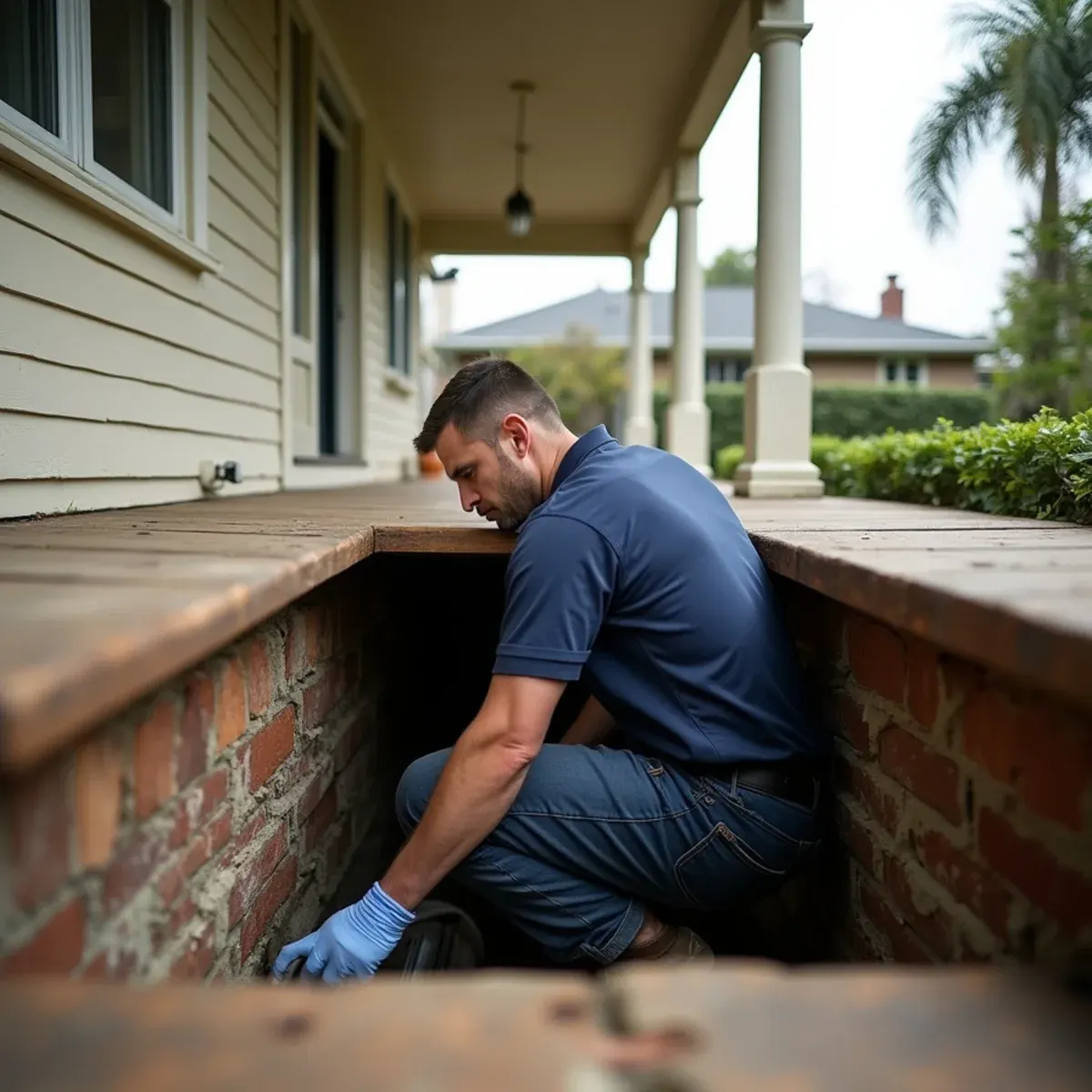
The Old Towne calls almost never start with visible water. They start with a smell in the hallway, a cold draft along a baseboard, or a floor that has gone slightly springy near the tub. In a raised-foundation home, a failed supply line does not pool on your tile. It drips into the dirt eighteen inches under the floor joists, where nothing tells you it is happening. By the time it reaches you as an odor, that line has often been running for weeks. The damage is not in the bathroom. It is in the subfloor, the joists, and the insulation you have never looked at.
Old Towne Orange is one of the largest National Register historic districts in California, roughly a square mile of late-1800s and early-1900s homes laid out around the Plaza traffic circle, with Chapman University sitting inside it. Craftsman bungalows, Victorians, and early cottages, nearly all of them on raised foundations over crawl spaces, most with some mix of original turn-of-the-century piping, galvanized steel added later, and cast iron or clay drain lines below. It is a beautiful housing stock and a demanding one, because almost every system in it has outlived the service life it was designed for.
Step outside that square mile and Orange changes completely. El Modena, Santiago Hills, and Serrano Heights are slab tract, where copper runs under concrete instead of over dirt and the failure signature flips to warm spots, unexplained bills, and a hairline crack in the tile that weeps. East of there, Orange Park Acres runs to half-acre equestrian lots with barns, arenas, and long private water lines that a tract home never has. Santiago Creek cuts through the middle of all of it, and the tree canopy that makes these streets what they are is also feeding roots into clay laterals.

Why Crawl-Space Leaks Run for Weeks Here
A slab leak announces itself eventually because concrete has nowhere to put the water. A crawl-space leak has somewhere to put it. Dirt absorbs a slow drip almost indefinitely, so the loss never produces the one thing homeowners watch for, which is water on a floor. Meanwhile the humidity under the house climbs, the fiberglass insulation between the joists soaks up moisture and sags, the subfloor picks up that moisture from below, and mold begins on the joists where it is invisible and undisturbed. Everything about this failure is built to stay quiet.
That changes how we dry it. Under IICRC S500:2025 the crawl space is its own drying chamber, not an afterthought to the room above, and drying the finished floor while the cavity underneath stays wet just relocates the problem. Wet fiberglass under a floor does not recover and comes out. We set containment and dehumidification under the house, monitor the joists and subfloor to a documented dry standard rather than to a schedule, and replace the ground vapor barrier if the old one has been torn or buried. Then we deal with the finish materials above.
The prevention here is embarrassingly simple and almost nobody does it. Once a year, on a dry day, open the crawl-space hatch and look. Ten minutes with a flashlight catches most of what we get called about in Old Towne months too late, and it costs nothing but a dirty shirt. If the access is tight or the hatch has been painted shut for thirty years, which is common in these houses, have somebody do it for you. An annual crawl-space inspection is the highest-value maintenance habit available to a raised-foundation homeowner in this city, and it is the one almost no one has.
- Dark, consistently damp soil under a bathroom, kitchen, or laundry area
- Insulation sagging out of the joist bays or lying on the ground
- A musty smell that is strongest in one part of the house and worst in the morning
- Rust staining or white efflorescence around foundation vents and piers
- A section of floor upstairs that flexes underfoot or feels cooler than the rest
Orange Park Acres: Big Lots, Long Water Runs
Orange Park Acres is a different service call than anywhere else in the city. On a half-acre or larger equestrian lot, the private water line between the meter at the street and the house can run a hundred feet or more underground, with branch lines out to barns, wash racks, hydrants, and irrigation. All of that is on your side of the meter, which means all of it is yours to find and yours to fix. A break out in that run does not show up as a wet wall. It shows up as a soft spot in the pasture, a bill that jumped, or nothing at all.
Outbuildings add their own problems. Barns and tack rooms are often plumbed as a later addition, left unheated and uninsulated, and visited less often than the house. A supply failure in a tack room ruins leather, feed, and hay long before anyone notices, and once water has run across a stall floor and mixed with bedding and manure it is Category 3 by any reasonable reading of the standard, which means removal rather than drying for porous materials. We plan those jobs around the animals, because equipment noise, hoses across a driveway, and open gates are real problems on a horse property.
Grading matters more out here too. These lots were cut with pads, arenas, and driveways that move a lot of runoff, and Santiago Creek and the surrounding open space put more water in play during a storm than the flat tract side of Orange ever sees. When an arena drain or a swale silts up over a dry summer, the first serious rain sends that water somewhere it was never meant to go, usually toward the lowest structure on the property.
The Slab Half of Orange Fails Differently
In El Modena, Santiago Hills, and the tracts filling the space between Old Towne and the hills, we are back to under-slab copper, and the diagnosis is nothing like a crawl-space job. There is no hatch to open. The evidence is indirect: a warm spot on the floor from a hot-water line, a water heater that runs more than it should, a section of baseboard that stays damp, or a meter dial turning with every fixture closed. We locate those with acoustic and thermal equipment before anyone touches concrete, because guessing means cutting the slab twice.
Once we find it, the choice is a spot repair through the slab or a reroute overhead through the attic and walls. On a home where the copper has failed once, a spot repair is usually the right call. On a home where it has failed twice, the pipe is telling you what the third one is going to cost. We will say which one we think you are looking at and why, and we will say it before we have any financial interest in the answer.
Orange also has an unusual concentration of clinical buildings, with UCI Medical Center, St. Joseph, and CHOC all within a short radius and dense medical office space packed in around them. Those losses run on different rules than a house. Containment has to hold so adjacent suites keep seeing patients, the noisy work gets scheduled around clinic hours or overnight, and nobody reoccupies a treated space without clearance documentation in hand. Records, imaging equipment, and sterile storage all complicate what can be moved and how fast. We do that work here regularly, and we build the schedule around your operations rather than ours.
Neighborhoods and Landmarks We Cover in Orange
We work throughout Orange — every neighborhood, every street, residential and commercial. If your address is in the city, we cover it.
Neighborhoods & corridors
- Old Towne
- Orange Park Acres
- El Modena
- Santiago Hills
- Serrano Heights
Landmarks nearby
- Old Towne Orange Plaza
- Chapman University
- Hart Park
- Santiago Creek
- The Outlets at Orange
- UCI Medical Center
- Irvine Regional Park
Why Orange Residents Call Us First
Any restoration company can put Orange on a service-area list. What matters at 2 a.m. is how far the truck has to come and whether the crew has opened a wall in a house like yours before.
About 13 minutes east
We dispatch from 6122-6182 Katella Ave in Cypress — not from a regional depot and not from a call centre that sells your job to whoever bids for it. That is the whole reason the 60-minute commitment is one we can put in writing.
Old Towne crawl spaces hide leaks for weeks
Under a raised foundation the water drips into dirt instead of pooling on a floor. Nothing announces it until the framing is affected.
Historic fabric is dried, not demolished
On an Old Towne house the plaster, trim and floors are the value. We cut to the meter reading, not to a convenient line.
- 20+ years restoring Orange County homes
- IICRC Certified Firm
- Licensed, Bonded & Insured
- We bill your insurance company directly
- IICRC S500:2025 compliant on every job
- 100% satisfaction guarantee — in writing, on every job
Orange Water Damage Questions
Pick a dry day, open the hatch, and use a good flashlight. You are looking at the soil directly under the bathrooms, kitchen, and laundry for dark damp patches, at the insulation for sagging or fallen batts, and at the piers and foundation vents for rust or white staining. Trust your nose as much as your eyes. If the access is too tight or you would rather not go under, we will do the inspection and photograph what is down there.
Yes, and it is worse than the same leak on a tile floor because nothing interrupts it. The soil stays saturated, humidity under the floor stays high, and that moisture drives upward into the joists and subfloor continuously. Wood that sits above about sixteen percent moisture content long enough grows mold, and structural members are the expensive part of a historic house to repair. The dirt is not absorbing the problem. It is hiding it.
It shapes the approach more than it limits the repair. Work visible from the street can fall under the city's design review, so it is worth a call to planning before anything exterior changes. Inside, our default in these homes is to dry and keep original material rather than remove it, because original fir flooring, trim profiles, and plaster cannot be bought back. We photograph original conditions on the first visit so the claim file and any review both have what they need.
For most of the city it is not the main risk. The great majority of Orange losses we respond to are plumbing, not the creek. Storm losses here more often come from clogged area drains, roof valleys packed with leaves from that mature canopy, and driveways that have been re-graded toward the house over the decades. Standard homeowners policies exclude ground-source flooding entirely, so if you are close to the channel, it is worth confirming what flood coverage you actually carry.