
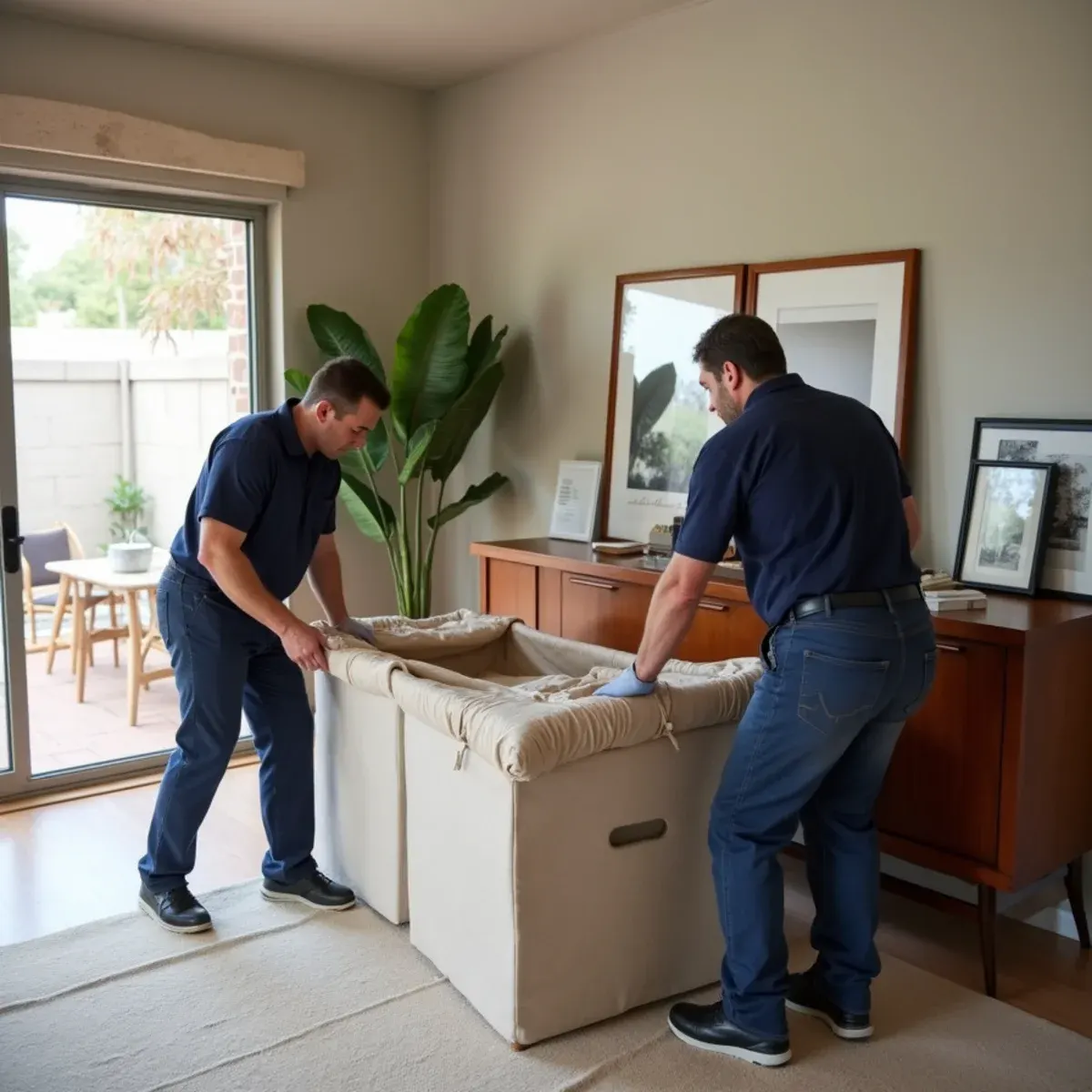
By the time an Old Towne contents loss reaches us, usually nothing is dripping. A supply line under a raised-foundation house on one of the streets radiating off the Plaza has been leaking into dirt for weeks, and the first sign inside is a smell in the hall closet. The belongings in that house are not wet in the way people picture. They are humid, mildew-spotted and odor-loaded, and the veneer on the furniture your grandmother left you has been quietly letting go at the glue joints the whole time.
Orange is not one housing stock, so it is not one pack-out. Old Towne holds late-1800s and early-1900s homes on raised foundations, many of them furnished with the same period pieces the Plaza's antique dealers sell a block away. Postwar slab tract fills most of the rest of the city. Out in Orange Park Acres the lots run half an acre with barns and tack rooms, where a loss means saddles, leather and feed as well as furniture. We size the truck and the crew to which Orange we are standing in.
What Orange Changes About Contents & Pack-Out
1Antique furniture fails at the joints
Period case goods in Old Towne were assembled with hide glue and thin veneer, both of which release in sustained humidity rather than in standing water. Moved carelessly, a wet chest comes apart in the doorway. We stabilize and support those pieces before they leave the room, keep them out of a hot truck, and bring them down slowly in controlled conditions rather than blasting them dry.
2Century-old paper in raised-foundation houses
Homes that have stayed in one family for generations here hold paper nobody has looked at in decades: deeds, letters, photographs, school and parish records stored in a closet against an exterior wall. Slow crawl-space moisture reaches that closet before it reaches anything you would notice. Wet paper gets frozen the same day to stop ink migrating and pages fusing, and sorted afterward.
3Staging around the Plaza is tight
Old Towne lots were platted long before anyone owned two cars. Driveways are short, garages sit detached at the back of the lot, and the streets close to the Plaza traffic circle fill early. We scout the approach before the truck comes, protect porch steps and original flooring along the carry path, and work in smaller loads rather than blocking a neighbor's driveway for a day.
How the Work Runs
The method is the same one we use on every contents & pack-out job, documented to the IICRC S500:2025 standard. Here it is in short — the full contents restoration & pack-out process explains each stage in detail.
- Room-by-room photographic inventory
- Triage into three categories
- Careful packing and transport
- Cleaning and restoration by material type
- Climate-controlled storage
- Delivery and placement back
The Orange Background Worth Knowing
A slab leak announces itself eventually because concrete has nowhere to put the water. A crawl-space leak has somewhere to put it. Dirt absorbs a slow drip almost indefinitely, so the loss never produces the one thing homeowners watch for, which is water on a floor. Meanwhile the humidity under the house climbs, the fiberglass insulation between the joists soaks up moisture and sags, the subfloor picks up that moisture from below, and mold begins on the joists where it is invisible and undisturbed. Everything about this failure is built to stay quiet.
There is more on the housing stock, drainage and plumbing history of this city on our water damage restoration in Orange page.
Orange at a glance
- Dominant construction era
- 1888–1975
- Foundation type
- mixed on grade
- Supply piping found here
- original turn-of-century piping, galvanized steel, under-slab copper
- Drain line materials
- cast iron, clay
- Terrain and water table
- flat, moderate water table
- Most common local failure
- crawl-space leaks under raised-foundation historic homes, running for weeks because water drips into the dirt instead of pooling on a floor
- Highest-value local prevention
- an annual crawl-space inspection, which almost nobody does and which catches nearly everything early
What It Costs in Orange
We do not quote a number over the phone before seeing the property — anyone who does is guessing. The variables that actually move the price on a contents & pack-out job are volume of contents, proportion of specialty items, storage duration, and they are broken down in full on the contents restoration & pack-out page. The assessment and the written estimate are free anywhere in Orange, day or night, with no obligation.
Contents & Pack-Out Questions from Orange Homeowners
Usually yes. Odor is evidence of microbial growth on and in porous items, and under S500:2025 that puts them in a category needing cleaning and controlled drying, not airing out. Textiles, upholstery, books and stored paper hold it longest. We inventory and photograph everything, treat by material type, and tell you honestly which pieces will not come back, because some upholstery and pressed-board furniture will not.
It depends on the scope. For a contained single-room loss we often move contents to an unaffected part of the home and block furniture in place. When the drying chamber covers most of the living area or reconstruction is extensive, off-site pack-out is usually both safer and faster.
Every item is photographed and barcoded at your home and tracked through cleaning, storage, and delivery. You receive the inventory, and at delivery we reconcile it with you item by item before we leave.
Pick a dry day, open the hatch, and use a good flashlight. You are looking at the soil directly under the bathrooms, kitchen, and laundry for dark damp patches, at the insulation for sagging or fallen batts, and at the piers and foundation vents for rust or white staining. Trust your nose as much as your eyes. If the access is too tight or you would rather not go under, we will do the inspection and photograph what is down there.