
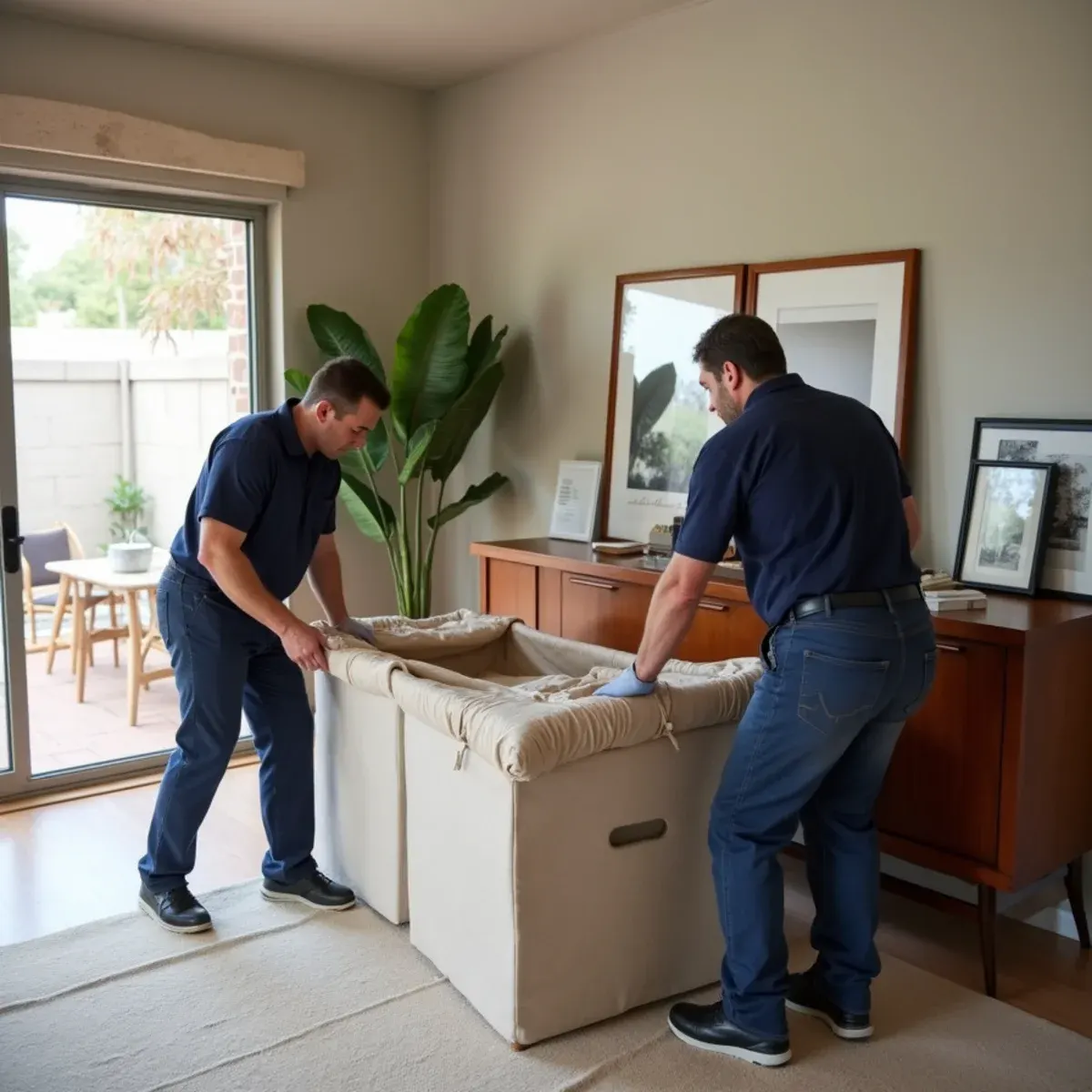
Before we quote a pack-out in Brea we work out how the truck gets to the door. The 1920s oil-town houses near downtown sit on small lots with short driveways, detached garages at the alley and street parking that fills up early. Ten minutes northeast, the 1990s and 2000s tracts toward Carbon Canyon have long, steep driveways, gated motor courts and turning radii a full-size box truck cannot use. Same city, same service, completely different day. We shuttle with smaller vehicles when the approach demands it, and we tell you that before we start.
What is inside is just as split. The early-century houses downtown still run galvanized steel, and when galvanized fails it stains, putting rusty water into carpets, linens and stored fabric. That is a cleaning problem more than a drying one. The hillside tracts run copper and PEX with ABS drains, larger floor plans and far more stored volume. The Brea Olinda oil field shaped the northern hills, and homes up that way carry heavy landscape irrigation that keeps ground moisture higher than a deep water table would suggest.
What Brea Changes About Contents & Pack-Out
1Rust staining from galvanized supply lines
Old galvanized pipe sheds iron as it fails. Water from those lines leaves an orange cast on light carpet, upholstery, drapes and stored linens near downtown. It is treatable if it is addressed quickly and by the right method for each fiber, and largely permanent if items sit folded and wet for a week. Textiles get separated and treated first for that reason, ahead of hard goods.
2Carbon Canyon storm timing is unforgiving
Concentrated canyon storms put water into houses over an hour or two and then stop, and roads and driveways on that side can be messy while it happens. We dispatch as fast as conditions allow rather than promising a clock we do not control on that terrain, and on the first trip we get contents up onto blocks and off wet flooring before the full pack-out begins.
3Two very different storage decisions
A small downtown bungalow has no spare room to hold anything, so nearly everything leaves the property. A large Olinda Ranch or Blackstone house often has dry square footage upstairs or in a wing we can stage into, which cuts both the claim and the disruption. We look for that option first, since contents that never leave your address are contents that cannot get lost.
How the Work Runs
The method is the same one we use on every contents & pack-out job, documented to the IICRC S500:2025 standard. Here it is in short — the full contents restoration & pack-out process explains each stage in detail.
- Room-by-room photographic inventory
- Triage into three categories
- Careful packing and transport
- Cleaning and restoration by material type
- Climate-controlled storage
- Delivery and placement back
The Brea Background Worth Knowing
Brea's hillside tracts were designed to handle rain. Terrace drains catch runoff partway up a slope, v-ditches carry it around the toe, area drains take the flat yard, and everything ties into a system that moves water past the house rather than through it. The design works. What fails is maintenance. Over a dry summer those inlets fill with eucalyptus leaf litter, decomposed granite, and whatever the wind brought down the canyon, and nobody looks at them because they sit on a slope behind a fence. The first hard storm of the season finds every one that is blocked.
There is more on the housing stock, drainage and plumbing history of this city on our water damage restoration in Brea page.
Brea at a glance
- Dominant construction era
- 1920–2005
- Foundation type
- mixed on grade
- Supply piping found here
- galvanized steel, under-slab copper, PEX in newer hillside tracts
- Drain line materials
- cast iron, clay, ABS
- Terrain and water table
- hillside-mixed, deep water table
- Most common local failure
- canyon and hillside runoff overwhelming slope drainage during concentrated storms
- Highest-value local prevention
- keeping Carbon Canyon-side slope drains, v-ditches and downspout extensions genuinely clear
What It Costs in Brea
We do not quote a number over the phone before seeing the property — anyone who does is guessing. The variables that actually move the price on a contents & pack-out job are volume of contents, proportion of specialty items, storage duration, and they are broken down in full on the contents restoration & pack-out page. The assessment and the written estimate are free anywhere in Brea, day or night, with no obligation.
Contents & Pack-Out Questions from Brea Homeowners
Often, if we get to it fast. That color is iron from failing galvanized supply pipe, and it sets as the fiber dries. Wool and older natural-fiber rugs need different chemistry than synthetics, so they are separated at pickup and treated individually. Be realistic, though. Heavily stained pad is replaced rather than cleaned, and light upholstery that sat saturated for days will not fully return. We tell you which is which before billing you for the attempt.
It depends on the scope. For a contained single-room loss we often move contents to an unaffected part of the home and block furniture in place. When the drying chamber covers most of the living area or reconstruction is extensive, off-site pack-out is usually both safer and faster.
Every item is photographed and barcoded at your home and tracked through cleaning, storage, and delivery. You receive the inventory, and at delivery we reconcile it with you item by item before we leave.
Usually not under a standard homeowners policy. Water that runs across the ground and enters a building is surface water, and that is an excluded cause on nearly every form, whether it came off a Carbon Canyon slope or out of the street. Separate flood coverage handles it. Damage from a covered failure is a different story, so let us document the entry point and cause before anything gets cleaned up.