
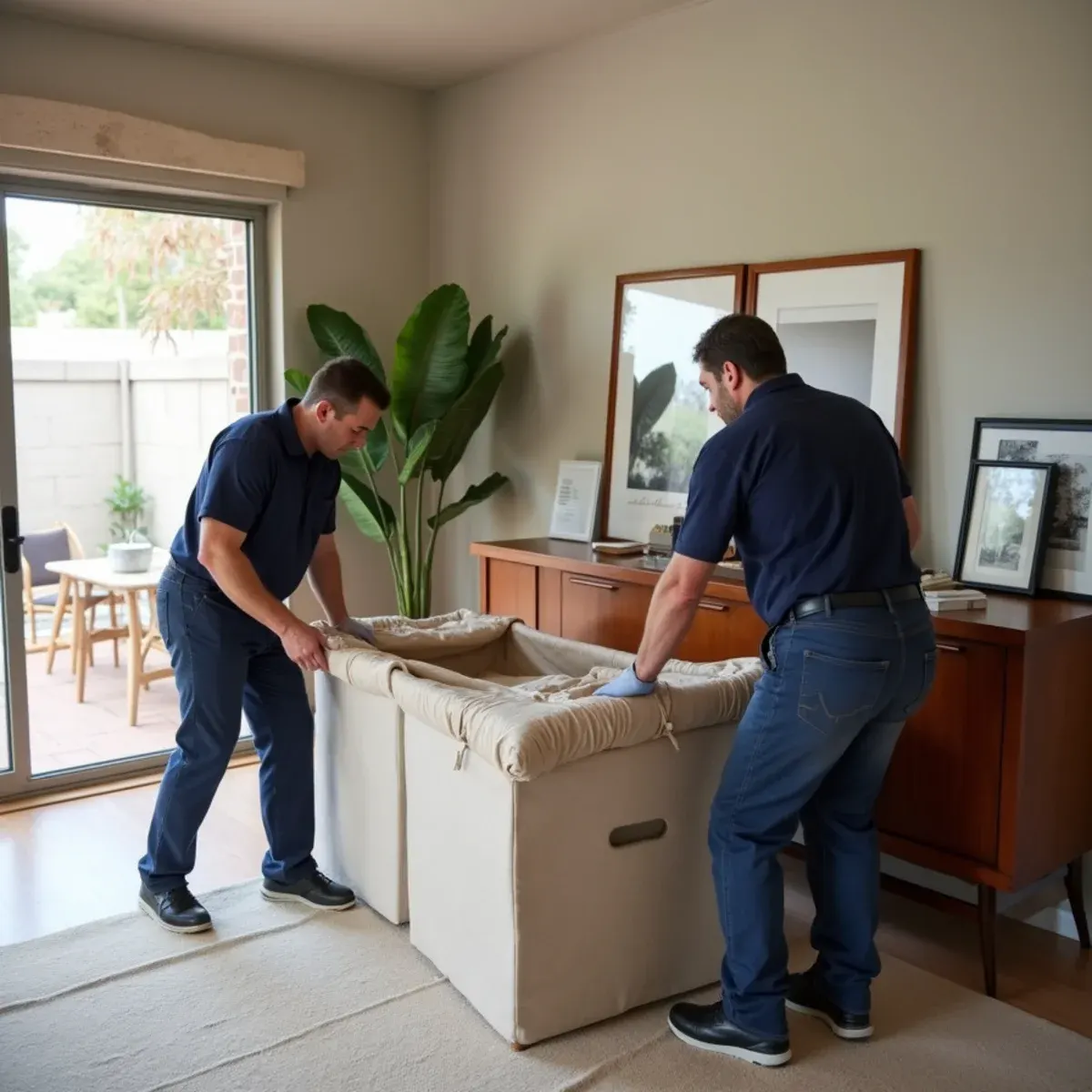
A manufactured home has particleboard floor decking over a belly wrap, and once water gets into that assembly it stays. There is no dry corner to shift a couch into either, because the rooms are narrow, the hallway is narrow, and air movers cannot work around furniture in a space that tight. Carson has an unusually large mobile home park population, and in those coaches the home has to be emptied before equipment can go in. That is not a service upgrade. It is the only sequence that works, and it has to start before the decking swells.
The other Carson is conventional: postwar slab tract from the 1950s through the 1970s in Scottsdale, Carson Park and around Victoria, on galvanized and under-slab copper, with garages holding the household's real storage. Between the two sits heavy industry, refineries and logistics along the Del Amo Boulevard and Carson Street corridors, plus the campuses at Cal State Dominguez Hills and Dignity Health Sports Park. A shallow water table under most of the city means slabs give moisture back slowly, so we do not rush contents home.
What Carson Changes About Contents & Pack-Out
1Coach lanes will not take a box truck
Mobile home park lanes are narrow, often one-way, with carports and awnings overhanging the drive and neighbors parked tight against it. We stage at the park entrance and shuttle with smaller vehicles rather than forcing a full-size truck down a lane. Park management usually needs notice as well, and arranging that in advance keeps a one-day pack-out from stretching into three.
2Soft floors mean trapped water
In a manufactured home, water reaching the belly wrap has nowhere to drain and stays under the decking. Any soft or springy spot in the floor should be treated as moisture until a meter proves otherwise. Contents sitting on that floor, including beds, dressers and boxes stored underneath, absorb from below over days, so they get metered individually rather than assumed dry because they look it.
3Storage matters more when the home is small
Coaches have very little closet space, so households store outside in sheds and under awnings, where heat, humidity and pests have already been working on the boxes. Once packed out, those items need controlled storage rather than a return to the same shed. We say so up front, since the storage line on an estimate is usually the first part people want to cut.
How the Work Runs
The method is the same one we use on every contents & pack-out job, documented to the IICRC S500:2025 standard. Here it is in short — the full contents restoration & pack-out process explains each stage in detail.
- Room-by-room photographic inventory
- Triage into three categories
- Careful packing and transport
- Cleaning and restoration by material type
- Climate-controlled storage
- Delivery and placement back
The Carson Background Worth Knowing
Manufactured homes are built with the floor deck, usually particleboard or OSB, sitting on a steel frame, with batt insulation below it and a vapor barrier belly wrap stapled underneath to hold everything in place. Supply lines run through that cavity. When one leaks, the water does not run out onto the ground where you would see it. The belly wrap catches and holds it, the insulation soaks it up, and you now have a sealed reservoir under your floor with no path to evaporate. It can sit there for months before anything shows upstairs.
There is more on the housing stock, drainage and plumbing history of this city on our water damage restoration in Carson page.
Carson at a glance
- Dominant construction era
- 1950–1975
- Foundation type
- slab on grade
- Supply piping found here
- galvanized steel, under-slab copper, manufactured-home supply lines
- Drain line materials
- cast iron
- Terrain and water table
- flat, shallow water table
- Most common local failure
- manufactured-home underfloor leaks trapped in the belly wrap, alongside conventional 1960s slab failures
- Highest-value local prevention
- treating any soft spot in a manufactured-home floor as moisture until a meter proves otherwise
What It Costs in Carson
We do not quote a number over the phone before seeing the property — anyone who does is guessing. The variables that actually move the price on a contents & pack-out job are volume of contents, proportion of specialty items, storage duration, and they are broken down in full on the contents restoration & pack-out page. The assessment and the written estimate are free anywhere in Carson, day or night, with no obligation.
Contents & Pack-Out Questions from Carson Homeowners
The bedroom does at minimum, and usually more. That soft spot means the decking has absorbed water and the belly wrap is holding it underneath, and drying that assembly needs the room cleared so equipment can reach the floor directly. Beds and dressers standing on it are wicking from below whether or not they feel damp. We meter each piece, pack what reads wet, and tell you honestly which particleboard furniture will not survive drying.
It depends on the scope. For a contained single-room loss we often move contents to an unaffected part of the home and block furniture in place. When the drying chamber covers most of the living area or reconstruction is extensive, off-site pack-out is usually both safer and faster.
Every item is photographed and barcoded at your home and tracked through cleaning, storage, and delivery. You receive the inventory, and at delivery we reconcile it with you item by item before we leave.
By locating it rather than arguing about it. The dividing line is the connection point where the park's service meets your home. Upstream of that is the park's responsibility, downstream is yours. We open the belly wrap where water is pooling, trace the wet path back to its source, and photograph what we find with the connection in frame. That documentation settles the question. Guessing from where the wet spot showed up inside is unreliable, because water travels along the frame first.