
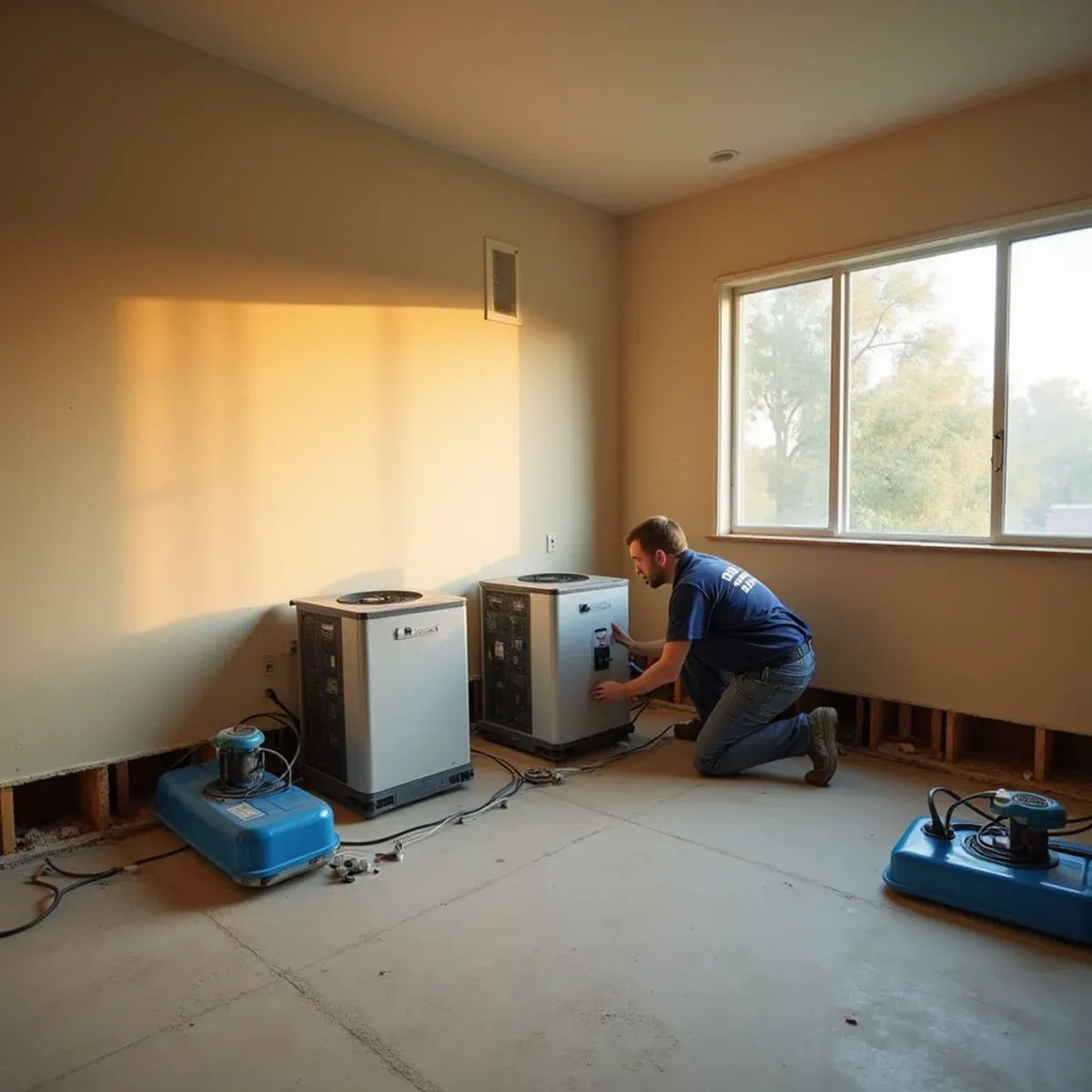
A manufactured home can't be dried the way a stick-built house can, and pretending otherwise wastes a week. Under the floor there's a poly belly wrap holding insulation against the joists, and when a supply line leaks the wrap does exactly what it was designed to do. It holds water. Air movers in the living room accomplish nothing at all. The wrap has to be opened from below so the cavity can be dried directly and the saturated insulation removed, then repaired properly once the readings hold where they should.
Be ready for one honest limit. The particleboard decking used in these floors swells when it's soaked and doesn't recover its strength when it dries. If the deck is soft, drying preserves the framing, the walls and the cabinetry around it, but that section of floor still gets replaced. The postwar tract through Scottsdale and Carson Park is conventional 1960s slab with galvanized and under-slab copper, closer to what we do in Bellflower, with a shallow water table sitting under all of it.
What Carson Changes About Structural Drying
1Belly wrap has to be opened to dry
The poly belly under a manufactured floor holds water against the joists and insulation, and no amount of airflow in the room will reach it. We open the wrap from below at the low points, remove saturated insulation, dry the cavity directly with directed airflow and dehumidification, then repair the wrap once readings hold. Skipping that step guarantees a return call in a month.
2Park power decides the equipment plan
Coach pedestals in Carson's mobile home parks supply limited amperage, and neighbors are close enough that noise and cord routing genuinely matter. We size the chamber to the power actually available, use quieter placements overnight where we can, and coordinate with park management for anything needing a separate feed. Overloading a pedestal stops a drying job cold and annoys the whole row.
3Soft decking is replaced, not dried
Particleboard floor decking swells when it's soaked and doesn't regain its strength as it dries. Drying protects the framing, walls and cabinetry around it, but a spongy section of deck still gets cut out and replaced. We'd rather tell you that on day one than run equipment for a week and deliver the same news at the end with a bigger invoice attached.
How the Work Runs
The method is the same one we use on every structural drying job, documented to the IICRC S500:2025 standard. Here it is in short — the full structural drying & dehumidification process explains each stage in detail.
- Establish the dry standard
- Calculate the load and build the chamber
- Place air movers for surface evaporation
- Run LGR dehumidification to capture the moisture
- Monitor and adjust daily
- Verify, document, and demobilize
The Carson Background Worth Knowing
Manufactured homes are built with the floor deck, usually particleboard or OSB, sitting on a steel frame, with batt insulation below it and a vapor barrier belly wrap stapled underneath to hold everything in place. Supply lines run through that cavity. When one leaks, the water does not run out onto the ground where you would see it. The belly wrap catches and holds it, the insulation soaks it up, and you now have a sealed reservoir under your floor with no path to evaporate. It can sit there for months before anything shows upstairs.
There is more on the housing stock, drainage and plumbing history of this city on our water damage restoration in Carson page.
Carson at a glance
- Dominant construction era
- 1950–1975
- Foundation type
- slab on grade
- Supply piping found here
- galvanized steel, under-slab copper, manufactured-home supply lines
- Drain line materials
- cast iron
- Terrain and water table
- flat, shallow water table
- Most common local failure
- manufactured-home underfloor leaks trapped in the belly wrap, alongside conventional 1960s slab failures
- Highest-value local prevention
- treating any soft spot in a manufactured-home floor as moisture until a meter proves otherwise
What It Costs in Carson
We do not quote a number over the phone before seeing the property — anyone who does is guessing. The variables that actually move the price on a structural drying job are size of the drying chamber, class of water intrusion, material types involved, and they are broken down in full on the structural drying & dehumidification page. The assessment and the written estimate are free anywhere in Carson, day or night, with no obligation.
Structural Drying Questions from Carson Homeowners
Partly. The framing, walls and cabinetry around it can usually be saved by opening the belly wrap from below, pulling the wet insulation and drying the cavity directly. The spongy part itself is likely particleboard decking that has swollen, and that doesn't recover its strength when it dries. We meter it before deciding, but if it's soft it gets cut out and replaced. Everything around it is still worth drying properly.
Three to five days covers most residential losses. Saturated hardwood, plaster, or a concrete slab can run seven or more. We will give you an estimated window after the first readings and update you daily — and equipment comes out when the numbers say so, not on a fixed schedule.
We would rather you did not. Drying is a continuous process, and every hour off extends the total run — which usually costs more than the sleep is worth. If noise is genuinely unmanageable we can often reconfigure the chamber or reposition units to reduce it. Talk to us instead of unplugging them.
By locating it rather than arguing about it. The dividing line is the connection point where the park's service meets your home. Upstream of that is the park's responsibility, downstream is yours. We open the belly wrap where water is pooling, trace the wet path back to its source, and photograph what we find with the connection in frame. That documentation settles the question. Guessing from where the wet spot showed up inside is unreliable, because water travels along the frame first.