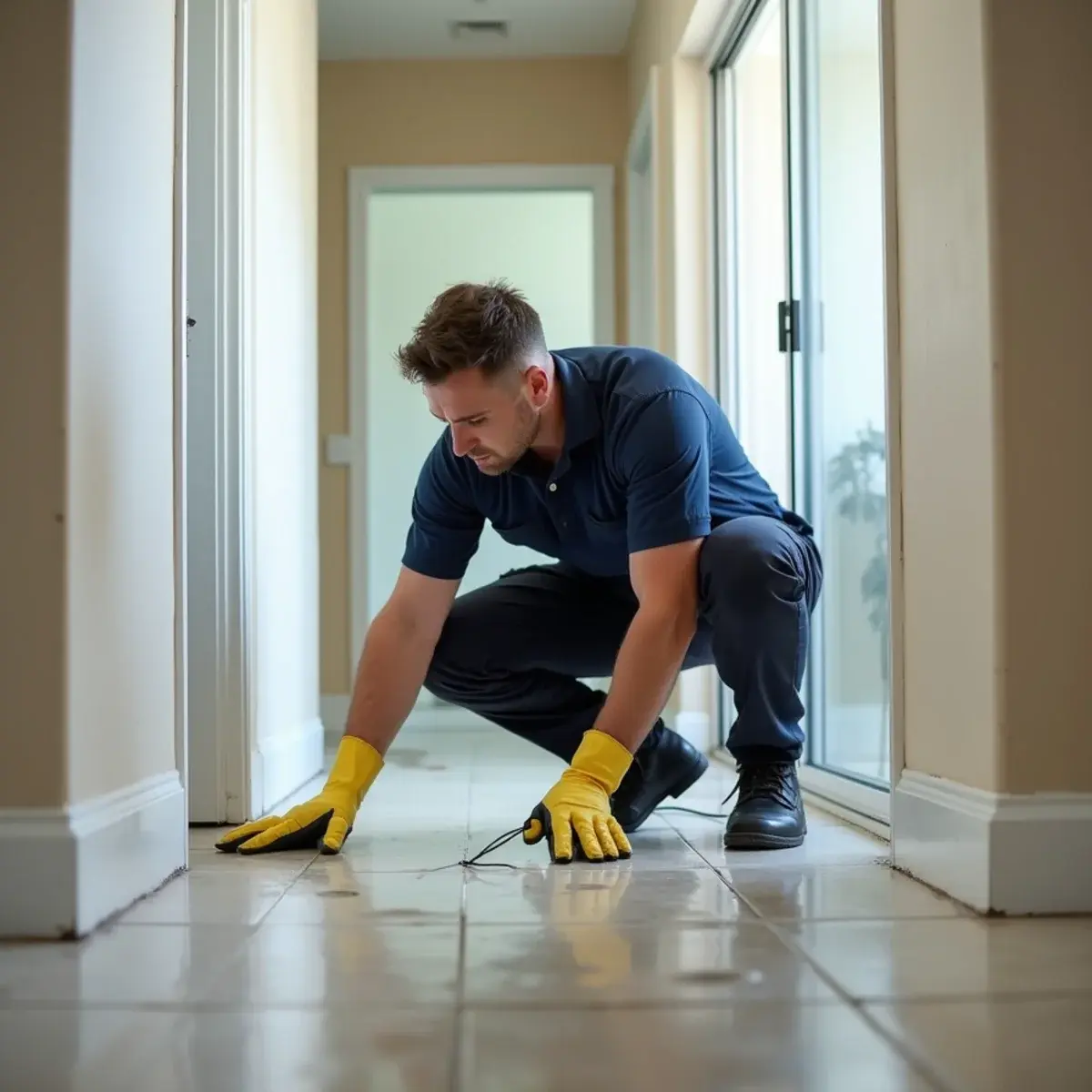
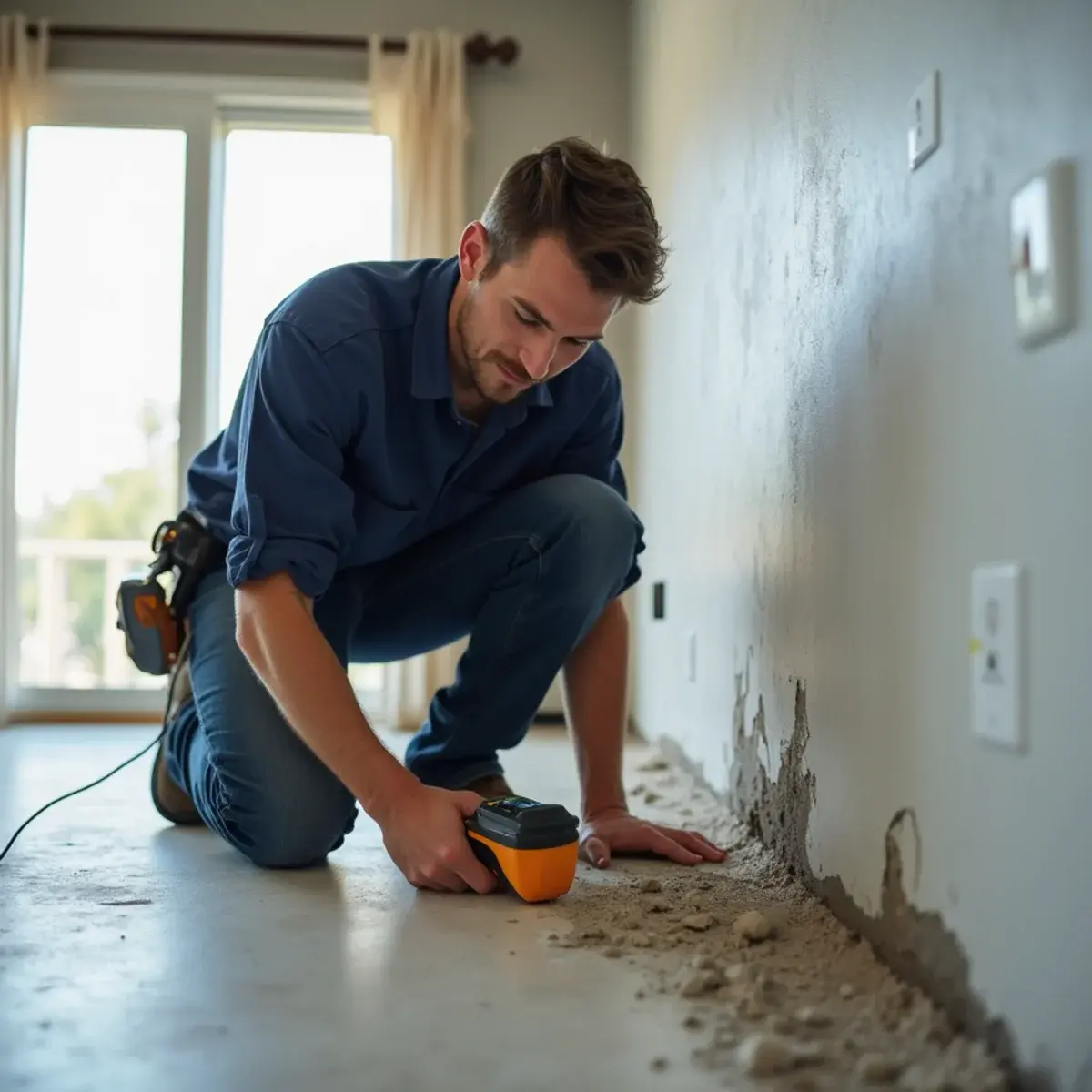
Most people who call us about this have never made a call like it before. Someone died at home and was not found for a while. There was an accident in the garage, or a suicide, and the coroner's van has left but the room has not been touched. A property manager opened a unit and could not go past the doorway. Whatever brought you here, you are not calling because you want a quote. You are calling because something has to be handled, and handled by people who will not make it worse. Police and the coroner investigate and remove; they do not clean. That responsibility lands on the family or the owner, usually within a day or two.
The work itself is closer to a Category 3 water loss under IICRC S500:2025 than to any kind of cleaning. Blood and decomposition fluids behave like water: they follow gravity, wick into carpet pad, run along the seams of vinyl and laminate, and soak into subfloor, sill plates, and the gap between a tub and the framing. What is visible on the surface is rarely the extent of it. Porous material that has absorbed fluid cannot be disinfected all the way through — that is not an opinion, it is why the standards call for removal. Companies that scrub the visible stain and leave the substrate produce a room that looks clean and smells wrong three weeks later.
The other half of this job has nothing to do with technique. We show up in unmarked vehicles. We stage equipment out of sight of the street where we can, keep crew conversation off the driveway, and we do not discuss the address with anyone who is not on your side of it. In the dense multi-family buildings in Hawaiian Gardens and Buena Park, and on the tight tract lots across Cypress and Lakewood, neighbors notice everything — so we plan the approach before we park. We will also work directly with a coroner's investigator, a property manager, or an attorney handling an estate, so you are not the one relaying details you would rather not repeat.
Signs the Contamination Goes Deeper Than It Looks
These are the things people notice first, usually in this order, and each one says something about how far the material traveled.
A heavy, sweet odor you can taste
Decomposition odor is unlike anything else and it does not fade with an open window. It attaches to hair, clothing, and drywall paper, and it is heaviest low to the floor. If you can smell it from the hallway, fluid has already reached porous material inside the room.
Flies collecting at an interior window
Blow flies find a body within hours and their next generation heads for light. Dozens of flies or small dark casings on a windowsill, especially in a room nobody has entered, is often the first thing a neighbor or manager reports. The casings themselves are contaminated and have to be collected, not vacuumed loose.
A stain with a dark, spreading edge
Surface blood dries to a hard crust. Fluid that has soaked in leaves a halo that keeps advancing outward along the grain of the subfloor or the length of a carpet seam. The outer edge is the honest boundary of the job, and it is usually well past what you can see from standing height.
Discoloration on the ceiling below
On raised-foundation homes in Old Towne Orange, Uptown Whittier, or the Anaheim Colony, fluid that passes a second-story floor shows up as a brown ring on the ceiling underneath. On slab construction it goes the other way, into the seam where flooring meets the slab and under the baseboard.
Droplets in rooms nobody mentioned
Trauma scenes rarely stay in one room. We routinely find dried spatter on door casings, light switches, and ceilings well outside the area anyone described, and on the underside of furniture. Any of it is potentially infectious material, so the search has to be systematic rather than based on what someone remembers.
Odor that comes back in a week
A room that smelled fine after cleaning and smells bad again once the house warms up means the source is still in the building — usually in the pad, the subfloor, or the wall cavity. Odor is a measurement, not a nuisance. It tells you material was left behind.
Soft flooring and ammonia in a hoarded home
In heavy hoarding conditions the hazard is under the piles, not in them. Floors that flex underfoot, a sharp ammonia smell from years of animal urine, and rodent droppings through the lower layers all mean the structure and the contents have to be assessed separately.
How We Handle a Biohazard Scene
Every step here exists to control what leaves the room, and to keep the day from being harder on you than it already is.

- 1
Arrival, walkthrough, and containment
We arrive in unmarked vehicles and park where the equipment is not on display. One of us walks the scene and maps the affected boundary — including the areas you have not seen — while you deal with one point of contact and nothing else. Then the zone gets sealed with poly barriers and put under HEPA-filtered negative air, with a marked transition point for everyone entering and leaving.
- 2
Full PPE and gross removal
Crews work in full protective equipment under OSHA's bloodborne pathogen standard: suits, respirators, eye protection, and double gloves changed on a schedule rather than when they look dirty. Bulk material and saturated items come out first, into rigid, labeled medical waste containers. None of it goes in your trash cans or a dumpster, and none of it leaves through the front door if there is another way out.
- 3
Remove affected porous materials
Carpet, pad, drywall, insulation, cabinetry, and affected subfloor come out. We cut back past the visible edge, not to it, because fluid travels further through the substrate than it shows on the surface. Everything is photographed and measured before it is removed, which matters later for the estate, the claim, or the landlord. On slab homes we check the flooring adhesive line and the baseboard gap specifically.
- 4
Clean first, then disinfect
Cleaning and disinfecting are two separate operations and the order is not negotiable. Surfaces are cleaned to remove the organic soil load first, because disinfectant does not work through blood or tissue residue. Then remaining framing, slab, and hard surfaces get a hospital-grade, EPA-registered disinfectant applied and left for its full dwell time — the step most often shortened, and the reason results fail.
- 5
Treat odor at the source
Odor comes from residue, not from air, so we treat what is left in the structure rather than covering it. HEPA scrubbers run throughout, and where odor persists after removal and disinfection we use hydroxyl or ozone treatment and, on framing and subfloor, a sealer applied only after the surface is clean. We do not use fragrance. A room that smells like flowers is a room still telling you something.
- 6
Verify, dispose, and release
Before we release the space we verify it — visual inspection under strong light, ATP surface swabs where they are appropriate, and moisture readings if water was part of the loss. Waste leaves with a licensed medical waste transporter and you get the manifest. You also get a documented scope with photographs. If you would rather not walk the room, we will walk it with someone you name.
When You Do Not Need a Biohazard Crew
A small amount of blood on a hard, non-porous surface is not a remediation job. A kitchen cut, a nosebleed, a scraped knee on tile — gloves, paper towels, and a fresh dilute bleach solution handle it, and the CDC guidance for that is simple and public. If you can clean it up without soaking anything and without it having spread past what you can see, do that and keep your money. The line we use is porosity and volume: fluid on sealed tile or a countertop is a cleaning task, fluid that reached carpet, upholstery, grout, or subfloor is not.
An expected death at home with family or hospice present usually leaves nothing that needs remediation at all. Linens and a mattress may need disposal, and that is often the whole of it. We get calls from families who have been told they need a full decontamination after a peaceful death that was found within the hour, and the honest answer is that they do not. We will tell you that on the phone, before anyone drives out, and it costs you nothing to ask. Free assessments are exactly that, and inside the city of Cypress we are there within 60 minutes; elsewhere across the 37 cities we cover, we dispatch as fast as conditions allow.
Hoarding is the same. A house packed with belongings but no biological contamination is a hauling and sorting job, and a hauling company will do it for less than we will. What changes the answer is animal waste, spoiled food through the lower layers, rodent or roach infestation, or human waste — any of those and you need containment, respirators, and disposal that a hauler is not equipped or licensed to provide. We can walk a property and tell you which one you have.
The Mistake That Makes Families Pay Twice
The most expensive version of this job is the one that gets done twice. It usually goes the same way. Somebody cleans the visible area — a family member, a turnover crew, a general cleaning company — the carpet gets replaced, the wall gets a coat of primer and paint, and the room looks finished. Then the weather warms up, the house closes up for a weekend, and the smell is back. Now the new flooring and the new drywall come out along with the material that should have come out the first time.
The reason is physical. Sealing a surface does not neutralize what is under it — it delays it. Volatile compounds from decomposition residue keep releasing from the substrate, and a coat of primer only holds them until the framing warms and the vapor pressure pushes them through. Sealers have a place, but only over material that has already been cleaned and disinfected, as insurance against trace residue. Applied over contamination, a sealer is a timer. The same is true of an ozone treatment run in a room where the source is still in the floor.
If you are comparing proposals, the thing to look for is not the number at the bottom. It is whether the scope names the substrate. Anything that stops at surfaces — clean, deodorize, sanitize — describes a cleaning, and it is the proposal that comes back to you in a month. A complete scope reads like a demolition and decontamination plan, because that is what it is. These are the lines we would want to see if somebody were writing an estimate for our own family:
- Removal of carpet, pad, and affected subfloor, with cut lines described past the visible edge rather than to it
- Drywall removed to a stated height, not spot-patched around a stain
- Cleaning listed as a separate step from disinfection, with a named EPA-registered product and its dwell time
- Odor treatment identified as source treatment, not fogging, sealing, or fragrance
- Disposal by a licensed medical waste transporter, with manifests handed to you
- Verification before release, plus photographs and measurements of everything removed
Slab Floors, Raised Foundations, and Where Fluid Goes
Most of the homes we work in across Cypress, Rossmoor, Lakewood, Norwalk, La Palma, and Cerritos are slab-on-grade tract houses from the fifties through the eighties. Fluid on a slab cannot go down, so it goes sideways. It runs the adhesive plane under vinyl and laminate, follows the tack strip, and gets under the baseboard into the bottom plate of the wall. Concrete looks impervious and is not — the top layer is porous enough to hold both stain and odor, which is why cleaning a slab is a mechanical process and sometimes ends in grinding a shallow layer off.
The older raised-foundation neighborhoods change the job entirely. In Old Towne Orange, Uptown Whittier, Old Town Tustin, Eastside Costa Mesa, and the Anaheim Colony, the floor is board subfloor over joists with gaps at every seam. Fluid that reaches those gaps does not stop at the room — it drips into the crawl space and lands on joists, on ducting, and on bare soil. That means crawl space access, soil removal, and cleaning overhead in a space you cannot stand up in. Closer to the coast, in Seal Beach, Huntington Beach, and Long Beach, the marine layer keeps residue damp longer, which lengthens odor treatment without changing the protocol.

What Drives the Cost of Biohazard Cleanup
This work is priced by scope and hazard rather than by square footage alone, and we itemize it so you can see what every line is for.
How far the material traveled
The visible area and the affected area are two different numbers. Fluid that reached the pad, the subfloor seams, or a wall cavity turns a single-room job into a structural one. We establish the real boundary during the assessment so the scope you approve is the scope we do.
Time between the event and the call
Time is the single biggest cost driver here. Warm weather, a closed-up house, and a week of elapsed time move contamination from the surface into the structure and put odor into materials that would otherwise have been fine. A scene addressed within a day is often a fraction of the removal scope of the same scene a week later.
Volume of regulated waste
Anything saturated with potentially infectious material is regulated medical waste in California, not trash. It has to be containerized, transported by a licensed hauler, and destroyed under manifest. Mattresses, upholstered furniture, and carpet fill containers fast, and disposal is charged by what actually leaves the property.
Access, stairs, and building type
A ground-floor slab home in Cypress is straightforward. A second-floor unit in Hawaiian Gardens with one stairwell and shared hallways means longer containment runs, protected egress paths, and more crew time moving material without contaminating common areas. Manufactured homes in Stanton or Midway City add tight framing and narrow doorways.
Contents and what you want kept
Sorting is labor. Porous items that contacted fluid are not salvageable, but a lot of what is in the room never did, and finding documents, jewelry, and photographs takes careful hands rather than fast ones. Tell us what matters before we start and we will look for it. That time is worth budgeting.
Insurance note: Most homeowners and landlord policies treat this as covered property damage rather than cleaning, and carriers are generally used to seeing it. We bill the carrier directly and document the scope in the format adjusters expect. Where a violent crime is involved, the California Victim Compensation Board also has a crime scene cleanup benefit that families are often never told about. We will point you to it. Unattended death in a rental is usually the owner's claim, not the estate's.
Why Cypress Homeowners Call Us for Biohazard Cleanup
Plenty of companies list this service. Fewer can tell you what equipment they will bring, what standard the work is measured against, or what happens if they are wrong. Here is what you are actually buying.
Discretion is part of the service
Unmarked vehicles and crews who understand where they are. Neighbours do not need to know what happened in your home.
Regulated waste handled and manifested correctly
Disposal follows the legal chain for biohazardous material, with the paperwork to prove it.
Structural decontamination, not surface cleaning
Porous material that has absorbed biological matter is removed. Verification follows the cleaning rather than replacing it.
- 20+ years restoring Orange County homes
- IICRC Certified Firm
- Licensed, Bonded & Insured
- We bill your insurance company directly
- IICRC S500:2025 compliant on every job
- 100% satisfaction guarantee — in writing, on every job
Frequently Asked Questions
Not from us. We arrive in unmarked vehicles, we do not wear anything with a company name on it in view of the street, and we stage equipment inside or on the far side of the vehicle where the layout allows. On tight lots and in apartment buildings there is a limit to what we can hide — a crew carrying containers is visible. What we can control is that nobody hears anything from us, ever.
No. The coroner's office removes the deceased and investigators collect what they need for the case, and then the scene is released back to whoever owns the property. Everything left — flooring, bedding, biological material, fingerprint powder, and the residue from any medical response — is the property owner's responsibility. That surprises almost everyone. It is also why families are often standing in a released house with no idea who to call.
Most single-room scenes are one to two days of remediation. Heavy contamination, multiple rooms, or a crawl space adds days, and hoarding conditions can run a week or more. You do not need to be on site, and most people would rather not be. We do need one person reachable by phone for decisions about contents. If you want to be present, you can — outside the containment.
Often, yes, but not the soft goods that absorbed fluid. Mattresses, upholstery, carpet, pad, and clothing in the affected zone go. Hard, non-porous items — jewelry, ceramics, metal, sealed photographs, most documents in a closed drawer — can usually be cleaned and returned. Tell us what you are hoping to recover before we start, because once material is containerized as regulated waste it cannot come back out. We would rather spend the extra hour looking.
We verify before release rather than asking you to take our word for it: inspection under strong light, ATP swabs on cleaned surfaces where they are meaningful, moisture readings if water was involved, and a written scope with photographs of what was removed. Honest limitation — there is no single test that certifies a room free of every pathogen, and any company that tells you otherwise is selling certainty it cannot deliver. What we can show you is that the affected material is gone and the surfaces that remain were cleaned, disinfected, and checked.
Related Reading
- Water Damage Categories 1, 2, and 3 Explained — The category of the water decides what can be saved, what has to be thrown out, and whether it is safe to be in the room. Here is how to tell them apart.
- How Fast Does Mold Grow After Water Damage? — The commonly cited window is 24 to 48 hours. Here is what that actually means, what makes it faster, and where the real deadline sits.