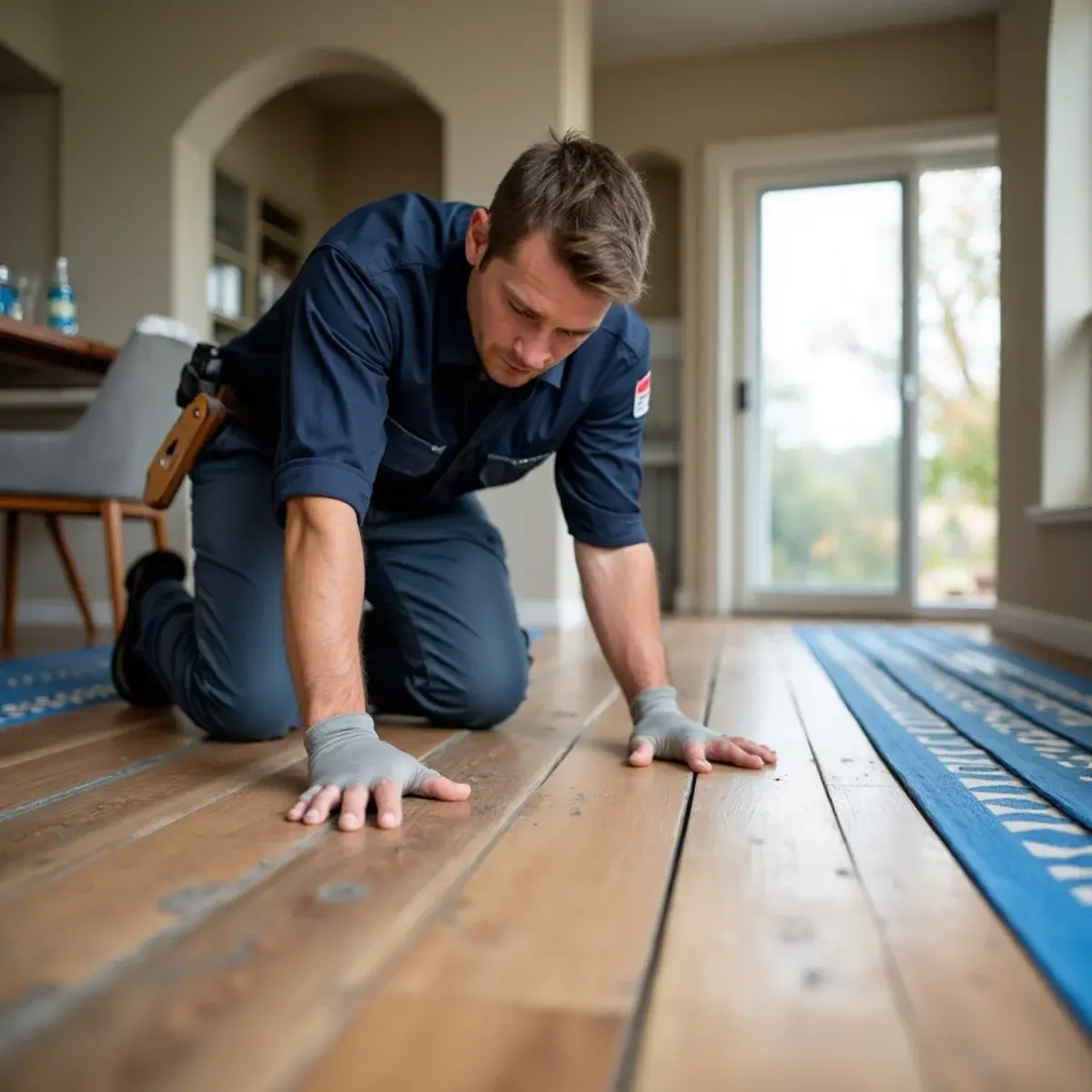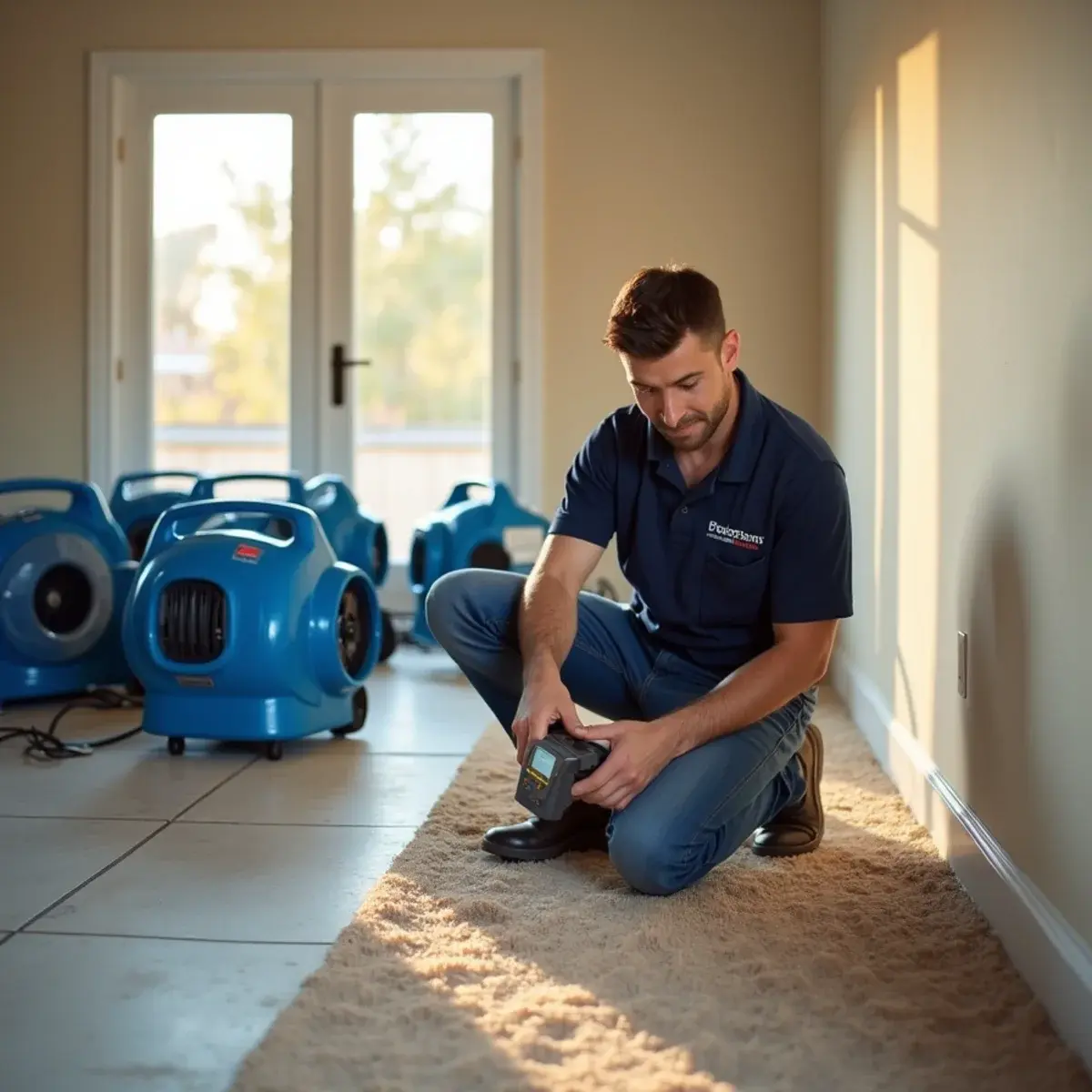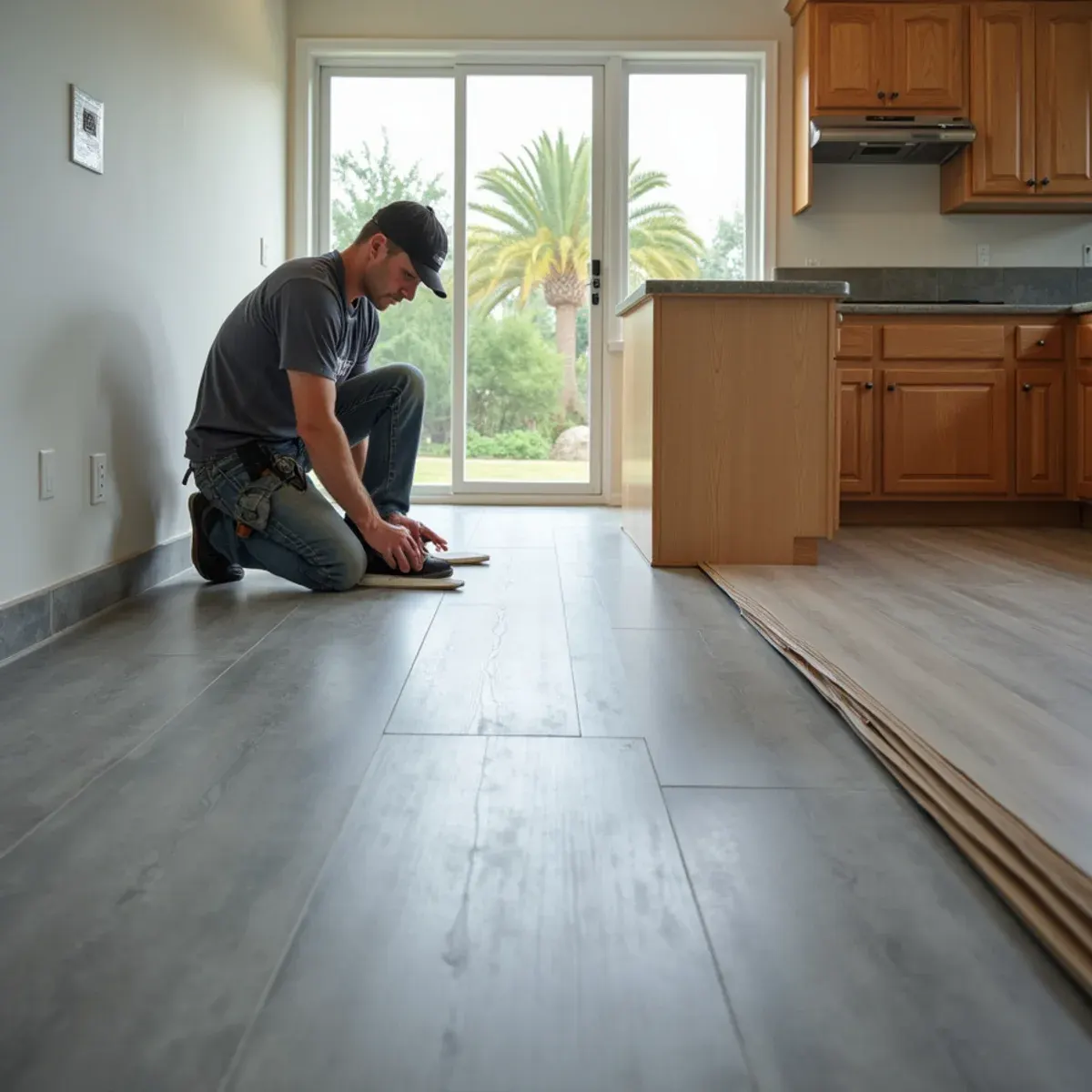
The floor looks fine. That is the problem. Luxury vinyl plank is waterproof, so after a dishwasher line lets go or a toilet supply fails overnight, the surface wipes dry and looks exactly like it did the week before. Underneath, water has spread across the slab in every direction, and the plank sitting on top of it works like a lid. Nothing evaporates. Nothing shows. Three weeks later a musty smell arrives in a room with no visible damage, or the baseboard darkens, or the planks start clicking loose because the underlayment gave up.
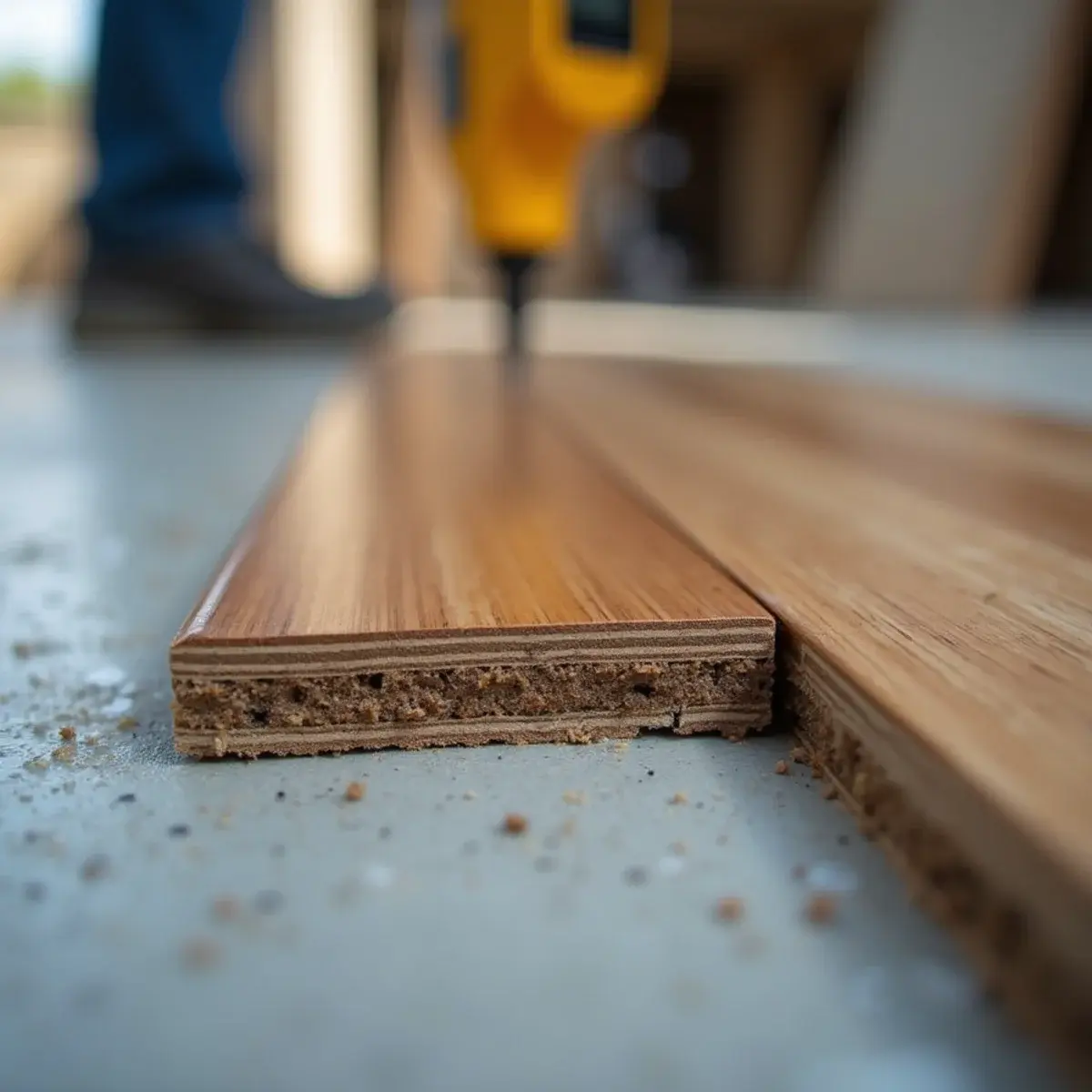
Laminate does the opposite, and does it fast. What looks like wood is a photographic layer over a high-density fiberboard core, and that core is compressed wood fiber and glue. Wet it and it swells at the edges, permanently. You get the chipped, puffy line along every seam within a day or two, and no amount of drying brings it back down, because the fibers have already sprung. We say that plainly on the first visit. Laminate that has swollen is finished. What matters after that point is the slab or subfloor beneath it, which has to be dried, tested and documented before anything new goes down.
These two floors get lumped together because they install the same way and cost about the same, and they get handled badly for the same reason: everyone treats the visible surface as the job. A crew sets air movers in the room, the surface dries, the readings on the drywall come back fine, and the equipment leaves with a wet slab still sealed under an intact floor. That is where the second bill comes from. Under IICRC S500:2025 the drying goal is defined by each material's own dry standard, not by how the room feels, and a slab under vinyl has to be opened to be measured at all.
How Water Shows Itself Under a Sealed Floor
These are the signs in the order homeowners actually notice them, and the first few usually arrive with nothing visible on the surface.
Planks that click or shift underfoot
The first sign in most vinyl failures is movement. Water under a floating floor breaks down the attached pad or underlayment, so planks that felt solid now flex and tick as you cross the room. Walk it barefoot when the house is quiet, and you will hear it before you see anything.
Swollen, chipped edges on laminate
Laminate tells on itself fast. The fiberboard core drinks water at the exposed seam, swells upward, and the wear layer cracks along the top edge, leaving a rough white line you can feel with a fingertip. It usually starts at the plank ends nearest the leak and works outward one row at a time.
A musty smell with nothing to see
This is the one that brings most people to the phone, often weeks after the leak. The floor looks perfect, the walls read dry, and the room still smells like a damp basement. That odor is coming from the sealed space between the plank and the slab, which is warm, dark and wet.
Baseboard and shoe molding darkening
Water under a floating floor migrates to the perimeter, where the expansion gap lets it reach the back of the baseboard. You see a darkened band along the bottom inch, blistered paint, or caulk pulling away from the wall. In tract homes with MDF baseboard, the bottom edge swells and the profile rounds off.
Peaking or lifting at the seams
A floating floor needs room to move at the walls. When moisture builds under it, laminate swells at the locking edges and pushes against itself, while glue-down vinyl releases from its adhesive and lifts. Either way a seam rises into a small ridge, usually at a doorway or against a kitchen island where the floor is pinned.
Shadowing or bubbles under sheet vinyl
Sheet vinyl is a single membrane, so trapped moisture shows as a soft gray shadow spreading from the leak or as raised bubbles where the adhesive has let go. Press one and it moves. Around toilets and tub aprons the seam usually opens first, and the felt backing underneath holds water long after the surface feels dry.
How We Dry a Floor That Cannot Breathe
The sequence is deliberate, because the flooring, the underlayment and the slab each get a different decision.
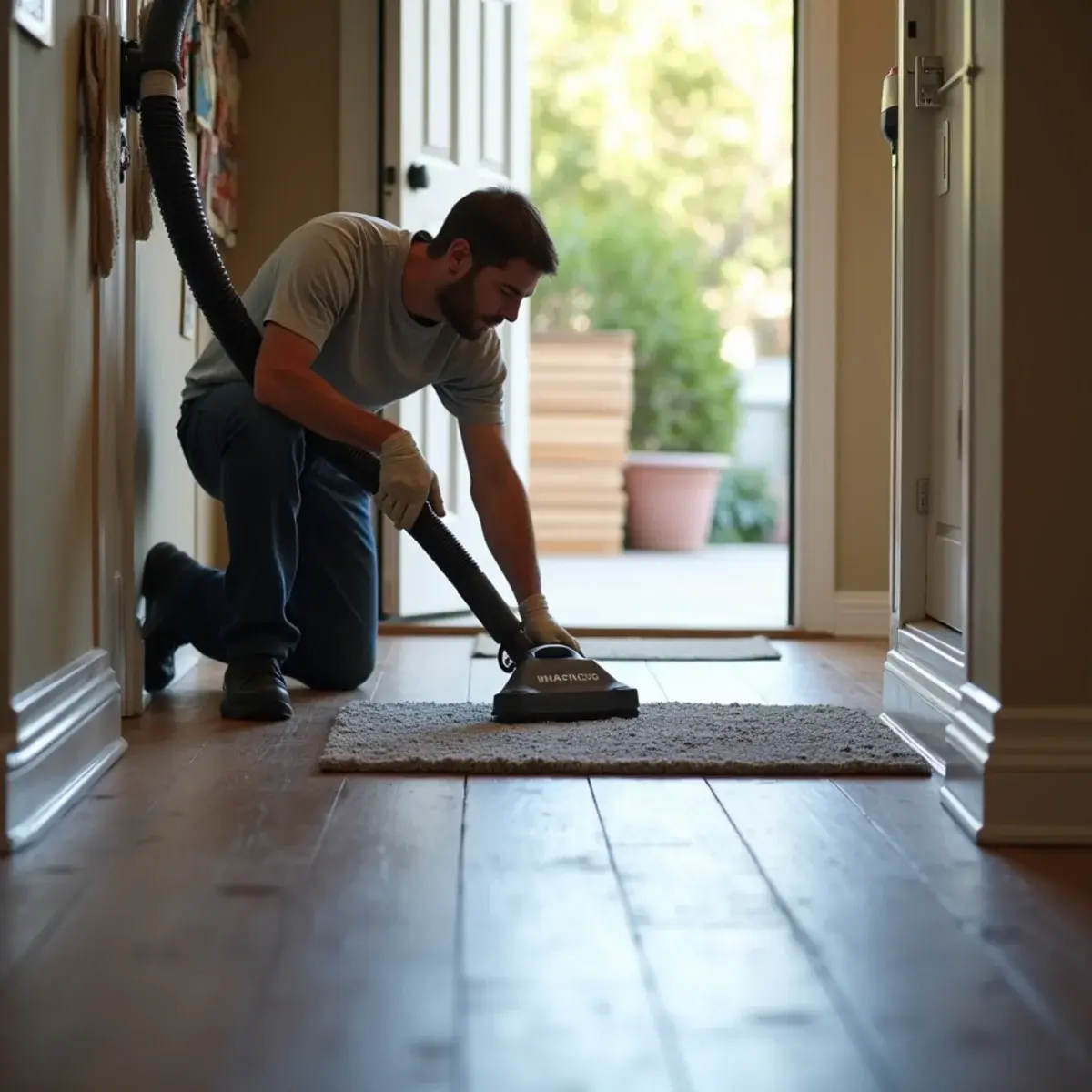
- 1
Map the wet area before lifting anything
We start at the walls, not the middle. A non-invasive meter sweeps the field, thermal imaging shows the cool footprint of the wet slab, and we pull a short run of baseboard to look into the expansion gap. That tells us where the water actually went, which is almost always further than the room where the leak happened.
- 2
Lift and number the planks
Floating plank comes up in reverse order from the last row installed, and every piece gets numbered and stacked flat in the order it came out so it can go back the same way. Click-lock joints survive one careful disassembly more often than people expect. Glue-down vinyl and any swollen laminate come out as waste.
- 3
Strip what sat under the floor
Whatever was between the floor and the slab does not go back. Foam and felt underlayment holds water and cannot be dried in place. Planks with a pad bonded to their backs are the same story, and that is usually what decides whether yours are reusable. Old adhesive residue traps moisture under any new bond, so we scrape the slab down to clean concrete.
- 4
Dry the slab to a documented standard
With the slab open, drying is straightforward and slow. We build a contained chamber, run dehumidification rather than open windows, since our marine layer mornings push outdoor humidity into the eighties, and we log slab moisture, chamber temperature and humidity every day. The target is a dry standard taken from unaffected concrete in the same house, not a guess about how long concrete takes.
- 5
In-situ RH test before anything goes down
Surface meters only tell you about the top few millimeters. Flooring manufacturers specify against internal relative humidity, measured with probes set into holes drilled to forty percent of slab depth and left to equilibrate. That test is the difference between a floor that stays down and a warranty claim the manufacturer declines. We run it, and you get the printed result.
- 6
Reinstall or replace, honestly
Numbered planks go back in the order they came out, over new underlayment, with the expansion gap reset at the walls. Where product is missing or damaged, we deal with the real problem: the product you installed a few years back has been discontinued, and a partial replacement will not match. Sometimes the fix is running new material to a natural break instead of feathering it in.
Why "Waterproof" Is the Most Expensive Word on the Box
Waterproof is a true claim about the plank and a misleading one about your floor. The vinyl itself will sit in water for a year and not change dimension. The assembly is a different thing: seams, a perimeter gap, an underlayment, a slab. Water finds the seams going in, spreads across the concrete, and then cannot get back out through the very material that kept it from staining. What the label describes as protection is, once water is underneath, a vapor barrier holding it in place.
What happens in that sealed space is predictable. Concrete wicks moisture sideways well past the visible wet area. Foam underlayment stays saturated because nothing can evaporate through the plank above it. The fine construction dust and adhesive residue on the slab give mold everything it needs, and the temperature under a heated house suits it. None of this shows on the surface, which is why the call usually comes in as a smell complaint rather than a water damage call.
The Floor Half This Service Area Installed Last Decade
Walk the 1950s to 1980s tract housing in Cypress, Lakewood, Norwalk, Cerritos and La Palma and you find the same remodel over and over: carpet and original oak pulled out, luxury vinyl plank floated wall to wall over the existing slab. It is a good product and a sensible choice. What most of those installations did not include is a vapor retarder under the concrete, because slabs from that era were commonly poured without one. So the floor now sits on concrete that already breathes ground moisture upward, before a leak adds anything.
Not every home here is on a slab, and the difference decides the whole job. Over the raised foundations in Old Towne Orange, Uptown Whittier and Eastside Costa Mesa, vinyl sits on a plank or plywood subfloor with a crawl space beneath, and we can move air under the joists while the top side dries. That is a shorter, cheaper job. In the manufactured housing around Stanton and Midway City, laminate usually sits on particleboard decking above a sealed belly wrap, and the decking rarely survives.
- Slab-on-grade tract homes (Cypress, Rossmoor, Lakewood, Cerritos): floating plank over foam underlayment, with moisture able to leave in one direction only.
- Raised foundations (Old Towne Orange, Uptown Whittier, Old Town Tustin): vinyl over a wood subfloor we can dry from both sides, which shortens everything.
- Manufactured homes (Stanton, Midway City, Carson): laminate over particleboard decking above a sealed belly wrap that has to be opened and drained first.
- Coastal cities (Seal Beach, Huntington Beach, Long Beach): the same assemblies, plus overnight marine humidity that stalls any open-air approach.
When Lifting the Floor Is the Wrong Call
Not every wet vinyl floor needs to come up. If a dishwasher overflowed and the water was on the surface for twenty minutes, if the perimeter gap is dry when we pull a baseboard, and if the slab reads at the same moisture as unaffected concrete elsewhere in the house, then the right answer is to dry the baseboard and cabinet toe kicks and leave your floor alone. We take those readings before we quote anything, and a fair number of our assessments end with us telling people there is nothing to do.
The expensive mistake runs the other way. Someone puts fans in the room for three days, the surface dries, and a new floor goes down on a slab nobody measured internally. Six months later the adhesive fails, or the new laminate swells at the seams, or the smell comes back, and the whole job gets paid for twice. If you take one thing from this page, take this: the slab has to be tested from the inside before new flooring is installed, and the result should be handed to you on paper.
What Drives the Cost of Vinyl and Laminate Floor Drying
No two of these jobs price the same, and these are the variables that move the number.
How much floor has to come up
Floating floors have to be lifted from the most recently installed row back toward the wet area, so we often remove more square footage than actually got wet. There is no way around that geometry. Where a room can be isolated at a doorway or a transition strip, the lifted area stays close to the damage.
Floating, glue-down, or sheet
Floating click-lock is the cheapest to remove and the only type with a real chance of reinstallation. Glue-down vinyl gets scraped off in pieces and the adhesive residue has to come off the slab behind it, which is slow labor. Sheet vinyl with a felt backing is the worst of the three, because the backing tears and lifts in strips.
Whether the planks can be reused
Reusing your planks saves the material line and costs labor, because numbering, stacking and refitting takes longer than laying new. Whether it is worth doing depends on the locking profile, the age of the product, and whether the backs carry a bonded pad. We give you that read before we start lifting rather than after.
How wet the slab got, and for how long
Concrete gives moisture up slowly. A slab that took water for an hour behaves differently from one that sat under a slow supply leak for weeks, and the second needs more equipment for more days. Drying to a flooring manufacturer's reinstallation spec also takes longer than drying to a structural standard, which surprises people.
What sits on top of the floor
Floating floors are installed around cabinets, islands and door casings, not under them, so anything sitting on the floor has to move and anything the floor runs under has to be undercut or worked around. Appliances come out, toe kicks come off where water got behind them, and baseboard is usually removed to reset the expansion gap.
Insurance note: Carriers rarely argue about lifting a floor to dry a slab; that part is well understood and our logs support it. The argument is almost always about how much floor gets replaced, since most policies pay for the damaged area rather than every room the same product runs through. Where the flooring has been discontinued, an itemized match statement helps. We bill insurance directly and document the job either way.
Why Cypress Homeowners Call Us for Vinyl & Laminate Floors
Plenty of companies list this service. Fewer can tell you what equipment they will bring, what standard the work is measured against, or what happens if they are wrong. Here is what you are actually buying.
Vinyl traps water underneath — that is the whole problem
Sheet vinyl and LVP are impermeable, so moisture sits between the flooring and the subfloor with nowhere to go. It has to be lifted or perforated to dry at all.
Laminate is assessed honestly
Swollen HDF core does not recover. We identify which planks are gone and whether the run can be spot-replaced from a matching lot before you commit to a full floor.
Subfloor is dried before anything goes back
Laying new flooring over a subfloor at elevated moisture guarantees a second failure. The moisture reading gates the reinstall.
- 20+ years restoring Orange County homes
- IICRC Certified Firm
- Licensed, Bonded & Insured
- We bill your insurance company directly
- IICRC S500:2025 compliant on every job
- 100% satisfaction guarantee — in writing, on every job
Frequently Asked Questions
Because the plank is waterproof and the space under it is not. Water gets in at the seams and the perimeter, spreads across the slab, and then has no way out, because the plank blocks evaporation. The flooring is usually the only part of the assembly that is fine. Lifting it is how we reach the underlayment and the concrete, which are the parts holding the moisture.
No. That is one of the few places in this work where the answer is flat. The core is compressed wood fiber and glue, and once water breaks that compression the fibers stay expanded. Drying stops it getting worse; it does not reverse it. If only a few boards near the leak have swollen and the rest reads dry, a partial replacement is sometimes possible, though matching an older run is rarely clean.
Often, yes, and it is worth trying. Click-lock planks lifted carefully in reverse order, numbered and stacked flat, usually go back with a small percentage of loss at the locking edges. What rules it out is a pad bonded to the plank backs, a brittle older product, or a glue-down installation, where the planks come up in pieces. We tell you which one you have on the first visit.
Longer than the structure. Framing and drywall can hit their dry standard in three to five days while the concrete is still holding moisture deeper down. Slabs commonly need a week or two of contained dehumidification, and the reinstallation test is a separate hurdle after that, because manufacturers specify an internal humidity number rather than a surface reading. Anyone promising a new floor in a few days is skipping that test.
Get standing water off the surface, move furniture out of the room, and open the toe kick under any cabinet the water reached. Do not put fans on the plank and assume that solves it, because the moisture is under the floor and airflow on top will not reach it. Call us and we will read it. Inside Cypress we are there within 60 minutes; elsewhere in our service area we dispatch as fast as conditions allow.
Related Reading
- Can Hardwood Floors Be Saved After Water Damage? — Often, yes — and the default recommendation to tear it out is frequently wrong. Here is what actually decides it.
- How Long Does Water Damage Restoration Actually Take? — Extraction is measured in hours, drying in days, and reconstruction in weeks. Here is what each phase actually involves and what stretches it.