
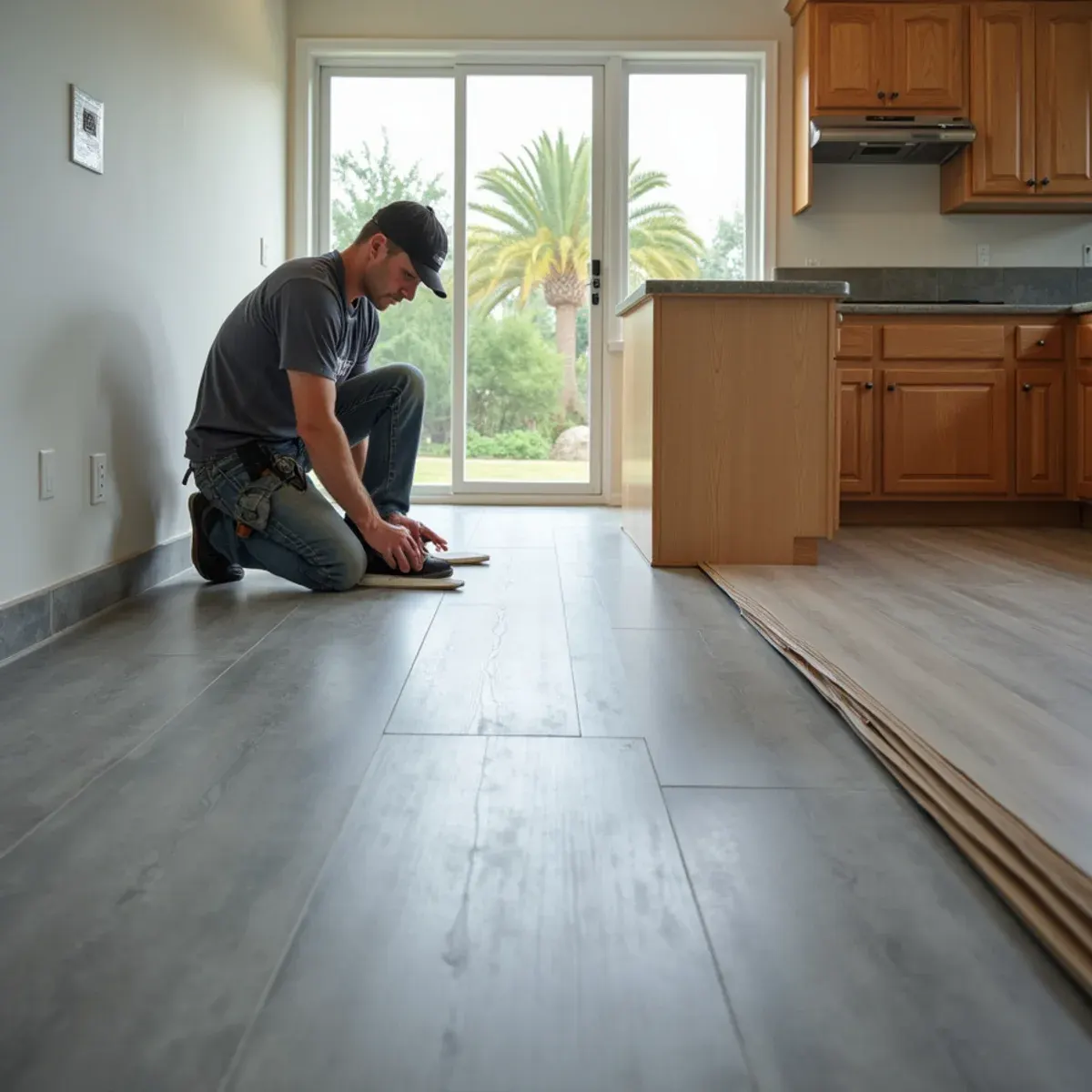
Carson has an unusually large mobile home park population, and the floor assembly in a manufactured home is nothing like the one in a stick-built house. Plank flooring goes over particleboard decking, the decking sits on framing, and beneath that is a belly wrap, a sealed membrane meant to keep insulation dry from below. When a supply line inside that cavity leaks, the wrap does exactly what it was built to do and holds the water in. It does not drain. It does not evaporate. It sits against the underside of the decking for weeks.
Above it, a floating vinyl plank floor gives almost no warning. The first symptom is usually a soft spot underfoot, and by then the decking has swollen and lost strength. Particleboard does not come back once it delaminates. The rest of the city is conventional 1950 to 1975 slab tract on former ranch, oilfield and industrial land, with a shallow water table underneath and refinery and logistics operations immediately adjacent. Two housing types, two entirely different floor jobs, in neighborhoods a few blocks apart from each other.
What Carson Changes About Vinyl & Laminate Floors
1The belly wrap must be opened
There is no drying a manufactured-home floor cavity through the top. We open the wrap from underneath at low points, let it drain, pull the wet insulation, dry the decking from both sides and then reseal the membrane properly. Companies that skip the underside and just run air movers in the room leave a sealed bag of water beneath the floor and hand you a mold problem in about a month.
2Particleboard decking does not recover
Plywood subfloor can often be dried and kept. The particleboard decking in most of these homes cannot, because once it has swollen it has lost the bond that gave it strength, and no plank floor sits flat over it afterward. We say that early, since it changes the scope from a dry-out to a partial floor rebuild, and finding it out at the end is how these projects go sideways.
3Slab tracts with a shallow water table
In the conventional Carson housing the work is standard slab drying with one local wrinkle: the ground under this flat city holds moisture and gives it back slowly, so a slab keeps reading high well after the plumbing repair is done. We run in-situ RH probes and hold the reinstall to the number. Glue-down vinyl over a slab still releasing vapor bubbles and lets go within a season.
How the Work Runs
The method is the same one we use on every vinyl & laminate floors job, documented to the IICRC S500:2025 standard. Here it is in short — the full vinyl & laminate floor water damage process explains each stage in detail.
- Map the wet area before lifting anything
- Lift and number the planks
- Strip what sat under the floor
- Dry the slab to a documented standard
- In-situ RH test before anything goes down
- Reinstall or replace, honestly
The Carson Background Worth Knowing
Manufactured homes are built with the floor deck, usually particleboard or OSB, sitting on a steel frame, with batt insulation below it and a vapor barrier belly wrap stapled underneath to hold everything in place. Supply lines run through that cavity. When one leaks, the water does not run out onto the ground where you would see it. The belly wrap catches and holds it, the insulation soaks it up, and you now have a sealed reservoir under your floor with no path to evaporate. It can sit there for months before anything shows upstairs.
There is more on the housing stock, drainage and plumbing history of this city on our water damage restoration in Carson page.
Carson at a glance
- Dominant construction era
- 1950–1975
- Foundation type
- slab on grade
- Supply piping found here
- galvanized steel, under-slab copper, manufactured-home supply lines
- Drain line materials
- cast iron
- Terrain and water table
- flat, shallow water table
- Most common local failure
- manufactured-home underfloor leaks trapped in the belly wrap, alongside conventional 1960s slab failures
- Highest-value local prevention
- treating any soft spot in a manufactured-home floor as moisture until a meter proves otherwise
What It Costs in Carson
We do not quote a number over the phone before seeing the property — anyone who does is guessing. The variables that actually move the price on a vinyl & laminate floors job are how much floor has to come up, floating, glue-down, or sheet, whether the planks can be reused, and they are broken down in full on the vinyl & laminate floor water damage page. The assessment and the written estimate are free anywhere in Carson, day or night, with no obligation.
Vinyl & Laminate Floors Questions from Carson Homeowners
Yes, and in this housing that is where most of the work is. We access the underside, open the belly wrap at the low points to let trapped water out, remove saturated insulation, and dry the decking from both faces before resealing the membrane. We also document the source and the condition in writing, which matters when responsibility between you, the park and your insurer has to be sorted out afterward.
Because the plank is waterproof and the space under it is not. Water gets in at the seams and the perimeter, spreads across the slab, and then has no way out, because the plank blocks evaporation. The flooring is usually the only part of the assembly that is fine. Lifting it is how we reach the underlayment and the concrete, which are the parts holding the moisture.
No. That is one of the few places in this work where the answer is flat. The core is compressed wood fiber and glue, and once water breaks that compression the fibers stay expanded. Drying stops it getting worse; it does not reverse it. If only a few boards near the leak have swollen and the rest reads dry, a partial replacement is sometimes possible, though matching an older run is rarely clean.
By locating it rather than arguing about it. The dividing line is the connection point where the park's service meets your home. Upstream of that is the park's responsibility, downstream is yours. We open the belly wrap where water is pooling, trace the wet path back to its source, and photograph what we find with the connection in frame. That documentation settles the question. Guessing from where the wet spot showed up inside is unreliable, because water travels along the frame first.