
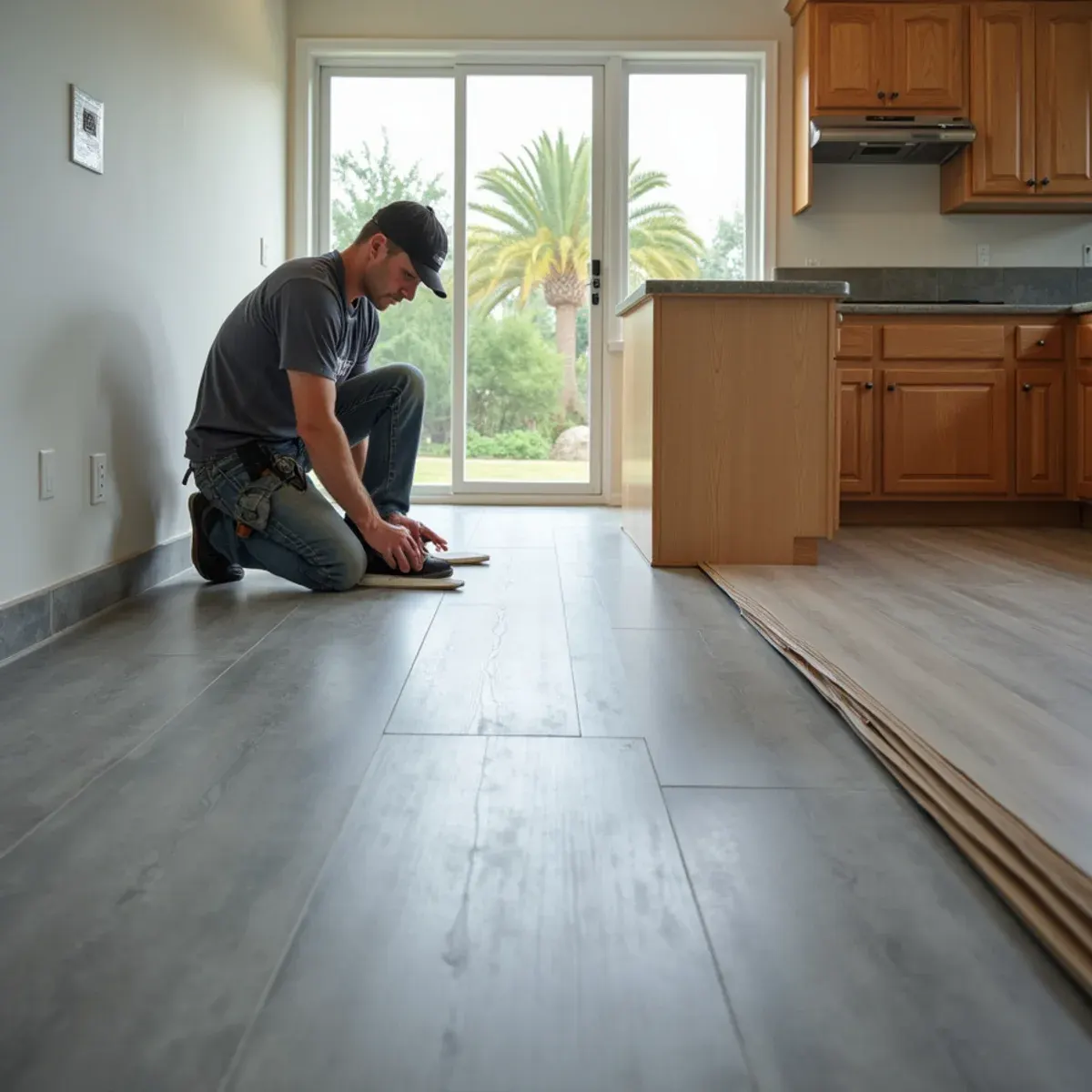
You can drive from a 1920s oil-town cottage near downtown Brea to a 2001 hillside tract toward Carbon Canyon in about eight minutes and cross a full century of construction doing it. The cottages are small, often on raised foundations, with subfloor we can reach from below. The hillside houses are slab-on-grade with enormous continuous plank runs, where great room, kitchen and hallway were laid as one floating field with no transition strips. Same product, opposite jobs. One we dry from underneath. The other has to come up in sequence from a far wall.
The northern hills carry the Brea Olinda oil field's grading and the canyon's drainage behavior, and that shows up in the work. Storms here concentrate, because the canyon collects and delivers rather than absorbs, and slope drainage sized for average rainfall gets overwhelmed in a couple of hours. Water arriving that way enters at the low corner of a pad and is under the floating floor immediately. Down toward the Brea Mall corridor and the older streets the failures are more ordinary: supply lines, appliances and the occasional slab leak in the mid-century pockets between the two extremes.
What Brea Changes About Vinyl & Laminate Floors
1Continuous plank runs in hillside tracts
Late-nineties and 2000s builders ran flooring through entire ground floors with no thresholds, which looks excellent and complicates every repair. Click-lock has a direction. To reach wet slab in the middle of a twelve-hundred-square-foot field, planks come up in order from a free edge and get numbered, or the tongues break. Done properly, a good share go back down. Done in a hurry, none of them do.
2Canyon runoff arrives concentrated
Carbon Canyon delivers a lot of water in a short window during real storms, and the slope drainage on the tracts below is sized for typical rain. When it is overwhelmed, water sheets across the pad and enters at door lines and slider tracks rather than seeping in slowly. Speed defines this failure. A floor can be flooded underneath in under a minute while the surface looks like nothing happened.
3Downtown cottages on raised floors
The older small houses near downtown often still have their original raised foundations, so where the crawl space is accessible we can dry the subfloor from below and lift far fewer planks. The catch is that these crawl spaces are shallow and were never built to hold equipment. We check access before promising the low-demolition route, because in some of these houses it genuinely is not available.
How the Work Runs
The method is the same one we use on every vinyl & laminate floors job, documented to the IICRC S500:2025 standard. Here it is in short — the full vinyl & laminate floor water damage process explains each stage in detail.
- Map the wet area before lifting anything
- Lift and number the planks
- Strip what sat under the floor
- Dry the slab to a documented standard
- In-situ RH test before anything goes down
- Reinstall or replace, honestly
The Brea Background Worth Knowing
Brea's hillside tracts were designed to handle rain. Terrace drains catch runoff partway up a slope, v-ditches carry it around the toe, area drains take the flat yard, and everything ties into a system that moves water past the house rather than through it. The design works. What fails is maintenance. Over a dry summer those inlets fill with eucalyptus leaf litter, decomposed granite, and whatever the wind brought down the canyon, and nobody looks at them because they sit on a slope behind a fence. The first hard storm of the season finds every one that is blocked.
There is more on the housing stock, drainage and plumbing history of this city on our water damage restoration in Brea page.
Brea at a glance
- Dominant construction era
- 1920–2005
- Foundation type
- mixed on grade
- Supply piping found here
- galvanized steel, under-slab copper, PEX in newer hillside tracts
- Drain line materials
- cast iron, clay, ABS
- Terrain and water table
- hillside-mixed, deep water table
- Most common local failure
- canyon and hillside runoff overwhelming slope drainage during concentrated storms
- Highest-value local prevention
- keeping Carbon Canyon-side slope drains, v-ditches and downspout extensions genuinely clear
What It Costs in Brea
We do not quote a number over the phone before seeing the property — anyone who does is guessing. The variables that actually move the price on a vinyl & laminate floors job are how much floor has to come up, floating, glue-down, or sheet, whether the planks can be reused, and they are broken down in full on the vinyl & laminate floor water damage page. The assessment and the written estimate are free anywhere in Brea, day or night, with no obligation.
Vinyl & Laminate Floors Questions from Brea Homeowners
Not necessarily, but the answer depends on where the free edge is. Floating floors unlock from one direction, so reaching a wet area in the middle means removing planks in order from the nearest wall and numbering as we go. We meter first to find the actual boundary of the wet slab, which in these Brea great rooms is usually smaller than people fear and rarely quite where they expect it.
Because the plank is waterproof and the space under it is not. Water gets in at the seams and the perimeter, spreads across the slab, and then has no way out, because the plank blocks evaporation. The flooring is usually the only part of the assembly that is fine. Lifting it is how we reach the underlayment and the concrete, which are the parts holding the moisture.
No. That is one of the few places in this work where the answer is flat. The core is compressed wood fiber and glue, and once water breaks that compression the fibers stay expanded. Drying stops it getting worse; it does not reverse it. If only a few boards near the leak have swollen and the rest reads dry, a partial replacement is sometimes possible, though matching an older run is rarely clean.
Usually not under a standard homeowners policy. Water that runs across the ground and enters a building is surface water, and that is an excluded cause on nearly every form, whether it came off a Carbon Canyon slope or out of the street. Separate flood coverage handles it. Damage from a covered failure is a different story, so let us document the entry point and cause before anything gets cleaned up.