
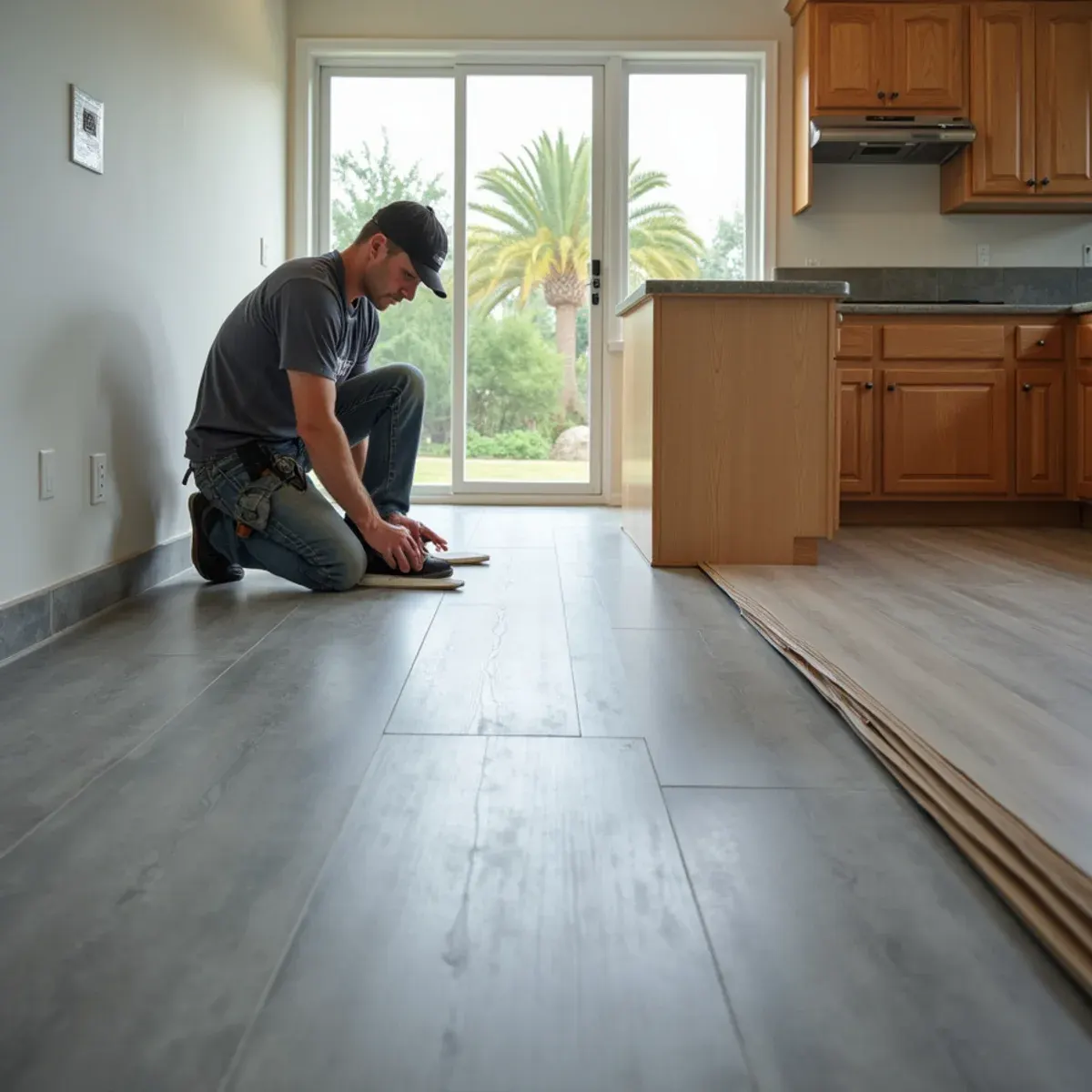
A Pioneer Boulevard kitchen backs up on a Friday night and the water on the floor is not clean. Most of these buildings went up in the 1950s as ordinary retail, with cast iron waste lines never designed for decades of commercial kitchen grease, and the restriction builds until the line pushes back into the room. Under commercial vinyl plank that water spreads flat and fast and works into the seams and the underlayment. It is Category 3 from the first minute, and that classification decides the entire job before we have even arrived.
Here is the part nobody wants to hear. Contaminated water under a floating vinyl floor means the plank comes out and does not go back. The surface can be cleaned, but the seams, the underlayment and the adhesive line underneath cannot be verified clean, and a health inspector is not going to take our word for it. We remove, clean and disinfect the slab, dry it to a documented number, and new material goes down. The residential side of Artesia, the modest postwar slab homes off South Street, is a far more salvageable job.
What Artesia Changes About Vinyl & Laminate Floors
1Grease-loaded cast iron in 1950s buildings
Pioneer Boulevard has one of the densest concentrations of independent restaurants anywhere in the region, nearly all in buildings never designed for commercial kitchens. Decades of grease narrow the original cast iron until it restricts, then backs up. The failure is not sudden and it recurs, which is why we photograph the line condition and note it in the file rather than treating each backup as an isolated event.
2Category 3 water means the plank goes
Once sewage-contaminated water gets under a floating floor, the underside of the plank, the underlayment and the seam faces are all in contact with it. There is no way to verify those surfaces clean after the fact and no inspector will accept an assumption. We remove the flooring, disinfect and dry the slab, and document the whole sequence so reopening is a straightforward conversation.
3Reopening the kitchen drives the schedule
Every day a Pioneer Boulevard kitchen is closed costs more than the restoration. We work overnight and through off-hours where the building allows it, stage the dining room and kitchen as separate zones, and prioritize the sequence that gets you inspected and open. That means being honest early about which parts genuinely cannot be rushed, because the drying standard is not negotiable.
How the Work Runs
The method is the same one we use on every vinyl & laminate floors job, documented to the IICRC S500:2025 standard. Here it is in short — the full vinyl & laminate floor water damage process explains each stage in detail.
- Map the wet area before lifting anything
- Lift and number the planks
- Strip what sat under the floor
- Dry the slab to a documented standard
- In-situ RH test before anything goes down
- Reinstall or replace, honestly
The Artesia Background Worth Knowing
A commercial kitchen is one of the hardest things you can ask a building to accommodate. High water use, continuous drainage, grease loading, floor drains, and equipment connections that get added and modified over the years. When that kitchen is in a building from the 1950s with original cast-iron waste lines, the failure is a matter of time.
There is more on the housing stock, drainage and plumbing history of this city on our water damage restoration in Artesia page.
Artesia at a glance
- Dominant construction era
- 1950–1970
- Foundation type
- slab on grade
- Supply piping found here
- galvanized steel, copper
- Drain line materials
- cast iron
- Terrain and water table
- flat, moderate water table
- Most common local failure
- grease-loaded cast-iron waste lines restricting until a commercial kitchen backs up
- Highest-value local prevention
- hydro-jetting the waste line rather than snaking it, so the pipe wall actually gets cleaned
What It Costs in Artesia
We do not quote a number over the phone before seeing the property — anyone who does is guessing. The variables that actually move the price on a vinyl & laminate floors job are how much floor has to come up, floating, glue-down, or sheet, whether the planks can be reused, and they are broken down in full on the vinyl & laminate floor water damage page. The assessment and the written estimate are free anywhere in Artesia, day or night, with no obligation.
Vinyl & Laminate Floors Questions from Artesia Homeowners
Waterproof describes the top surface, not the assembly. In a backup the contaminated water travels through the seams and sits under the plank against the underlayment and slab, and those surfaces cannot be reached, cleaned or verified with the floor in place. A health inspector will ask how you confirmed it, and there is no honest answer. We remove it, disinfect and dry the slab to a documented number, and install new.
Because the plank is waterproof and the space under it is not. Water gets in at the seams and the perimeter, spreads across the slab, and then has no way out, because the plank blocks evaporation. The flooring is usually the only part of the assembly that is fine. Lifting it is how we reach the underlayment and the concrete, which are the parts holding the moisture.
No. That is one of the few places in this work where the answer is flat. The core is compressed wood fiber and glue, and once water breaks that compression the fibers stay expanded. Drying stops it getting worse; it does not reverse it. If only a few boards near the leak have swollen and the rest reads dry, a partial replacement is sometimes possible, though matching an older run is rarely clean.
Yes, and on Pioneer Boulevard that is usually how we schedule it. Overnight crews cost somewhat more in labor and almost always cost dramatically less than lost revenue from closing during operating hours.