
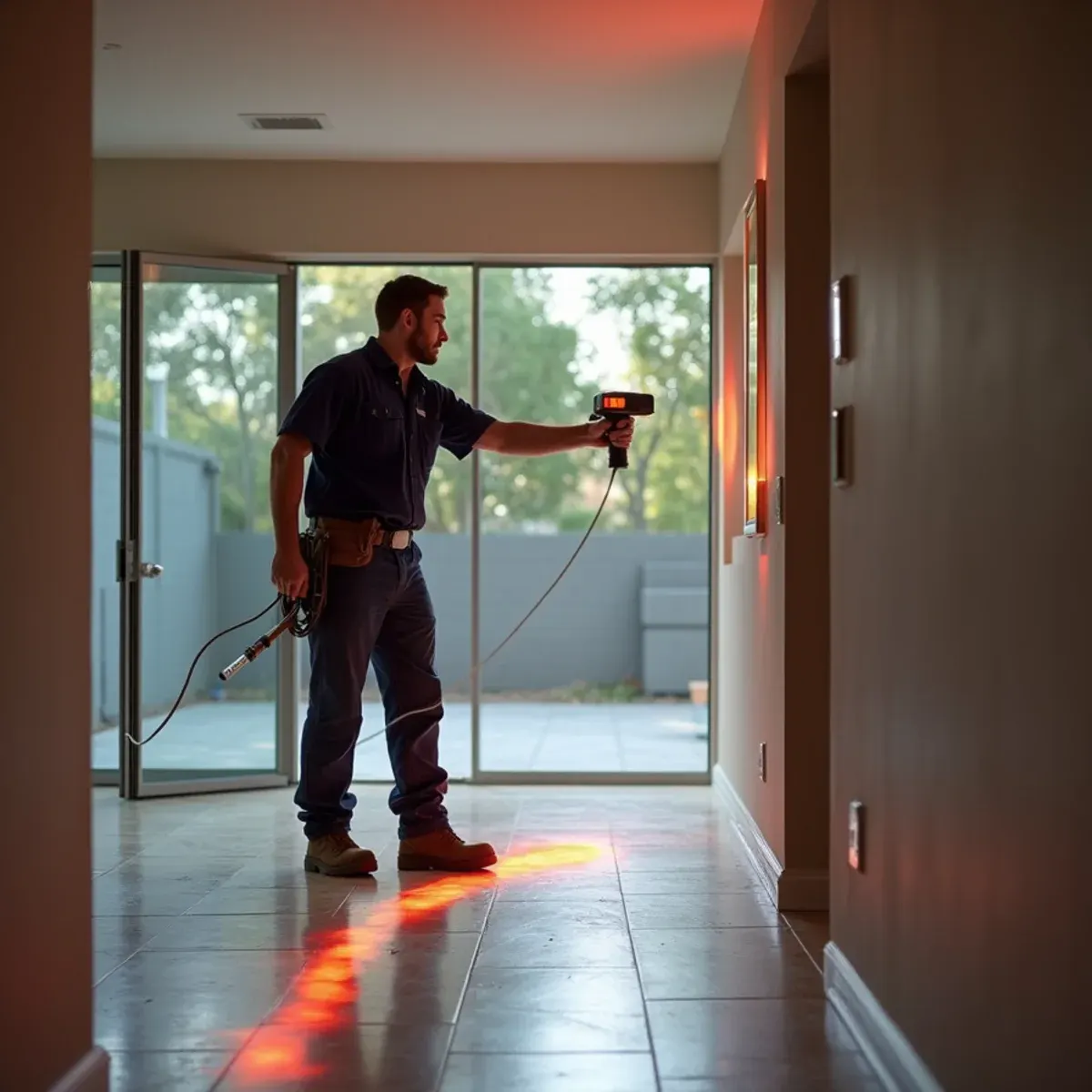
Closure days, not square footage, is how a slab leak gets measured on Pioneer Boulevard. Little India packs one of the region's densest runs of independent restaurants into buildings put up in the 1950s for retail, never for commercial kitchens. Quarry tile bedded in thinset over slab has to be cored rather than chipped. The trench has to be closed and sealed to a health inspector's satisfaction. None of that fits neatly between a lunch and a dinner service, so we run detection after close and plan the opening before anyone touches a saw.
The homes behind the boulevard are modest 1950s and 60s slab-on-grade with galvanized and copper of the same vintage, and underground they behave much like their Cerritos and Lakewood neighbors. What's different in Artesia is who absorbs the interruption. Independent owners here have no corporate reserve to ride out three weeks of closure, so we phase work to keep as much of a kitchen operating as the trench line and the code allow, and we document business interruption from the first hour instead of reconstructing it for an adjuster later.
What Artesia Changes About Slab Leak Damage
1Coring quarry tile instead of chipping it
The kitchens along Pioneer Boulevard sit on quarry tile bedded in thinset over slab. Chipping through it wrecks far more floor than the repair requires and leaves a ragged edge nothing will bond to. We core a tight opening, protect the surrounding tile, and patch back to a surface that passes inspection and cleans properly afterward.
2Phasing work to keep a kitchen open
Where the trench line and the health code allow it, we section the work so part of a kitchen stays in service instead of shutting the whole operation down for the duration. It's slower and takes more coordination on our end. For an independent owner with no corporate reserve behind them, it's frequently the difference between a hard month and a closed business.
3Business interruption documented from hour one
Adjusters pay for what's recorded, not what's remembered. From the first visit we log the affected area, the equipment, the daily readings and the parts of the operation that are down, and we bill the carrier directly. Reconstructing three weeks of lost service after the fact is where independent owners on this street lose real money.
How the Work Runs
The method is the same one we use on every slab leak damage job, documented to the IICRC S500:2025 standard. Here it is in short — the full slab leak water damage repair process explains each stage in detail.
- Confirm it is actually a slab leak
- Electronic leak location
- Choose the repair approach with you
- Dry the slab and the affected assemblies
- Address the flooring and wall base
- Restore the floor and finish
The Artesia Background Worth Knowing
A commercial kitchen is one of the hardest things you can ask a building to accommodate. High water use, continuous drainage, grease loading, floor drains, and equipment connections that get added and modified over the years. When that kitchen is in a building from the 1950s with original cast-iron waste lines, the failure is a matter of time.
There is more on the housing stock, drainage and plumbing history of this city on our water damage restoration in Artesia page.
Artesia at a glance
- Dominant construction era
- 1950–1970
- Foundation type
- slab on grade
- Supply piping found here
- galvanized steel, copper
- Drain line materials
- cast iron
- Terrain and water table
- flat, moderate water table
- Most common local failure
- grease-loaded cast-iron waste lines restricting until a commercial kitchen backs up
- Highest-value local prevention
- hydro-jetting the waste line rather than snaking it, so the pipe wall actually gets cleaned
What It Costs in Artesia
We do not quote a number over the phone before seeing the property — anyone who does is guessing. The variables that actually move the price on a slab leak damage job are how long the leak ran undetected, flooring type over the leak, repair method chosen, and they are broken down in full on the slab leak water damage repair page. The assessment and the written estimate are free anywhere in Artesia, day or night, with no obligation.
Slab Leak Damage Questions from Artesia Homeowners
That depends on where the line runs, what's on top of it, and whether a reroute can avoid the kitchen floor entirely, so we won't guess at a number before we've located it. What we can commit to is running detection after close, keeping the opening as small as coring allows, and phasing the work so whatever part of your kitchen can legally stay open does.
The meter test is the first step: shut off every fixture and watch the low-flow indicator. If it moves and nothing is wet above the floor, suspect the slab. Warm spots on the floor, running-water sounds from below, and flooring that lifts or cups without an obvious cause all point the same direction. We confirm it with thermal imaging and moisture mapping at no charge.
Not always. Depending on where the leak is and the condition of the system, rerouting the line overhead through the attic and walls avoids opening the concrete entirely. When a spot repair is the better option, precise electronic location keeps the opening small — typically a couple of feet, not a trench across the room.
Yes, and on Pioneer Boulevard that is usually how we schedule it. Overnight crews cost somewhat more in labor and almost always cost dramatically less than lost revenue from closing during operating hours.