
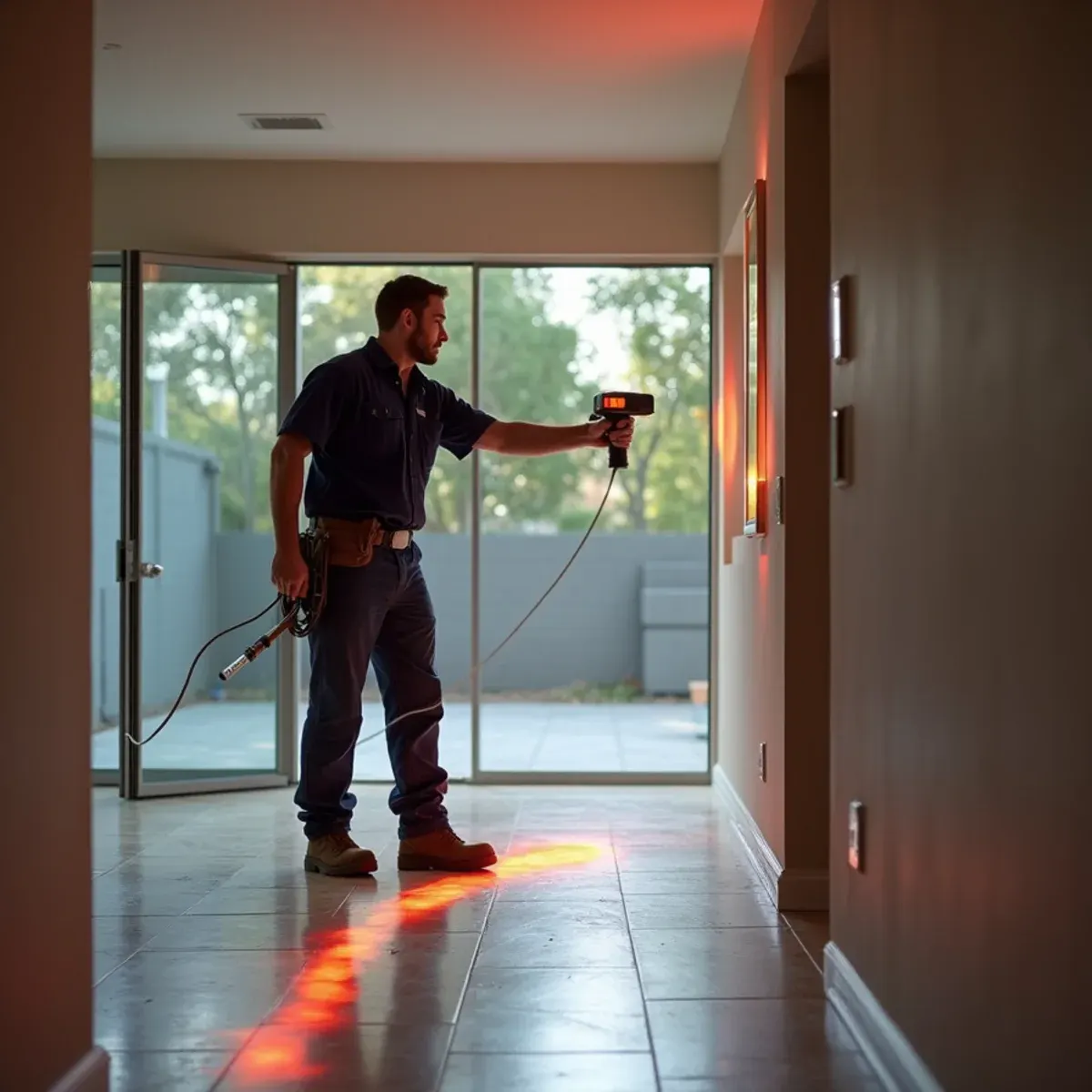
Before anyone cuts concrete in Anaheim Hills, we need to know whether the slab is post-tensioned. A lot of the hillside construction from the late seventies onward was built that way, with steel tendons held in tension through the pour, and putting a saw through one turns a plumbing job into a structural repair. On those homes an overhead reroute isn't the second-best option, it's the only sensible one. The stepped foundations under multi-level plans add a second wrinkle: water from a break on an upper pad travels along the step and shows up a whole floor below.
Anaheim covers more construction history than anywhere else we work. Five miles from those hillside homes, the Colony Historic District holds houses from the 1900s with lath-and-plaster walls and original early-century piping, while West Anaheim runs mile after mile of postwar slab tract on galvanized and early copper. The right answer changes street by street. Water wicking up into plaster is urgent, because wet plaster softens at the keys and starts leaving the lath. The same water in a 1958 drywall wall near Ball Road buys you considerably more time.
What Anaheim Changes About Slab Leak Damage
1Post-tensioned slabs rule out blind cutting
Hillside construction from the late 1970s onward is frequently post-tensioned, with steel tendons under load running through the concrete. Cutting one turns a plumbing repair into a structural one. We scan before any saw touches the floor, and on most of those homes the honest recommendation is an overhead reroute that leaves the slab completely alone.
2Stepped slabs move water between levels
Multi-level hillside plans sit on stepped foundations, and water from a break on an upper pad travels along the step and surfaces on the level below. The wet baseboard you can actually see is frequently downhill of the failure. We locate acoustically and confirm with thermal imaging rather than working backward from the damp carpet in front of us.
3Colony plaster changes the drying plan
In the Colony Historic District, water reaching original lath-and-plaster is a different job entirely. Plaster holds several times what drywall does and gives it up slowly, and as it stays wet the keys behind the lath soften and release. That needs desiccant capacity and an early start, and exterior repairs may require historic review before any work begins.
How the Work Runs
The method is the same one we use on every slab leak damage job, documented to the IICRC S500:2025 standard. Here it is in short — the full slab leak water damage repair process explains each stage in detail.
- Confirm it is actually a slab leak
- Electronic leak location
- Choose the repair approach with you
- Dry the slab and the affected assemblies
- Address the flooring and wall base
- Restore the floor and finish
The Anaheim Background Worth Knowing
The Anaheim Colony Historic District and the older streets around downtown contain homes built from the early 1900s through the 1930s, and they are constructed differently in ways that matter enormously during a water loss.
There is more on the housing stock, drainage and plumbing history of this city on our water damage restoration in Anaheim page.
Anaheim at a glance
- Dominant construction era
- 1900–2000
- Foundation type
- mixed on grade
- Supply piping found here
- galvanized steel, under-slab copper, original early-century piping in the Colony
- Drain line materials
- cast iron, clay
- Terrain and water table
- hillside-mixed, moderate water table
- Most common local failure
- lath-and-plaster assemblies that hold several times the water drywall does and release it far more slowly
- Highest-value local prevention
- acting immediately on any plaster-wall loss, because wet plaster keys soften and release from the lath
What It Costs in Anaheim
We do not quote a number over the phone before seeing the property — anyone who does is guessing. The variables that actually move the price on a slab leak damage job are how long the leak ran undetected, flooring type over the leak, repair method chosen, and they are broken down in full on the slab leak water damage repair page. The assessment and the written estimate are free anywhere in Anaheim, day or night, with no obligation.
Slab Leak Damage Questions from Anaheim Homeowners
It depends on whether your slab is post-tensioned, and that's the first thing we check rather than assume. If it is, we scan for tendons before considering any cut, and in most cases we recommend abandoning the failed line and rerouting overhead. That leaves the structure untouched and moves the work into drywall. On a conventional slab, a spot repair is often perfectly reasonable.
The meter test is the first step: shut off every fixture and watch the low-flow indicator. If it moves and nothing is wet above the floor, suspect the slab. Warm spots on the floor, running-water sounds from below, and flooring that lifts or cups without an obvious cause all point the same direction. We confirm it with thermal imaging and moisture mapping at no charge.
Not always. Depending on where the leak is and the condition of the system, rerouting the line overhead through the attic and walls avoids opening the concrete entirely. When a spot repair is the better option, precise electronic location keeps the opening small — typically a couple of feet, not a trench across the room.
Yes, and we approach them differently. Lath and plaster holds much more water than drywall and dries far more slowly, so it needs more equipment and considerably more patience — but it can usually be saved in place, and original plaster is not something a repair can replace.