
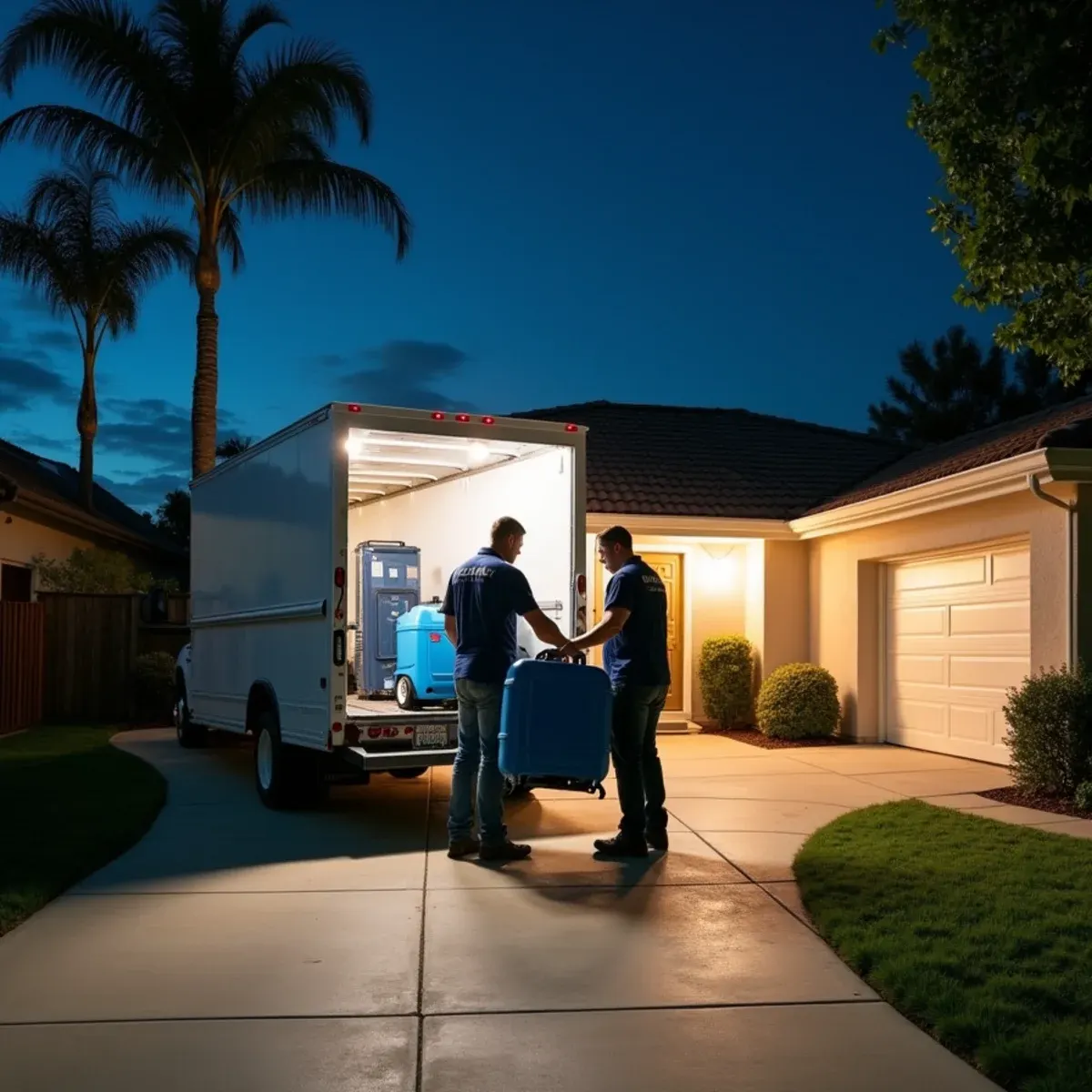
Four calls from Anaheim on the same night can be four genuinely different jobs. A 1910 house in the Colony has lath and plaster that holds several times the water drywall does and gives it up slowly. A West Anaheim tract house from 1958 is a slab-and-drywall problem we can scope in twenty minutes. A three-level home off Nohl Ranch sends water down two floors to the garage. And a Resort-district hotel needs rooms back tonight. No single playbook covers that spread, so we ask what we're walking into before loading the truck.
The hillside work has its own physics. Homes built from the 1970s onward in Anaheim Hills sit on engineered pads with retaining walls, subdrains and split levels, so an upstairs failure or a saturated slope doesn't pool, it travels, and it usually ends at the lowest finished space in the house. We start at the bottom and work up, because the wettest room is rarely the one where the pipe broke. Out on flat West Anaheim, that same approach would waste your time and ours.
What Anaheim Changes About Emergency Restoration
1Plaster holds water and hides it
In Colony District homes, wet plaster keys soften and lose their grip on the wood lath behind them, which is how a wall that looks intact comes down two weeks later. Plaster also releases moisture far more slowly than drywall, so it needs low-humidity drying and patience rather than more fans. We meter through the assembly instead of the surface, and we act on plaster losses the same day.
2Hillside homes drain to the lowest level
Multi-level construction in Anaheim Hills routes water through stair stringers, floor assemblies and wall chases toward the garage or lowest room. Exterior saturation behind a retaining wall can push through a lower-level wall entirely separately from any plumbing failure. Sorting out which one you have decides whether the fix is drying or drainage, and we'd rather learn that before writing a scope.
3Hotel rooms measured in nights lost
Around the Resort District, the real cost of a loss is rooms out of inventory. We stage equipment to release rooms in sequence, work corridors at low-traffic hours, and give the property a daily readings sheet showing exactly which rooms have met the dry standard. Housekeeping and engineering get told plainly what they can touch and what they can't.
How the Work Runs
The method is the same one we use on every emergency restoration job, documented to the IICRC S500:2025 standard. Here it is in short — the full emergency water damage restoration process explains each stage in detail.
- Call answered and crew dispatched
- Arrival, safety check, and moisture mapping
- Documentation before anything is touched
- Extraction
- Controlled structural drying
- Cleaning, sanitizing, and final verification
The Anaheim Background Worth Knowing
The Anaheim Colony Historic District and the older streets around downtown contain homes built from the early 1900s through the 1930s, and they are constructed differently in ways that matter enormously during a water loss.
There is more on the housing stock, drainage and plumbing history of this city on our water damage restoration in Anaheim page.
Anaheim at a glance
- Dominant construction era
- 1900–2000
- Foundation type
- mixed on grade
- Supply piping found here
- galvanized steel, under-slab copper, original early-century piping in the Colony
- Drain line materials
- cast iron, clay
- Terrain and water table
- hillside-mixed, moderate water table
- Most common local failure
- lath-and-plaster assemblies that hold several times the water drywall does and release it far more slowly
- Highest-value local prevention
- acting immediately on any plaster-wall loss, because wet plaster keys soften and release from the lath
What It Costs in Anaheim
We do not quote a number over the phone before seeing the property — anyone who does is guessing. The variables that actually move the price on a emergency restoration job are water category, affected square footage and number of rooms, how many days of equipment, and they are broken down in full on the emergency water damage restoration page. The assessment and the written estimate are free anywhere in Anaheim, day or night, with no obligation.
Emergency Restoration Questions from Anaheim Homeowners
Not automatically. Plaster is worth trying to save and often can be, but it has to be dried immediately with low humidity rather than airflow alone. We sound the wall and meter through the assembly to see whether the keys behind the lath are still gripping. If they are, we dry it in place, sometimes through a small cavity access. If they've let go, that section is already lost, and we'll say so rather than bill you for drying it.
We commit to being on-site within 60 minutes of a confirmed emergency call anywhere in Cypress, and we credit $100 off your invoice if we miss it. Most of the time we are there in 30 to 45 minutes because our trucks stage on Katella Avenue, right here in the city.
No. The emergency assessment and written estimate are free, 24 hours a day. You are not obligated to hire us after we walk the property, and we will tell you plainly if we think the damage is small enough to handle yourself.
Yes, and we approach them differently. Lath and plaster holds much more water than drywall and dries far more slowly, so it needs more equipment and considerably more patience — but it can usually be saved in place, and original plaster is not something a repair can replace.