
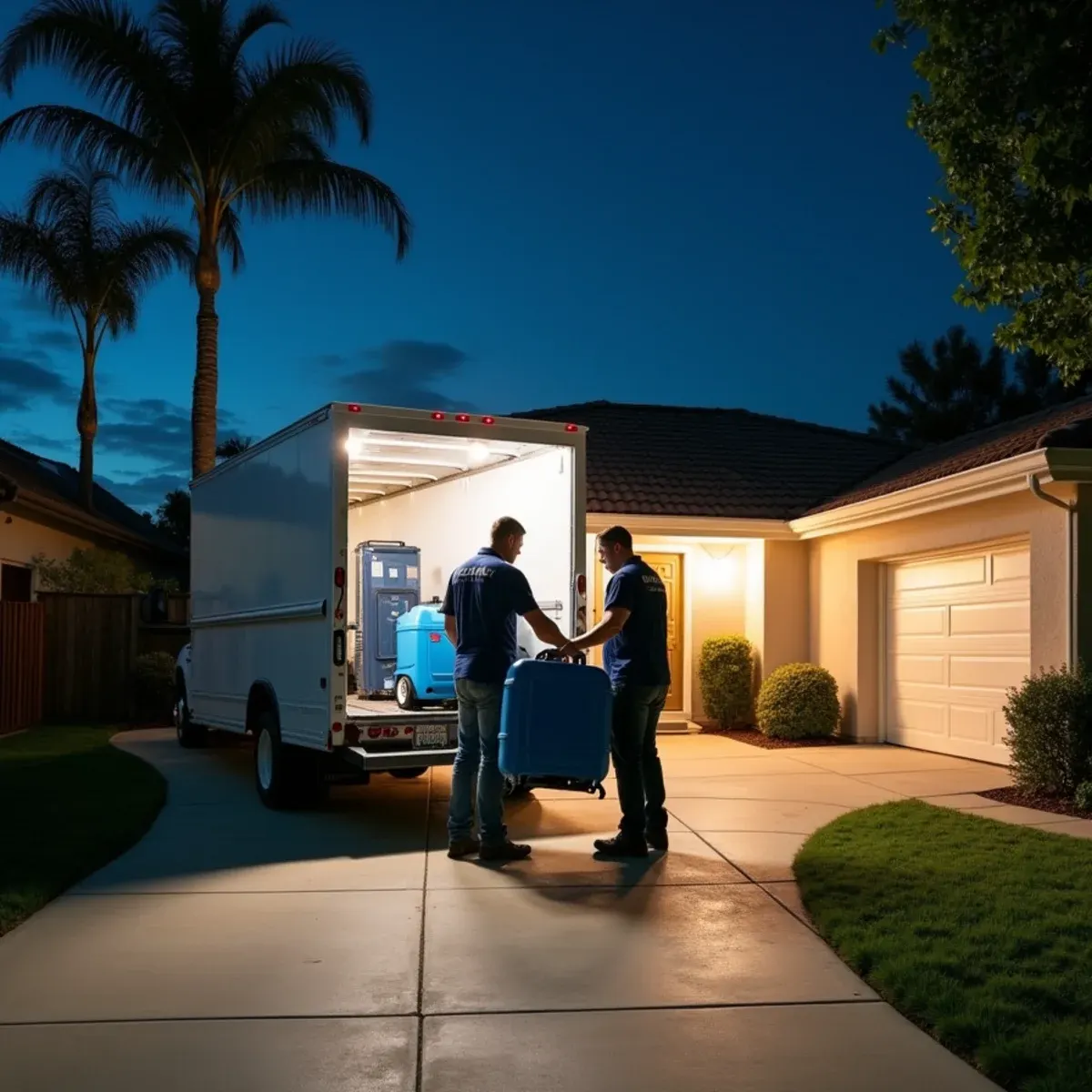
Bellflower filled in fast. Dairy and orchard land, named for the Bellflower apple, went to small houses on small lots almost as soon as the war ended, and a lot of those original systems are still in service. That makes the housing here older in mechanical terms than most of what we work on across the county line in Orange County. Galvanized supply lines and cast-iron drain lines installed in the same year are now reaching the end of their lives in the same decade, and we regularly find both failing in one house.
That combination changes the job. A clean supply leak is one category of water. The same leak in a house where the cast-iron lateral is scaled shut and backing up is a different category entirely, and the difference decides what gets dried and what gets removed. Around the Bellflower Boulevard corridor, Mayfair and the Somerset area, small lots also mean tight staging for trucks and equipment, and the substantial multi-family stock means one failure often involves several households. We are about twelve minutes southeast, one of the closest cities to our Cypress base.
What Bellflower Changes About Emergency Restoration
1Supply and drain lines aging out together
Galvanized corrodes closed from the inside and cast iron scales and cracks, and in a house built around 1950 both clocks started at once. We check the drain side even when the call is about a supply leak, because a lateral that cannot carry flow turns an ordinary extraction into a contaminated one. Under IICRC S500:2025 that reclassification drives what we can dry in place and what has to come out.
2Clean water does not stay clean
Category 1 water degrades with time and contact. In older Bellflower housing it can pick up decades of material from inside galvanized pipe, wet a subfloor that has been damp before, or meet a sluggish drain line. If it has been sitting more than a day or two, or if it smells, we treat it as escalated and say so on the report. Pretending otherwise makes the paperwork simpler and the outcome worse.
3Small lots, tight equipment staging
Compact postwar lots leave little room between houses and short driveways, so hose runs to the truck and generator placement need planning rather than improvisation. On duplexes and fourplexes along the corridors we often have one shared shutoff and no clear utility room. Locating that shutoff on arrival, and knowing whether the neighboring unit needs to be opened, is the first ten minutes of the call here.
How the Work Runs
The method is the same one we use on every emergency restoration job, documented to the IICRC S500:2025 standard. Here it is in short — the full emergency water damage restoration process explains each stage in detail.
- Call answered and crew dispatched
- Arrival, safety check, and moisture mapping
- Documentation before anything is touched
- Extraction
- Controlled structural drying
- Cleaning, sanitizing, and final verification
The Bellflower Background Worth Knowing
Galvanized steel was the standard supply pipe when Bellflower was being built, and it fails from the inside out. The zinc lining wears through, the steel underneath corrodes, and scale builds on the interior wall until the pipe is a fraction of its original diameter. Narrower pipe means faster, more turbulent water, which chews at elbows and threaded fittings until one of them lets go. Hot lines corrode faster than cold, which is why hot water pressure is usually the first thing to drop. Eighty years is well past any service life anyone intended when this was installed.
There is more on the housing stock, drainage and plumbing history of this city on our water damage restoration in Bellflower page.
Bellflower at a glance
- Dominant construction era
- 1940–1960
- Foundation type
- slab on grade
- Supply piping found here
- original galvanized steel, early copper
- Drain line materials
- cast iron
- Terrain and water table
- flat, moderate water table
- Most common local failure
- original galvanized supply lines and cast-iron laterals failing together in the same decade
- Highest-value local prevention
- scoping the sewer lateral, which on a house this age has usually never been looked at
What It Costs in Bellflower
We do not quote a number over the phone before seeing the property — anyone who does is guessing. The variables that actually move the price on a emergency restoration job are water category, affected square footage and number of rooms, how many days of equipment, and they are broken down in full on the emergency water damage restoration page. The assessment and the written estimate are free anywhere in Bellflower, day or night, with no obligation.
Emergency Restoration Questions from Bellflower Homeowners
Yes, and it should. Water that starts clean moves down the category scale as it sits and absorbs whatever it touches, and in a Bellflower house with eighty-year-old plumbing it has plenty to absorb. Once it escalates, saturated carpet pad, insulation and some porous materials come out rather than getting dried in place, and we add antimicrobial treatment and cleaning to the scope. We will show you the readings and the reasoning before anything is removed.
We commit to being on-site within 60 minutes of a confirmed emergency call anywhere in Cypress, and we credit $100 off your invoice if we miss it. Most of the time we are there in 30 to 45 minutes because our trucks stage on Katella Avenue, right here in the city.
No. The emergency assessment and written estimate are free, 24 hours a day. You are not obligated to hire us after we walk the property, and we will tell you plainly if we think the damage is small enough to handle yourself.
It is the most common gap we see here. A cast iron lateral that age has corroded along the bottom, the joints have shifted, and the parkway trees on most Bellflower streets have had seventy years to find them. A camera inspection costs a small fraction of a sewage remediation, and on a line that has never been scoped it usually finds something worth knowing about before it finds you at two in the morning.