
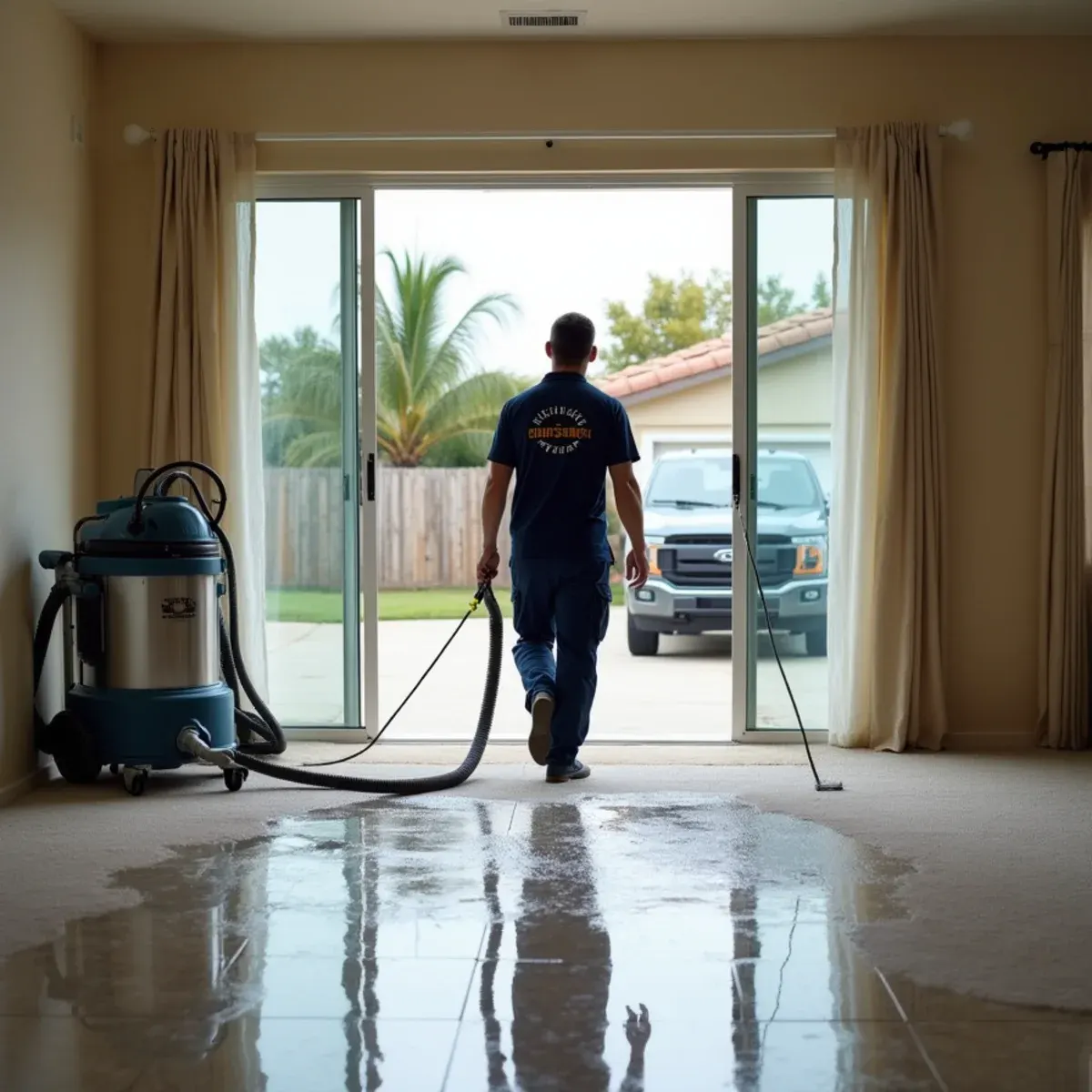
A thousand-square-foot house on a small Bellflower lot has no buffer. When a galvanized supply line finally gives up in a 1940s or 1950s home near the Boulevard or over in Mayfair, there isn't a big open plan for the water to thin out across — it reaches three rooms almost immediately, and the hallway carries it to the rest. Add eighty-year-old systems that were never designed to last this long, and the failures tend to arrive with volume rather than as a slow weep. Speed of extraction is what limits the damage.
The apartment stock adds a second clock. A large share of Bellflower housing is multi-family, and in a two-story building a kitchen supply failure upstairs becomes a ceiling collapse downstairs, often before the upstairs tenant has found the shutoff. On those calls we extract the source unit while a second technician gets into the unit below, because water sitting above a drywall ceiling is both a damage problem and a safety problem. We work with property managers on access, and we document unit by unit so the claim doesn't turn into an argument later.
What Bellflower Changes About Water Extraction
1Original galvanized fails with volume
Eighty-year-old galvanized supply lines corrode until the wall thins, then open suddenly rather than seeping. That produces a lot of water fast in a small house. It also means the pipe is likely to be in similar condition elsewhere. We extract and dry the loss, but we'll say plainly that a repair at one point in an original galvanized system isn't the same as fixing the system.
2Downstairs units are the priority
In Bellflower's two-story apartment buildings, gravity does the spreading for you. We treat the unit below as part of the same loss from the first minute — controlled release of trapped ceiling water, extraction of that unit's flooring, and separate documentation. Waiting for the ceiling to show damage means waiting for it to fail with people underneath it.
3Small lots complicate truck staging
Narrow streets, tight driveways and street parking along the Boulevard and Rosecrans corridors mean the truck often can't get close. We plan a hose route in before unloading and use portable extraction units inside when the run is too long for good lift. It's a small logistical thing that decides how quickly the first gallon comes out.
How the Work Runs
The method is the same one we use on every water extraction job, documented to the IICRC S500:2025 standard. Here it is in short — the full water extraction & removal process explains each stage in detail.
- Bulk removal with submersible pumps
- Truck-mounted extraction on carpet and pad
- Hard-surface and specialty extraction
- Cavity and void extraction
- Removing what cannot be saved
- Post-extraction moisture reading
The Bellflower Background Worth Knowing
Galvanized steel was the standard supply pipe when Bellflower was being built, and it fails from the inside out. The zinc lining wears through, the steel underneath corrodes, and scale builds on the interior wall until the pipe is a fraction of its original diameter. Narrower pipe means faster, more turbulent water, which chews at elbows and threaded fittings until one of them lets go. Hot lines corrode faster than cold, which is why hot water pressure is usually the first thing to drop. Eighty years is well past any service life anyone intended when this was installed.
There is more on the housing stock, drainage and plumbing history of this city on our water damage restoration in Bellflower page.
Bellflower at a glance
- Dominant construction era
- 1940–1960
- Foundation type
- slab on grade
- Supply piping found here
- original galvanized steel, early copper
- Drain line materials
- cast iron
- Terrain and water table
- flat, moderate water table
- Most common local failure
- original galvanized supply lines and cast-iron laterals failing together in the same decade
- Highest-value local prevention
- scoping the sewer lateral, which on a house this age has usually never been looked at
What It Costs in Bellflower
We do not quote a number over the phone before seeing the property — anyone who does is guessing. The variables that actually move the price on a water extraction job are volume and depth of water, flooring type, contamination level, and they are broken down in full on the water extraction & removal page. The assessment and the written estimate are free anywhere in Bellflower, day or night, with no obligation.
Water Extraction Questions from Bellflower Homeowners
Stay out from under the bulge. Trapped water in a ceiling can weigh a lot and drywall fails without much warning. Move what you can from the room, put a container under any active drip, and turn off electricity to that room at the breaker if fixtures are wet. Notify your property manager so we have access to the unit above — stopping the source is what limits the extraction scope in your unit.
For a typical single-room residential loss, extraction runs one to three hours. Multi-room losses or Category 3 water can take most of a day because of containment setup and material removal. We will give you a realistic timeframe after the walkthrough, before we start.
Often we can save the carpet and only replace the pad, which is the cheaper and less disruptive path. The deciding factors are water category, how long it sat, and whether the pad is a moisture barrier type. Clean water caught quickly usually means the carpet stays.
It is the most common gap we see here. A cast iron lateral that age has corroded along the bottom, the joints have shifted, and the parkway trees on most Bellflower streets have had seventy years to find them. A camera inspection costs a small fraction of a sewage remediation, and on a line that has never been scoped it usually finds something worth knowing about before it finds you at two in the morning.