
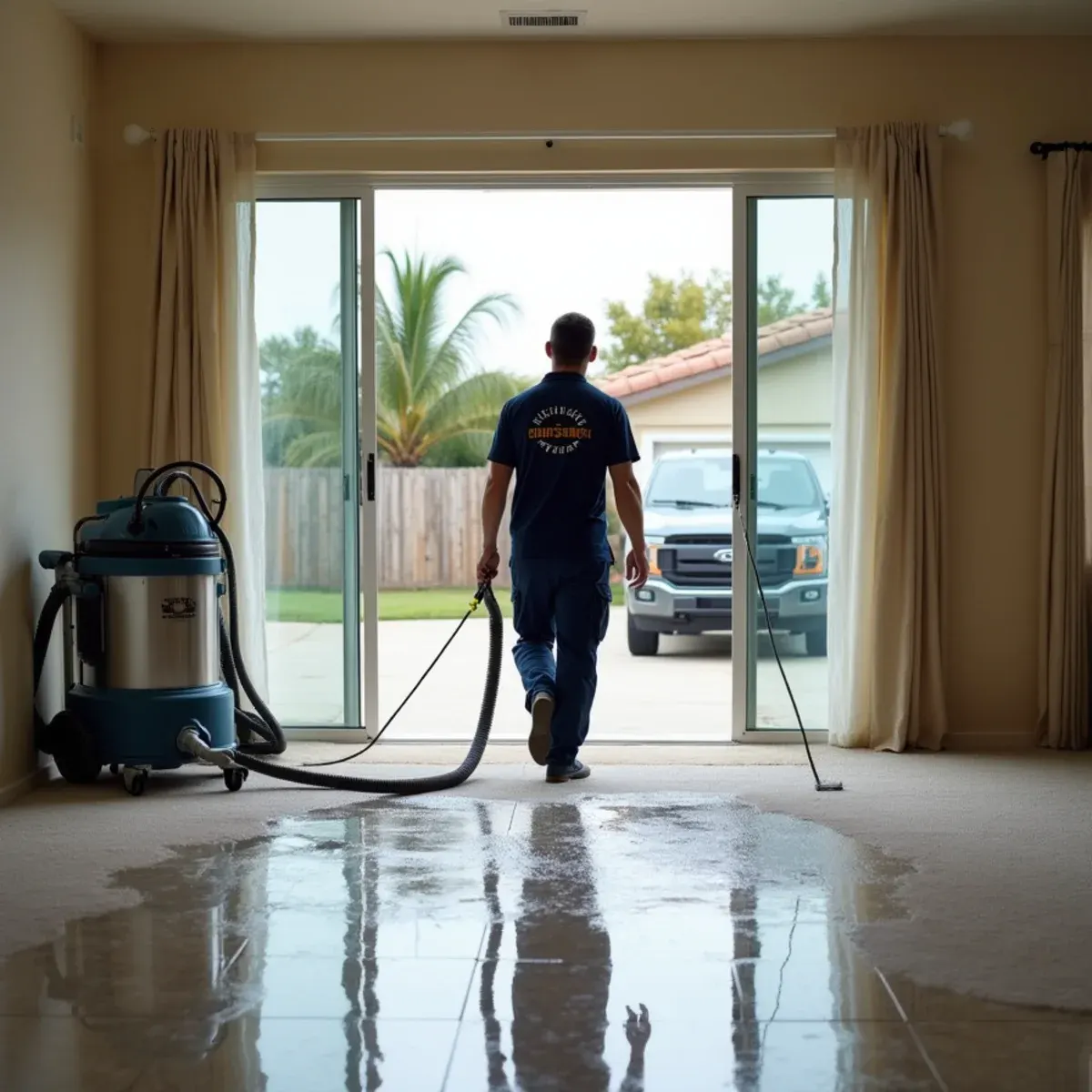
Roughly 17,500 homes went up here between 1950 and 1953, some days at close to a hundred a day. That means Lakewood's plumbing doesn't just share a decade, it shares a three-year installation window — and the original galvanized steel is now failing on schedule. Zinc wears through, steel corrodes, scale narrows the bore, velocity climbs, and eventually a fitting lets go. When it does, it usually does so inside a wall at full supply pressure, which is why these losses put down real standing water instead of a slow, polite stain.
The layouts work in our favor. In these houses the kitchen, bathroom and laundry cluster around shared plumbing walls, so before we walk in we already expect three rooms to be involved and expect water to have run under the hall flooring between them. Extraction follows the same sequence every time: pump anything standing, weighted passes over carpet until the pad genuinely stops giving water up, then hard-surface and cavity extraction along the shared wall. If those walls are already open for the repair, that is by far the cheapest moment to repipe.
What Lakewood Changes About Water Extraction
1Shared plumbing walls flood three rooms
The wet core layout that made these homes fast to build also concentrates the damage. A failure inside the shared wall drains into the kitchen, the bath and the laundry more or less at once, and then under the hallway connecting them. We scope all three from the start rather than treating the room where you first saw water as the whole job, because in this housing stock it almost never is.
2Galvanized failures release water fast
Seventy-year-old galvanized doesn't weep, it opens. A scaled, eroded fitting under pressure puts down volume quickly, so the first priority is bulk removal — submersible pump and truck-mounted extraction — before any drying equipment comes off the truck. Consumer shop vacs are hopeless against this. They pull the surface film and leave the pad fully saturated underneath, which reads as progress and isn't.
3Open walls are a repiping opportunity
After extraction, some drywall along that shared wall is coming out regardless. That's the moment to price a repipe, while the cavity is already accessible and you're already displaced. Doing it later as a standalone project means paying again to open the same walls. We'll flag it plainly and leave the decision to you and your plumber — we don't repipe, and we're not selling you one.
How the Work Runs
The method is the same one we use on every water extraction job, documented to the IICRC S500:2025 standard. Here it is in short — the full water extraction & removal process explains each stage in detail.
- Bulk removal with submersible pumps
- Truck-mounted extraction on carpet and pad
- Hard-surface and specialty extraction
- Cavity and void extraction
- Removing what cannot be saved
- Post-extraction moisture reading
The Lakewood Background Worth Knowing
Galvanized steel supply piping was standard when Lakewood was built, and it fails in a specific and predictable way. The zinc coating protecting the steel wears through from the inside, the steel corrodes, and scale builds up on the interior wall — narrowing the pipe over decades. As the diameter shrinks, water velocity and turbulence increase, which accelerates the erosion at elbows and fittings until a thin spot lets go.
There is more on the housing stock, drainage and plumbing history of this city on our water damage restoration in Lakewood page.
Lakewood at a glance
- Dominant construction era
- 1950–1953
- Foundation type
- slab on grade
- Supply piping found here
- original galvanized steel
- Drain line materials
- cast iron
- Terrain and water table
- flat, moderate water table
- Most common local failure
- seventy-year-old galvanized supply lines letting go at a scaled, eroded fitting
- Highest-value local prevention
- repiping while walls are already open for a repair, rather than as a separate project later
What It Costs in Lakewood
We do not quote a number over the phone before seeing the property — anyone who does is guessing. The variables that actually move the price on a water extraction job are volume and depth of water, flooring type, contamination level, and they are broken down in full on the water extraction & removal page. The assessment and the written estimate are free anywhere in Lakewood, day or night, with no obligation.
Water Extraction Questions from Lakewood Homeowners
Completely normal, and it's a function of how the tract was built. The kitchen, bath and laundry share plumbing walls so the builder could run one wet core per house, which means a single failure inside that wall feeds multiple rooms at once. It isn't two leaks. We meter every room adjoining that wall plus the hallway between them, because water travels under the flooring in the connecting space more often than not.
For a typical single-room residential loss, extraction runs one to three hours. Multi-room losses or Category 3 water can take most of a day because of containment setup and material removal. We will give you a realistic timeframe after the walkthrough, before we start.
Often we can save the carpet and only replace the pad, which is the cheaper and less disruptive path. The deciding factors are water category, how long it sat, and whether the pad is a moisture barrier type. Clean water caught quickly usually means the carpet stays.
Have it assessed. Seventy-year-old galvanized has exceeded any reasonable service life, and declining pressure or rust-colored water means it is well along. If a repair is already opening walls, that is the cheapest moment you will ever get to repipe — the demolition and patching are already in the scope.