
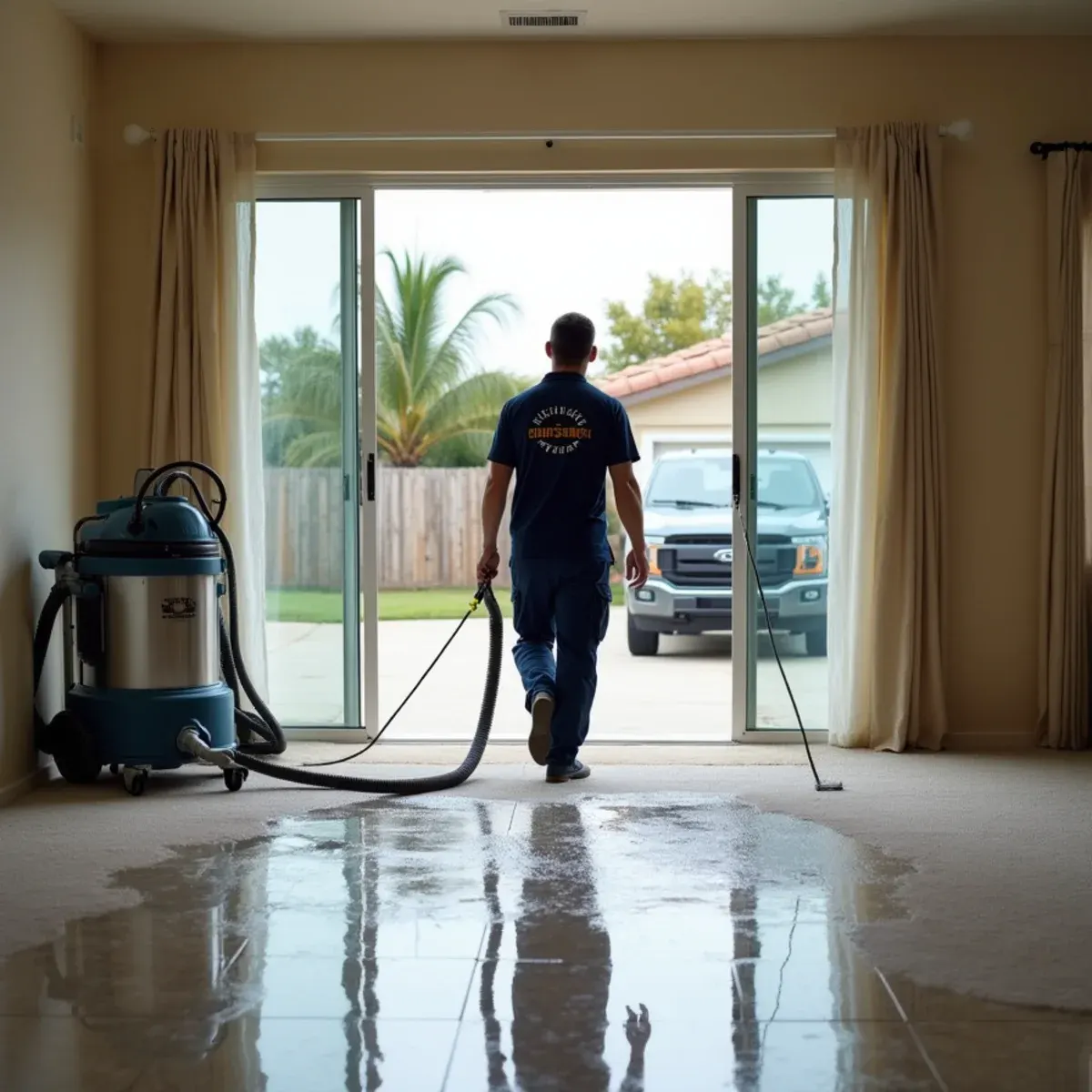
Cerritos was master-planned through the late 1960s and 1970s, and it shows: consistent construction, well-kept homes, and a far higher proportion of two-story houses than the cities on either side. That last detail is what matters most for extraction. When a line fails upstairs, water enters an enclosed floor assembly and travels laterally along the joist bays. It can surface on a ceiling twenty feet from the source, or not surface at all until the drywall is already carrying more weight than it was built to hold.
There's a timing story here too. The under-slab copper in these homes is only now entering the failure window that 1950s and 1960s cities have been living through for years. We're seeing first-time slab leaks in houses whose owners have never had a plumbing problem in forty years of ownership. On the ground floor that's conventional work — pump, weighted passes over carpet, remove unsalvageable pad. Upstairs losses near Cerritos Regional Park or over toward the Coyote Creek side are cavity work: controlled openings, then extraction from inside the assembly.
What Cerritos Changes About Water Extraction
1Floor cavities move water sideways
In a two-story home the joist bays act like channels. Water introduced at one end runs the length of the bay and pools wherever the assembly dips, which is why a visible ceiling stain is a poor guide to the actual wet area. We map the underside with meters and thermal imaging first, then open where readings say to open, and extract from inside the cavity rather than hoping it dries through drywall.
2Two-story losses need two work zones
We run the upper floor and the ceiling below simultaneously. Weighted extraction upstairs stops the pad from continuing to feed the assembly while cavity extraction below removes what already dropped. Working one and then the other lets the second zone keep getting worse while you're occupied with the first. It takes more crew on site at once, which is why we ask how many levels are involved when you call.
3First slab leaks in forty-year homes
Owners here are often facing their first plumbing failure ever, so the response is slower than in a city where everyone's neighbor has already had one. Under-slab copper from the 1970s is entering its failure window now. An annual meter test — shut every fixture, watch the meter for movement — costs nothing and catches these before they become an extraction job.
How the Work Runs
The method is the same one we use on every water extraction job, documented to the IICRC S500:2025 standard. Here it is in short — the full water extraction & removal process explains each stage in detail.
- Bulk removal with submersible pumps
- Truck-mounted extraction on carpet and pad
- Hard-surface and specialty extraction
- Cavity and void extraction
- Removing what cannot be saved
- Post-extraction moisture reading
The Cerritos Background Worth Knowing
Cerritos has a considerably higher proportion of two-story homes than the single-story tract cities around it, and that changes the geometry of every water loss. A failure on the second floor does not stay there — it goes through the floor assembly into the ceiling below and spreads laterally across the joists before it drops.
There is more on the housing stock, drainage and plumbing history of this city on our water damage restoration in Cerritos page.
Cerritos at a glance
- Dominant construction era
- 1965–1985
- Foundation type
- slab on grade
- Supply piping found here
- under-slab copper
- Drain line materials
- cast iron, ABS
- Terrain and water table
- flat, moderate water table
- Most common local failure
- upper-floor failures that spread laterally through the enclosed floor assembly before dropping through a ceiling well away from the source
- Highest-value local prevention
- the annual meter test, since 1970s under-slab copper is only now entering its failure window here
What It Costs in Cerritos
We do not quote a number over the phone before seeing the property — anyone who does is guessing. The variables that actually move the price on a water extraction job are volume and depth of water, flooring type, contamination level, and they are broken down in full on the water extraction & removal page. The assessment and the written estimate are free anywhere in Cerritos, day or night, with no obligation.
Water Extraction Questions from Cerritos Homeowners
That's the classic Cerritos two-story pattern. Water escaped into the floor assembly and traveled along a joist bay before finding a low point in the ceiling below, so the surface at the source dried while the cavity stayed wet. We meter both levels, use thermal imaging to trace the wet bay, then make a small controlled opening at the low point and extract from inside. That opening is almost always smaller than what the water would eventually cause.
For a typical single-room residential loss, extraction runs one to three hours. Multi-room losses or Category 3 water can take most of a day because of containment setup and material removal. We will give you a realistic timeframe after the walkthrough, before we start.
Often we can save the carpet and only replace the pad, which is the cheaper and less disruptive path. The deciding factors are water category, how long it sat, and whether the pad is a moisture barrier type. Clean water caught quickly usually means the carpet stays.
Usually fifteen to twenty minutes. Cerritos borders Cypress across Coyote Creek, so it is one of our closest service areas and the 60-minute commitment applies fully.