
Most Cerritos homeowners have never seen water in the house, and that is exactly the risk. The city was master-planned through the late sixties and seventies with drainage designed in, the stock is consistent and well maintained, and Coyote Creek along the Cypress border handles a great deal of water quietly most years. So flood coverage gets declined, the garage becomes storage for everything that matters, and when a storm finally overwhelms a local drain the loss lands on a household with no policy that responds to ground water.
The building stock does give something back. A far higher share of two-story homes than surrounding cities means a flood takes the ground floor and leaves the upstairs intact, so containment can keep half the house livable while the downstairs is opened up. The tracts are consistent enough that we can predict the wall assembly and slab detail before walking in, which shortens scoping. And under-slab copper from the seventies is only now entering its failure window, so source determination here is not a formality.
What Cerritos Changes About Flood Cleanup
1Coyote Creek is the local variable
The neighborhoods along the creek toward the Cypress line behave differently in a heavy storm than the interior tracts near Los Cerritos Center. Saturated ground and a full channel mean surface water has nowhere to infiltrate and moves toward the lowest doorways. If you are on that side of the city, exterior grading and the condition of your area drains matter far more than they do a mile east.
2Two stories keep half the house working
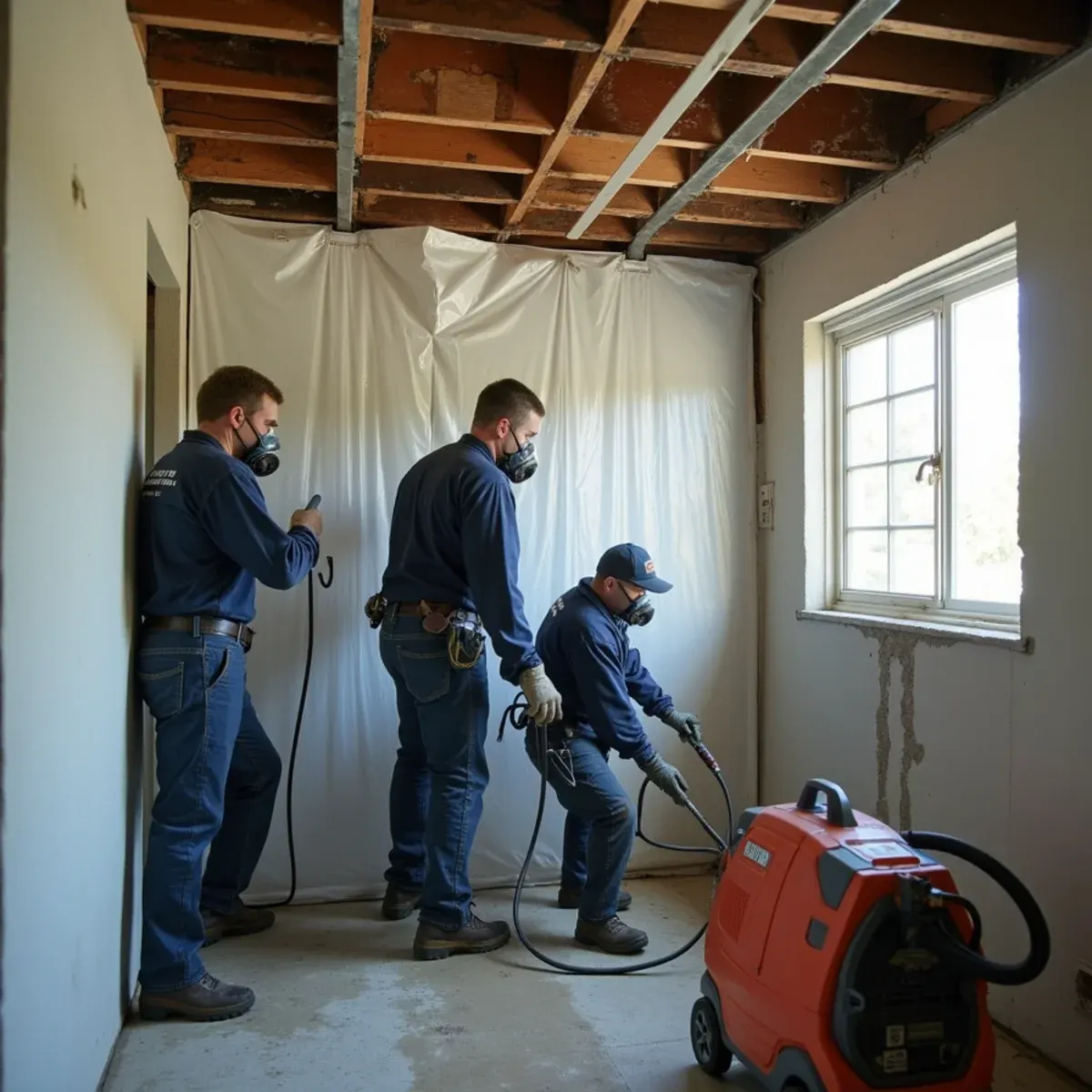
We contain the ground floor, exhaust negative air out the front, and keep the stairs and upper level sealed and usable, so bedrooms stay in service while flooring, base cabinetry and lower drywall come out below. The floor assembly between levels gets its own attention, because a saturated ground-floor ceiling cavity is the one path that carries the problem upward into dry space.
3Consistent tracts speed accurate scoping
Master-planned construction means homes on a street share slab detail, wall assembly and flooring generation. We know what is under the tile before we lift it and where the cavity insulation stops. That shortens investigation and reduces exploratory cutting, which matters most on an uninsured loss where every hour of labor comes directly out of the homeowner's pocket.
How the Work Runs
The method is the same one we use on every flood cleanup job, documented to the IICRC S500:2025 standard. Here it is in short — the full flood damage cleanup process explains each stage in detail.
- Safety assessment and utility check
- Containment and negative air
- Documentation and contents triage
- Extraction and controlled demolition
- Cleaning and disinfection
- Structural drying and clearance
The Cerritos Background Worth Knowing
Cerritos has a considerably higher proportion of two-story homes than the single-story tract cities around it, and that changes the geometry of every water loss. A failure on the second floor does not stay there — it goes through the floor assembly into the ceiling below and spreads laterally across the joists before it drops.
There is more on the housing stock, drainage and plumbing history of this city on our water damage restoration in Cerritos page.
Cerritos at a glance
- Dominant construction era
- 1965–1985
- Foundation type
- slab on grade
- Supply piping found here
- under-slab copper
- Drain line materials
- cast iron, ABS
- Terrain and water table
- flat, moderate water table
- Most common local failure
- upper-floor failures that spread laterally through the enclosed floor assembly before dropping through a ceiling well away from the source
- Highest-value local prevention
- the annual meter test, since 1970s under-slab copper is only now entering its failure window here
What It Costs in Cerritos
We do not quote a number over the phone before seeing the property — anyone who does is guessing. The variables that actually move the price on a flood cleanup job are how high the water reached, how long it sat before extraction, contents volume in the flooded area, and they are broken down in full on the flood damage cleanup page. The assessment and the written estimate are free anywhere in Cerritos, day or night, with no obligation.
Flood Cleanup Questions from Cerritos Homeowners
We do not sell insurance and will not tell you what to buy, but the mechanics are worth knowing: your homeowners policy almost certainly excludes ground-source water entirely, so a storm flood comes out of pocket unless you carry a separate flood policy. That holds whether or not you sit in a mapped high-risk zone. If you do flood uninsured, tell us — we scope differently, prioritize what saves you money, and stop where stopping is defensible.
Yes. Water that crossed soil, pavement, or a storm drain is Category 3 by IICRC classification regardless of appearance — it carries bacteria, fuel and oil residue, lawn chemicals, and whatever else was on the ground. Do not walk through it in open shoes, and keep children and pets out of the area entirely.
If the water came from outside across the ground, almost certainly not — that requires separate flood insurance. If it came from a failed water heater, a burst pipe, or a supply line inside the garage, it is usually covered. We document the source carefully because that distinction determines everything.
Usually fifteen to twenty minutes. Cerritos borders Cypress across Coyote Creek, so it is one of our closest service areas and the 60-minute commitment applies fully.