
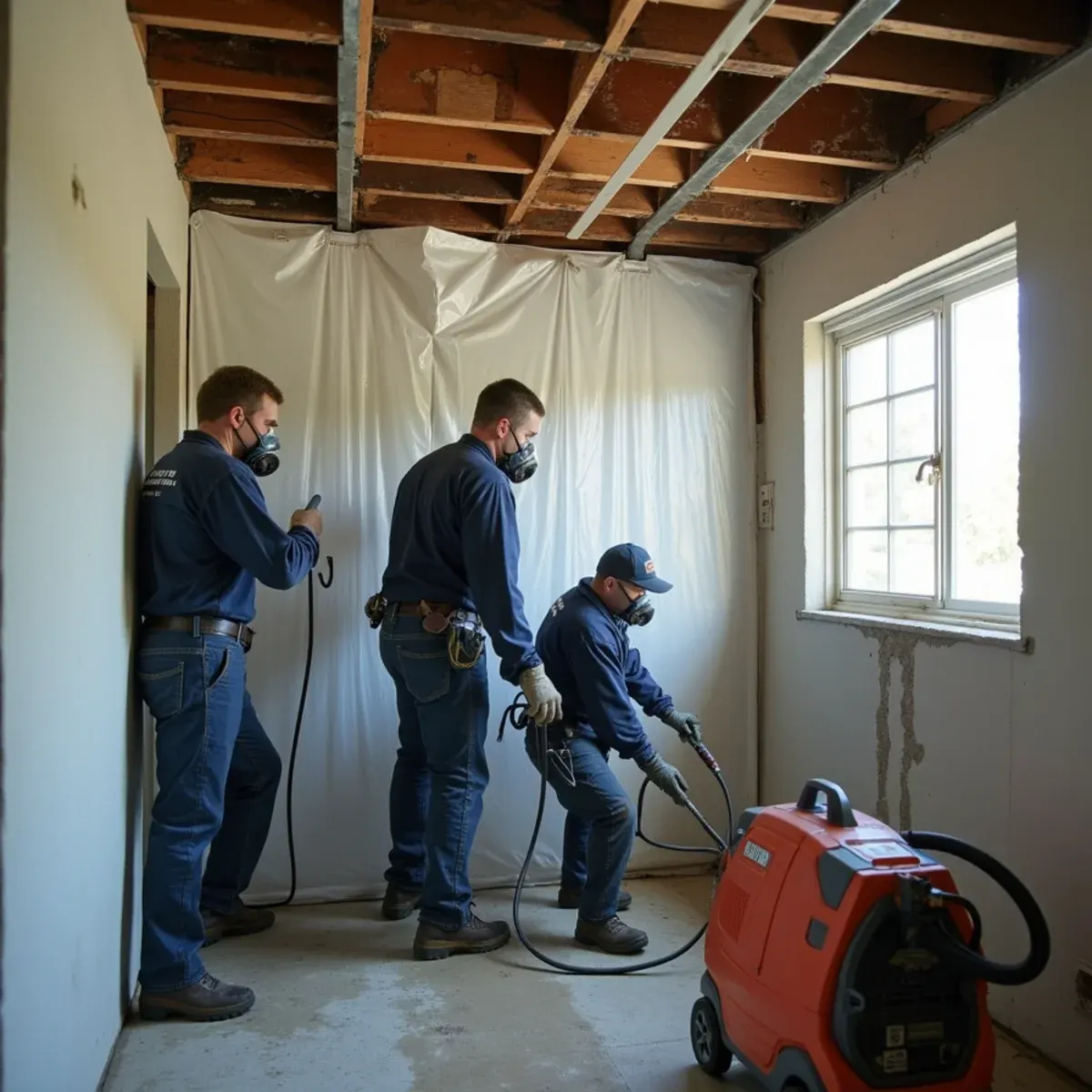
A Carson mobile home flood usually announces itself as a soft spot. Water from the yard or the park drive gets under the coach, the polyethylene belly wrap beneath the floor catches it, and instead of draining away it pools in the wrap against the underside of particleboard decking. Nothing shows in the room until the floor gives slightly underfoot near a wall or a doorway. By then the decking has been wet for a while and the insulation in the wrap has been holding contaminated water the entire time.
Carson was incorporated in 1968 on former ranch, oil-field and industrial land, and the housing mix reflects that: 1950s-to-1970s slab tract through Scottsdale, Carson Park and Victoria, an unusually large mobile home park population, and refinery and logistics industry immediately adjacent. The water table is shallow and the ground is flat, so storm water sits rather than runs. Runoff crossing industrial frontage along Del Amo picks up a load before it ever reaches a home. The same belly-wrap construction we deal with in Stanton and Midway City is here in volume.
What Carson Changes About Flood Cleanup
1Belly wrap has to be opened, not dried
You cannot dry a manufactured-home floor through the decking. We cut and open the belly wrap from below, drain the trapped water, remove saturated fiberglass insulation, disinfect, then dry the decking and framing directly before closing the wrap back up with proper repair material. Anyone who sets fans in the room and calls it finished has left a wet sandwich under your floor.
2Skirting and tie-downs affect access
Park spacing in Carson is tight and skirting is often permanent rather than removable panels. Getting under a coach to reach the belly wrap means planned removal and reinstallation, plus coordination with park management for access, power and disposal staging. We handle that conversation ourselves rather than leaving a resident to negotiate it while their floor is still wet.
3Refinery-adjacent runoff raises the caution level
Ground water in Carson has frequently crossed industrial and logistics ground before it reaches housing. It is Category 3 regardless, but here we work in full PPE from the start, contain before extraction, and dispose of porous material rather than attempting salvage. If the water carries an odor or a sheen we do not recognize, we stop and bring in testing rather than drying over it.
How the Work Runs
The method is the same one we use on every flood cleanup job, documented to the IICRC S500:2025 standard. Here it is in short — the full flood damage cleanup process explains each stage in detail.
- Safety assessment and utility check
- Containment and negative air
- Documentation and contents triage
- Extraction and controlled demolition
- Cleaning and disinfection
- Structural drying and clearance
The Carson Background Worth Knowing
Manufactured homes are built with the floor deck, usually particleboard or OSB, sitting on a steel frame, with batt insulation below it and a vapor barrier belly wrap stapled underneath to hold everything in place. Supply lines run through that cavity. When one leaks, the water does not run out onto the ground where you would see it. The belly wrap catches and holds it, the insulation soaks it up, and you now have a sealed reservoir under your floor with no path to evaporate. It can sit there for months before anything shows upstairs.
There is more on the housing stock, drainage and plumbing history of this city on our water damage restoration in Carson page.
Carson at a glance
- Dominant construction era
- 1950–1975
- Foundation type
- slab on grade
- Supply piping found here
- galvanized steel, under-slab copper, manufactured-home supply lines
- Drain line materials
- cast iron
- Terrain and water table
- flat, shallow water table
- Most common local failure
- manufactured-home underfloor leaks trapped in the belly wrap, alongside conventional 1960s slab failures
- Highest-value local prevention
- treating any soft spot in a manufactured-home floor as moisture until a meter proves otherwise
What It Costs in Carson
We do not quote a number over the phone before seeing the property — anyone who does is guessing. The variables that actually move the price on a flood cleanup job are how high the water reached, how long it sat before extraction, contents volume in the flooded area, and they are broken down in full on the flood damage cleanup page. The assessment and the written estimate are free anywhere in Carson, day or night, with no obligation.
Flood Cleanup Questions from Carson Homeowners
Usually you own the coach while the park owns the land and the utilities up to your space, so cleanup inside and underneath your home is generally yours and drainage or common-area causes are theirs. We are not in a position to settle that, but we can document it: where water entered the space, how deep it stood, the condition of the park's drainage, and time-stamped readings. Bring that to management. Either way, standard homeowners and mobile home policies exclude ground flooding.
Yes. Water that crossed soil, pavement, or a storm drain is Category 3 by IICRC classification regardless of appearance — it carries bacteria, fuel and oil residue, lawn chemicals, and whatever else was on the ground. Do not walk through it in open shoes, and keep children and pets out of the area entirely.
If the water came from outside across the ground, almost certainly not — that requires separate flood insurance. If it came from a failed water heater, a burst pipe, or a supply line inside the garage, it is usually covered. We document the source carefully because that distinction determines everything.
By locating it rather than arguing about it. The dividing line is the connection point where the park's service meets your home. Upstream of that is the park's responsibility, downstream is yours. We open the belly wrap where water is pooling, trace the wet path back to its source, and photograph what we find with the connection in frame. That documentation settles the question. Guessing from where the wet spot showed up inside is unreliable, because water travels along the frame first.