
In Paramount the water has already been somewhere before it reaches your floor. This is one of the most industrially dense cities in the area, with housing packed tightly between commercial corridors and very little permeable ground left on most lots. Runoff that has sheeted across a metal-finishing yard, a truck lot or the alley behind a plant carries more than the bacterial load we assume in an ordinary residential flood. It gets handled as Category 3 either way. It also gets handled with more caution, and we would rather over-prepare than find out afterward.
The city was assembled from the old Hynes and Clearwater communities on dairy and hay land, then built out with dense postwar housing between 1945 and 1965 — slab on grade, original galvanized supply, cast-iron drains, small lots with narrow separations. The Los Angeles River channel runs the western edge. Flat ground plus paved lots plus almost no absorption means storm water has nowhere to go but toward the low points, and here the low point is often a house or a small apartment building rather than an empty field.
What Paramount Changes About Flood Cleanup
1Unknown contaminants change the PPE and disposal
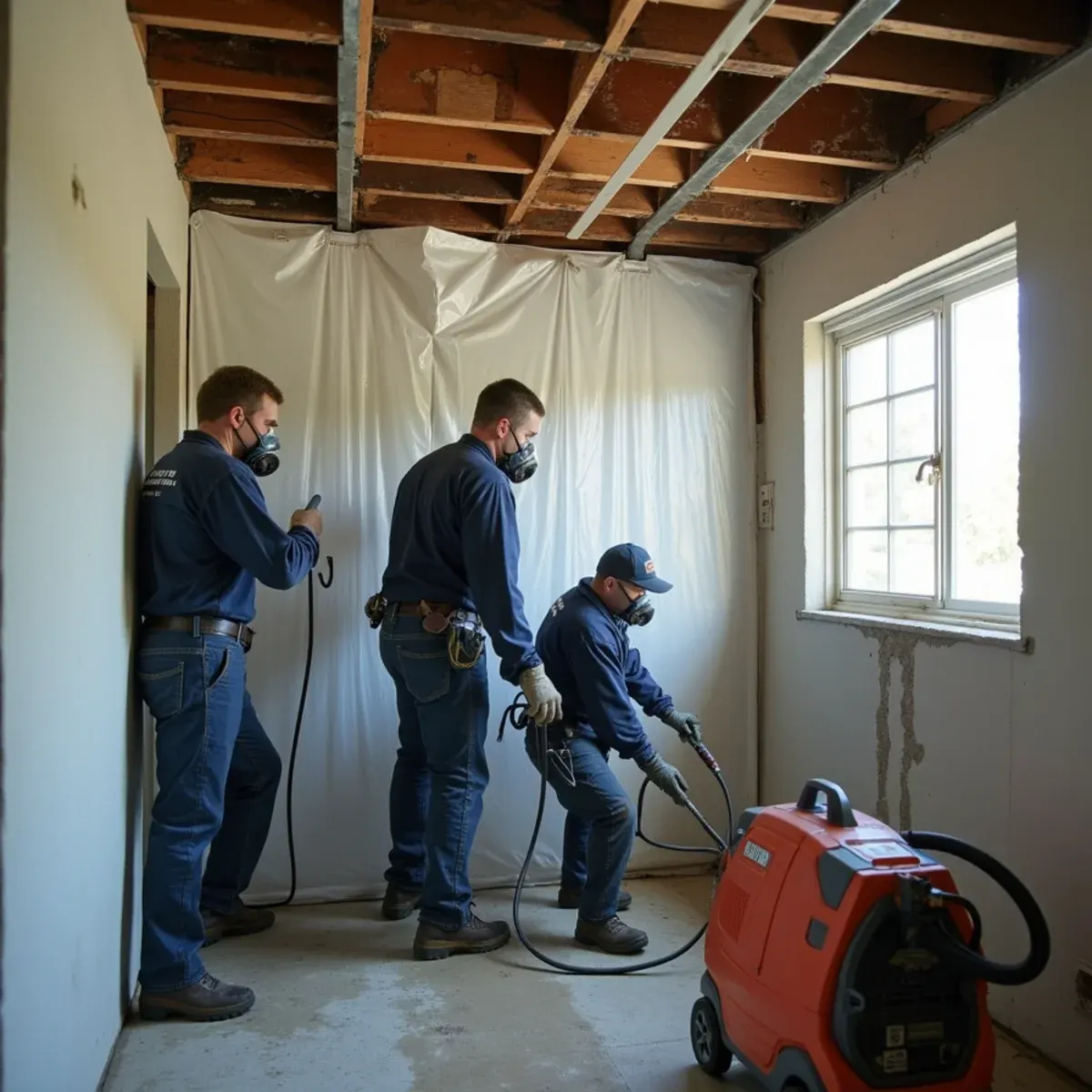
When runoff has crossed industrial ground we do not assume we know what is in it. Crews work in full PPE, containment goes up before extraction rather than after, and porous material that absorbed the water is bagged and disposed of rather than cleaned and reinstalled. If there is visible sheen, an unusual odor, or staining we do not recognize, we say so and bring in the right specialist instead of guessing.
2Residential and commercial losses on one block
A Paramount storm regularly puts us in a house and a warehouse a few hundred feet apart, and the two need different handling — different containment scale, different equipment, different documentation for very different policies. We staff them separately rather than treating a commercial floor as an oversized house. Being about fourteen minutes from our Cypress base helps us cover both quickly.
3Paved lots leave water nowhere to sink
On a typical Paramount lot most of the ground is concrete, asphalt or structure. Rain that would soak in elsewhere simply travels here, and the area drains meant to handle it are usually old and often partly blocked. That is why flooding shows up at the same addresses year after year. We note drain condition and flow path while we work, because it is the one useful thing to come out of the loss.
How the Work Runs
The method is the same one we use on every flood cleanup job, documented to the IICRC S500:2025 standard. Here it is in short — the full flood damage cleanup process explains each stage in detail.
- Safety assessment and utility check
- Containment and negative air
- Documentation and contents triage
- Extraction and controlled demolition
- Cleaning and disinfection
- Structural drying and clearance
The Paramount Background Worth Knowing
On a typical Paramount lot, the house, the driveway, the walkways and the rear slab cover most of the parcel. What is left is a narrow side yard, and everything that lands on the roof and the paving is supposed to leave through a couple of small area drains. That system has no margin. When a grate silts up, when a downspout dumps straight onto paving, or when the outlet at the curb has been crushed by a parked truck, the water has no soil to soak into and nowhere else to be. It ponds against the slab edge and comes in at the lowest threshold, which is usually a garage or a side door.
There is more on the housing stock, drainage and plumbing history of this city on our water damage restoration in Paramount page.
Paramount at a glance
- Dominant construction era
- 1945–1965
- Foundation type
- slab on grade
- Supply piping found here
- original galvanized steel, copper
- Drain line materials
- cast iron
- Terrain and water table
- flat, moderate water table
- Most common local failure
- residential and commercial losses on the same block, needing very different handling
- Highest-value local prevention
- clearing area drains before the season on lots with very little permeable ground
What It Costs in Paramount
We do not quote a number over the phone before seeing the property — anyone who does is guessing. The variables that actually move the price on a flood cleanup job are how high the water reached, how long it sat before extraction, contents volume in the flooded area, and they are broken down in full on the flood damage cleanup page. The assessment and the written estimate are free anywhere in Paramount, day or night, with no obligation.
Flood Cleanup Questions from Paramount Homeowners
Enough to take precautions, not enough to panic. Any ground floodwater is Category 3 under IICRC S500:2025, meaning it is assumed to carry bacteria and other hazards, so keep people and pets out of affected rooms and leave the HVAC off. In Paramount we add caution because runoff so often crosses industrial parcels first. In practice that means full PPE, containment before extraction, and disposal of porous material rather than attempts to save it.
Yes. Water that crossed soil, pavement, or a storm drain is Category 3 by IICRC classification regardless of appearance — it carries bacteria, fuel and oil residue, lawn chemicals, and whatever else was on the ground. Do not walk through it in open shoes, and keep children and pets out of the area entirely.
If the water came from outside across the ground, almost certainly not — that requires separate flood insurance. If it came from a failed water heater, a burst pipe, or a supply line inside the garage, it is usually covered. We document the source carefully because that distinction determines everything.
Almost certainly your area drains. Paramount lots have very little permeable ground, so everything that falls on the roof and the paving has to leave through a couple of small drains. If a grate silts up or the outlet is crushed, the water ponds against the slab and enters at the lowest threshold, which is usually the garage. Rodding the drains and checking the outlet before the season costs far less than drying the garage wall afterward.