
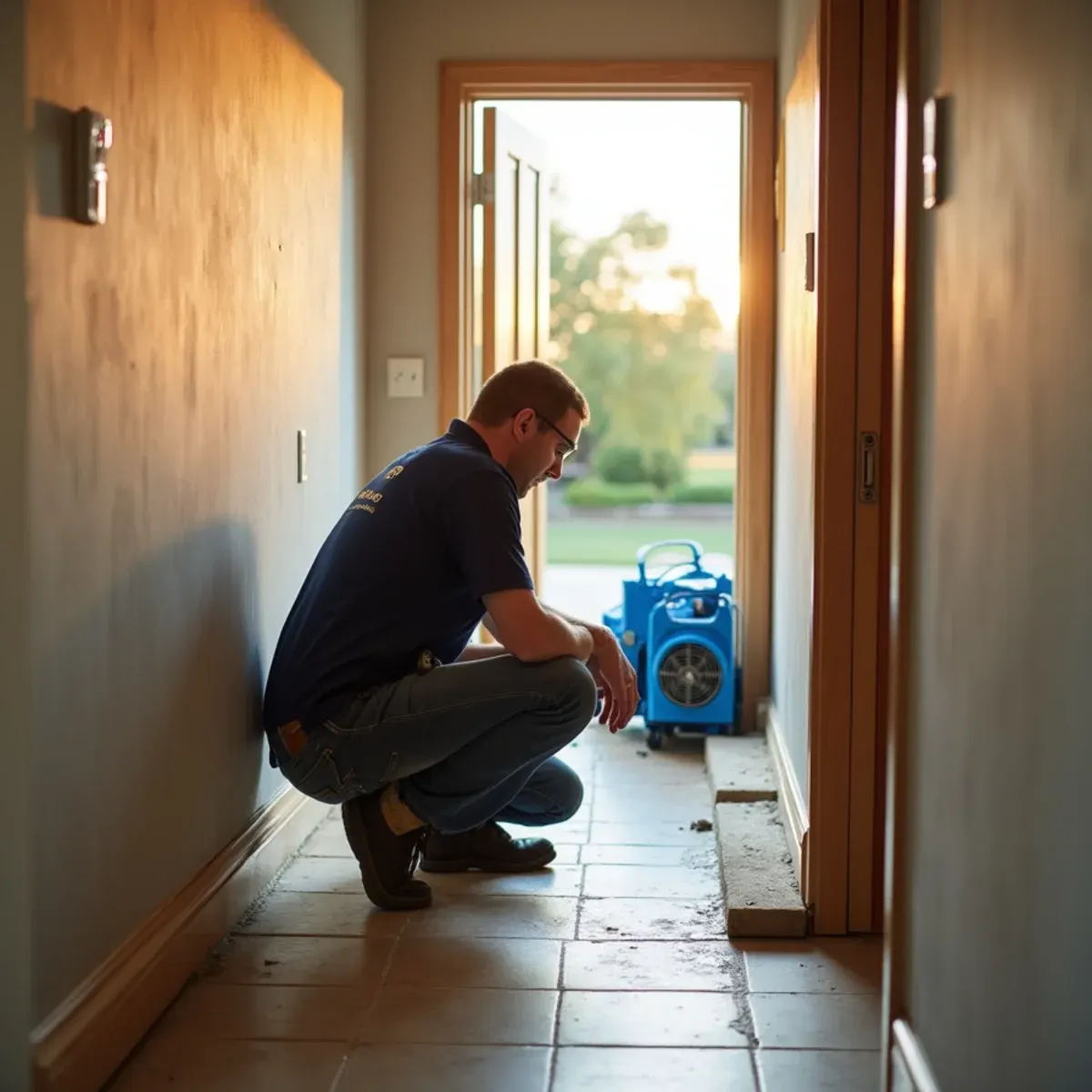
On a lot of Paramount blocks, the house sits fifteen feet off the property line with a machine shop behind the back fence and a driveway barely wider than our truck. That matters on a burst-pipe call, because cavity drying needs equipment placement, condensate routing and power, and there's often nowhere to put any of it except inside the house. We plan the staging before we plan the access. The houses here went up between 1945 and 1965 on the old Hynes and Clearwater dairy land, packed tight, mostly slab, mostly original galvanized with some early copper mixed in.
The other half of our work here is commercial. Tenant spaces and light industrial along the Paramount Boulevard and Rosecrans corridors, where a burst supply line above a suspended ceiling soaks insulation and ceiling tile across an entire bay before anybody arrives in the morning. Those jobs run on a different clock and a different documentation standard than a house does, and we don't treat them the same. We're about fourteen minutes west of our Cypress base and dispatch as fast as conditions allow, day or night.
What Paramount Changes About Burst Pipe Damage
1Tight side yards limit equipment placement
Three feet between the stucco and the fence is not a staging area. We route condensate to an interior drain instead of parking a pump outside, position dehumidifiers for the shortest duct path rather than the most convenient one, and watch total draw so we're not tripping a panel that's been in place since the Eisenhower administration. You'll know where every piece sits and roughly how long it stays.
2Residential and commercial on one block
It's genuinely normal here for a bungalow and a fabrication shop to share a property line. Our crews carry both sets of gear, because the next call on the same street may be either one. Commercial losses involve tenant improvements, suspended ceilings and fire-rated assemblies we can't open casually. Residential losses involve a family that needs their kitchen back. Different urgency, different plan, same dispatch.
3Very little permeable ground per lot
Between the house, the driveway, the slab patio and the shop pad, many Paramount lots have almost no exposed soil left. That changes where water goes during extraction and where exterior moisture sits against the foundation afterward. We check the area drains on arrival, because a blocked one holding standing water against a slab will keep your interior readings from ever settling.
How the Work Runs
The method is the same one we use on every burst pipe damage job, documented to the IICRC S500:2025 standard. Here it is in short — the full burst pipe water damage repair process explains each stage in detail.
- Stop the source
- Locate the failure precisely
- Coordinate the plumbing repair
- Extract and open only what must be opened
- Cavity and structural drying
- Rebuild and finish
The Paramount Background Worth Knowing
On a typical Paramount lot, the house, the driveway, the walkways and the rear slab cover most of the parcel. What is left is a narrow side yard, and everything that lands on the roof and the paving is supposed to leave through a couple of small area drains. That system has no margin. When a grate silts up, when a downspout dumps straight onto paving, or when the outlet at the curb has been crushed by a parked truck, the water has no soil to soak into and nowhere else to be. It ponds against the slab edge and comes in at the lowest threshold, which is usually a garage or a side door.
There is more on the housing stock, drainage and plumbing history of this city on our water damage restoration in Paramount page.
Paramount at a glance
- Dominant construction era
- 1945–1965
- Foundation type
- slab on grade
- Supply piping found here
- original galvanized steel, copper
- Drain line materials
- cast iron
- Terrain and water table
- flat, moderate water table
- Most common local failure
- residential and commercial losses on the same block, needing very different handling
- Highest-value local prevention
- clearing area drains before the season on lots with very little permeable ground
What It Costs in Paramount
We do not quote a number over the phone before seeing the property — anyone who does is guessing. The variables that actually move the price on a burst pipe damage job are how long the line ran before discovery, which floor it happened on, hot line versus cold line, and they are broken down in full on the burst pipe water damage repair page. The assessment and the written estimate are free anywhere in Paramount, day or night, with no obligation.
Burst Pipe Damage Questions from Paramount Homeowners
Mostly inside, and we plan that before we start. On tight Paramount lots we run condensate lines to a nearby interior drain instead of staging a pump outside, place dehumidifiers in the room that gives the shortest duct path, and route power carefully so we're not overloading a fifty-year-old panel. If we do need the side yard for anything, we'll show you exactly what goes where and how long it stays before we move a single thing.
We restore the water damage and coordinate the plumbing repair, working with your plumber or bringing in a licensed one from our network. Handling both under one schedule is what keeps a burst pipe from turning into two weeks of contractor coordination.
More than people expect. A half-inch supply line at typical residential pressure moves in the range of 8 to 10 gallons a minute. That is roughly 500 gallons in an hour — comparable to filling a small backyard pool inside your walls and floor.
Almost certainly your area drains. Paramount lots have very little permeable ground, so everything that falls on the roof and the paving has to leave through a couple of small drains. If a grate silts up or the outlet is crushed, the water ponds against the slab and enters at the lowest threshold, which is usually the garage. Rodding the drains and checking the outlet before the season costs far less than drying the garage wall afterward.