
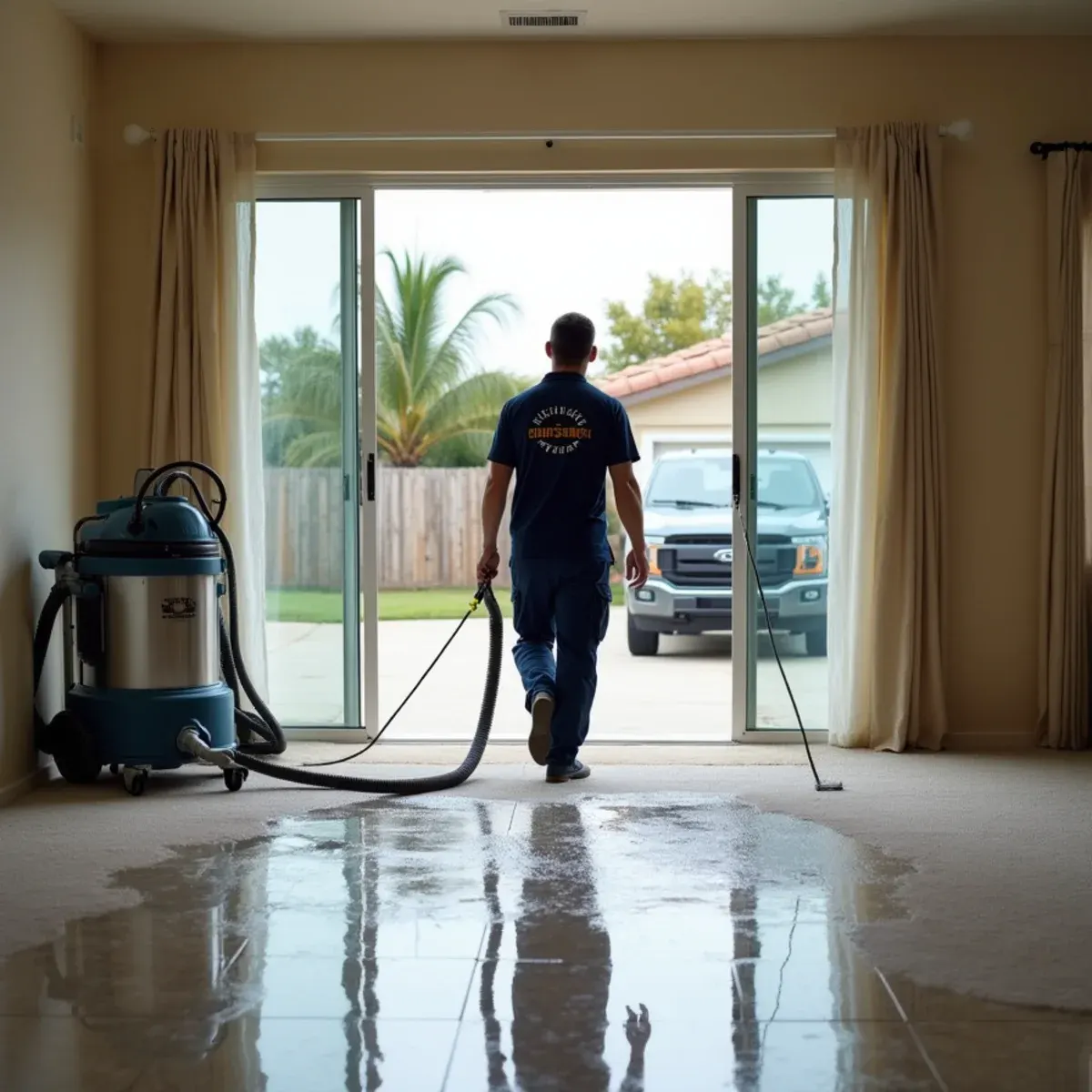
A call in Paramount can be a 1950s house in the old Hynes district with water across the living room, or a manufacturing floor off Somerset with a broken supply line running under racked pallets — sometimes on the same street. The city's industrial density is unusual for its size, and housing sits packed tightly between the commercial corridors on lots with very little permeable ground. That last detail matters more than it sounds: when there's almost no soil to absorb anything, water that reaches a lot has to leave through drains, and if the drains are loaded, it comes toward the building.
The residential losses are what you'd expect from 1945-to-1965 slab construction with original galvanized supply and cast-iron waste. Small rooms, fast spread, carpet and pad holding most of the volume. The commercial losses are a different discipline entirely: large open floors where water travels a long way before anything stops it, equipment and inventory that have to be moved before extraction can even start, and pumping rather than wanding for the first phase. We carry both setups because in Paramount we don't always know which one we're walking into.
What Paramount Changes About Water Extraction
1Very little permeable ground on most lots
Between building footprint, driveway, patio and side-yard concrete, many Paramount lots have almost no absorbent surface left. Storm water has to reach an area drain or it ponds against the slab. When those drains are blocked, water finds the lowest threshold. Before we leave a storm-related extraction, we check where the drains actually discharge — clearing them is the highest-value thing most homeowners here can do.
2Industrial floors need pumps first
On a manufacturing or warehouse floor, wanding standing water is the wrong tool for the first hour. We set submersible pumps at low points and move volume out, then transition to extraction across the slab once the depth is gone. Sealed and coated concrete holds water on the surface longer than it looks, so we squeegee to collection points rather than assuming it will find a drain.
3Product and equipment come off the floor
Commercial extraction in Paramount usually begins with moving things — pallets, raw stock, tooling. Anything sitting directly on a wet slab is wicking. We prioritize moving product to dry ground and blocking what can't move, because extraction under a loaded rack is slow and incomplete, and wet cardboard on a slab becomes a contamination problem within a day.
How the Work Runs
The method is the same one we use on every water extraction job, documented to the IICRC S500:2025 standard. Here it is in short — the full water extraction & removal process explains each stage in detail.
- Bulk removal with submersible pumps
- Truck-mounted extraction on carpet and pad
- Hard-surface and specialty extraction
- Cavity and void extraction
- Removing what cannot be saved
- Post-extraction moisture reading
The Paramount Background Worth Knowing
On a typical Paramount lot, the house, the driveway, the walkways and the rear slab cover most of the parcel. What is left is a narrow side yard, and everything that lands on the roof and the paving is supposed to leave through a couple of small area drains. That system has no margin. When a grate silts up, when a downspout dumps straight onto paving, or when the outlet at the curb has been crushed by a parked truck, the water has no soil to soak into and nowhere else to be. It ponds against the slab edge and comes in at the lowest threshold, which is usually a garage or a side door.
There is more on the housing stock, drainage and plumbing history of this city on our water damage restoration in Paramount page.
Paramount at a glance
- Dominant construction era
- 1945–1965
- Foundation type
- slab on grade
- Supply piping found here
- original galvanized steel, copper
- Drain line materials
- cast iron
- Terrain and water table
- flat, moderate water table
- Most common local failure
- residential and commercial losses on the same block, needing very different handling
- Highest-value local prevention
- clearing area drains before the season on lots with very little permeable ground
What It Costs in Paramount
We do not quote a number over the phone before seeing the property — anyone who does is guessing. The variables that actually move the price on a water extraction job are volume and depth of water, flooring type, contamination level, and they are broken down in full on the water extraction & removal page. The assessment and the written estimate are free anywhere in Paramount, day or night, with no obligation.
Water Extraction Questions from Paramount Homeowners
We dispatch as fast as conditions allow, day or night — no fixed guarantee outside our home city of Cypress. What determines your real start time is access. If we have current after-hours contact, gate and door access, and the location of your main shutoff on file ahead of time, crews begin pumping on arrival instead of waiting for someone to drive in. Setting that up takes one phone call and saves hours.
For a typical single-room residential loss, extraction runs one to three hours. Multi-room losses or Category 3 water can take most of a day because of containment setup and material removal. We will give you a realistic timeframe after the walkthrough, before we start.
Often we can save the carpet and only replace the pad, which is the cheaper and less disruptive path. The deciding factors are water category, how long it sat, and whether the pad is a moisture barrier type. Clean water caught quickly usually means the carpet stays.
Almost certainly your area drains. Paramount lots have very little permeable ground, so everything that falls on the roof and the paving has to leave through a couple of small drains. If a grate silts up or the outlet is crushed, the water ponds against the slab and enters at the lowest threshold, which is usually the garage. Rodding the drains and checking the outlet before the season costs far less than drying the garage wall afterward.