
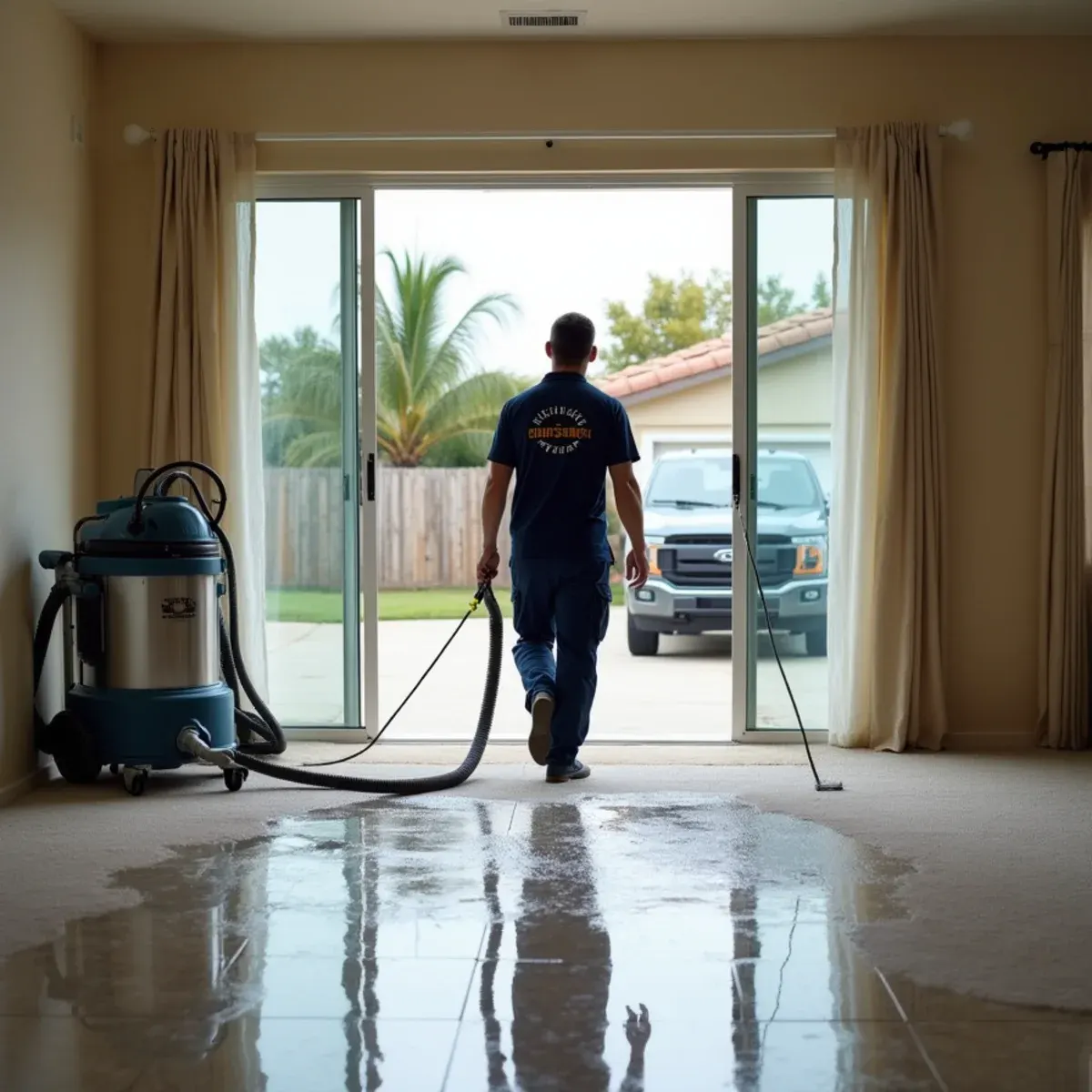
In a manufactured home, the floor is a sandwich, and the bottom layer is a sealed plastic belly wrap designed to keep things out. It also keeps water in. When a supply line lets go inside one of Carson's mobile home parks, water runs down through the particleboard decking and collects in that wrap, where it can sit for weeks with nothing visible above except a floor that feels slightly soft near a wall. Extraction there means getting under the home and cutting controlled drains in the belly board to release what's trapped, then drying the cavity from below.
The rest of Carson is conventional 1950s-to-1975 slab tract in Scottsdale, Carson Park and the Victoria area, with galvanized and under-slab copper supply and cast-iron waste. A shallow water table across the flats means the ground offers less help than you'd like during storm season, and the refinery and logistics industry immediately adjacent brings commercial-scale losses into the same service area. We stage for both, because in one week here we'll do a belly-wrap drain, a slab-leak carpet extraction and a warehouse floor.
What Carson Changes About Water Extraction
1Belly wrap has to be drained, not vacuumed
You cannot extract water out of a sealed underfloor cavity from inside the home. It has to be released from below. We access the crawl area, cut drain points at the low spots of the belly board, let the trapped water out, remove saturated batt insulation, and then dry the cavity and decking directly. Skipping that leaves water against particleboard, which is how these floors fail.
2Soft spots mean moisture until metered
Particleboard decking loses strength when it gets wet and doesn't recover. A floor that gives slightly underfoot near a bathroom or water heater closet is a moisture finding, not a wear finding, until a meter says otherwise. Homeowners in Carson's parks often live with a soft spot for a year. By then the decking usually needs replacement rather than drying.
3Shallow water table under the flats
On the conventional tract side, the shallow table means the soil around a slab is often already near capacity during wet months. That slows outward drainage and keeps slab edges damp, so extracted floors regain moisture more readily than they would inland. We extend monitoring on Carson slab losses rather than closing the job on a single good reading.
How the Work Runs
The method is the same one we use on every water extraction job, documented to the IICRC S500:2025 standard. Here it is in short — the full water extraction & removal process explains each stage in detail.
- Bulk removal with submersible pumps
- Truck-mounted extraction on carpet and pad
- Hard-surface and specialty extraction
- Cavity and void extraction
- Removing what cannot be saved
- Post-extraction moisture reading
The Carson Background Worth Knowing
Manufactured homes are built with the floor deck, usually particleboard or OSB, sitting on a steel frame, with batt insulation below it and a vapor barrier belly wrap stapled underneath to hold everything in place. Supply lines run through that cavity. When one leaks, the water does not run out onto the ground where you would see it. The belly wrap catches and holds it, the insulation soaks it up, and you now have a sealed reservoir under your floor with no path to evaporate. It can sit there for months before anything shows upstairs.
There is more on the housing stock, drainage and plumbing history of this city on our water damage restoration in Carson page.
Carson at a glance
- Dominant construction era
- 1950–1975
- Foundation type
- slab on grade
- Supply piping found here
- galvanized steel, under-slab copper, manufactured-home supply lines
- Drain line materials
- cast iron
- Terrain and water table
- flat, shallow water table
- Most common local failure
- manufactured-home underfloor leaks trapped in the belly wrap, alongside conventional 1960s slab failures
- Highest-value local prevention
- treating any soft spot in a manufactured-home floor as moisture until a meter proves otherwise
What It Costs in Carson
We do not quote a number over the phone before seeing the property — anyone who does is guessing. The variables that actually move the price on a water extraction job are volume and depth of water, flooring type, contamination level, and they are broken down in full on the water extraction & removal page. The assessment and the written estimate are free anywhere in Carson, day or night, with no obligation.
Water Extraction Questions from Carson Homeowners
Very likely yes, and it's sitting where you can't see it. Water from a supply or drain failure drops through the decking into the belly wrap and pools there, held by the plastic. The soft spot you're feeling is particleboard that has already absorbed it. We access the underside, cut drain points to release the trapped water, remove wet insulation, and meter the decking. Where the board has lost integrity, replacement is the honest answer rather than drying.
For a typical single-room residential loss, extraction runs one to three hours. Multi-room losses or Category 3 water can take most of a day because of containment setup and material removal. We will give you a realistic timeframe after the walkthrough, before we start.
Often we can save the carpet and only replace the pad, which is the cheaper and less disruptive path. The deciding factors are water category, how long it sat, and whether the pad is a moisture barrier type. Clean water caught quickly usually means the carpet stays.
By locating it rather than arguing about it. The dividing line is the connection point where the park's service meets your home. Upstream of that is the park's responsibility, downstream is yours. We open the belly wrap where water is pooling, trace the wet path back to its source, and photograph what we find with the connection in frame. That documentation settles the question. Guessing from where the wet spot showed up inside is unreliable, because water travels along the frame first.