
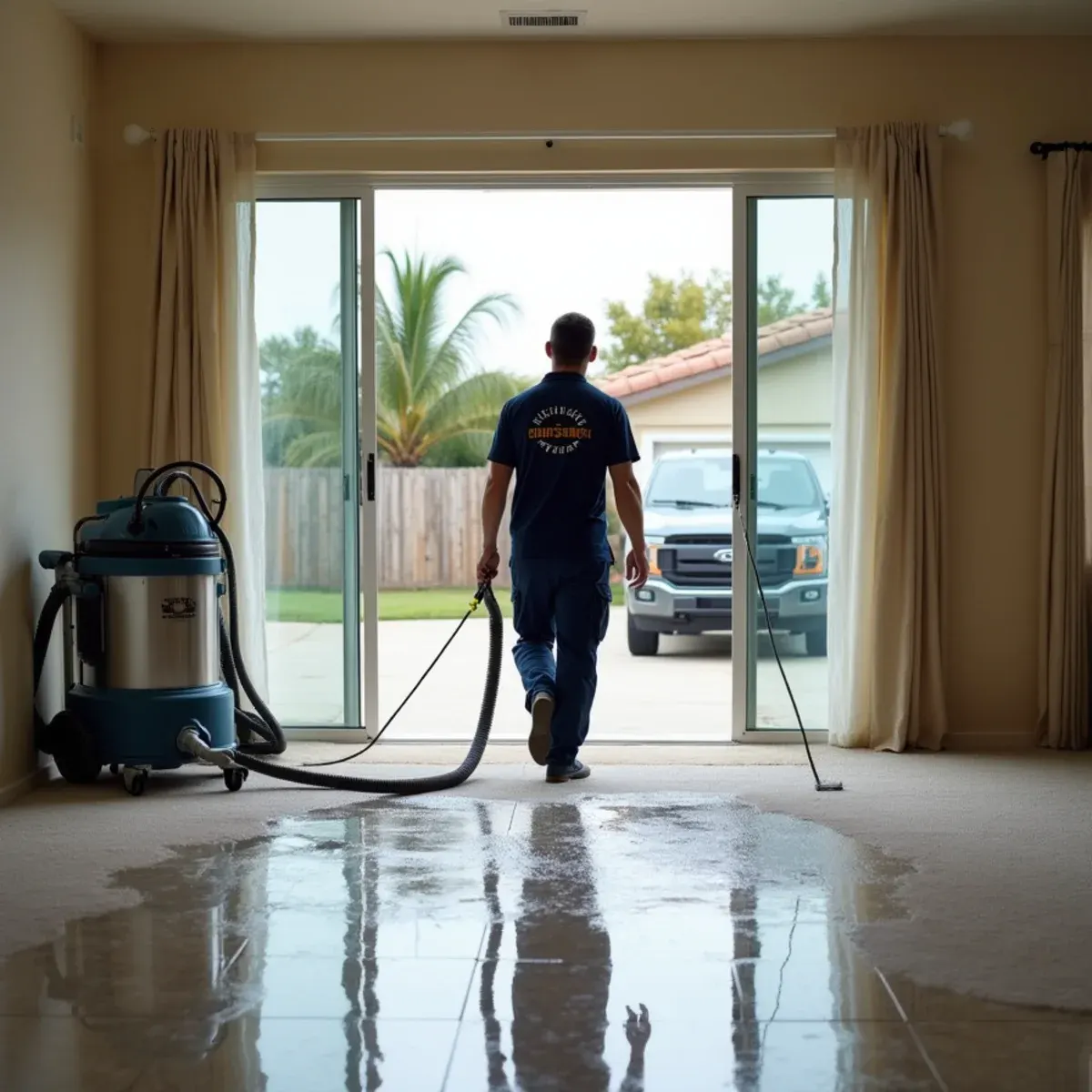
A homeowner in a 1920s house a few blocks off Birch Street and a homeowner in Olinda Ranch can call us the same night with what they'd both describe as a flood, and we would arrive with different equipment. The old oil-town stock downtown has galvanized supply lines that fail from the inside out, small rooms, and in places raised floors — those are slow, contained losses where the water has been finding its way into structure for a while. The hillside tracts up toward Carbon Canyon get fast, dirty water arriving from outside during concentrated storms.
Carbon Canyon concentrates runoff the way a funnel does. When a v-ditch or a slope drain above a Country Hills or Blackstone home plugs, the overflow arrives with velocity, and volume shows up in a garage or a side yard within minutes. Those jobs start with pumps, not wands — get the standing water out of the low point, then deal with what soaked into finishes. Downtown, the same night's work might be a single bathroom where the real job is pulling water out of a wall cavity and a subfloor nobody can see.
What Brea Changes About Water Extraction
1Galvanized failures soak structure before surfacing
Downtown Brea's original supply piping corrodes internally and often weeps inside a wall long before anything shows on a finish surface. When it finally opens up, the framing and sheathing around it are already loaded. Surface extraction handles the visible water in minutes; the meaningful work is cavity extraction through drilled or removed baseboard so the wall isn't sealed up wet.
2Garages take the first hit on hillside lots
On the Carbon Canyon side, garages sit at the low point of the driveway and become the collection basin. That's actually useful — a garage floor is the easiest place to pump from. We prioritize it so water stops feeding into the interior at the garage-to-house threshold, then extract what already crossed. Stored cardboard and drywall bottoms usually come out.
3Two building stocks, one drive apart
Advice written for one half of Brea misfires on the other. Small early-century houses near Downtown have short plumbing runs and old materials; 1990s and 2000s hillside homes have PEX, engineered slopes and far more square footage per loss. We ask which one you're in before we quote equipment counts, because the number of extraction units and the access plan are genuinely different.
How the Work Runs
The method is the same one we use on every water extraction job, documented to the IICRC S500:2025 standard. Here it is in short — the full water extraction & removal process explains each stage in detail.
- Bulk removal with submersible pumps
- Truck-mounted extraction on carpet and pad
- Hard-surface and specialty extraction
- Cavity and void extraction
- Removing what cannot be saved
- Post-extraction moisture reading
The Brea Background Worth Knowing
Brea's hillside tracts were designed to handle rain. Terrace drains catch runoff partway up a slope, v-ditches carry it around the toe, area drains take the flat yard, and everything ties into a system that moves water past the house rather than through it. The design works. What fails is maintenance. Over a dry summer those inlets fill with eucalyptus leaf litter, decomposed granite, and whatever the wind brought down the canyon, and nobody looks at them because they sit on a slope behind a fence. The first hard storm of the season finds every one that is blocked.
There is more on the housing stock, drainage and plumbing history of this city on our water damage restoration in Brea page.
Brea at a glance
- Dominant construction era
- 1920–2005
- Foundation type
- mixed on grade
- Supply piping found here
- galvanized steel, under-slab copper, PEX in newer hillside tracts
- Drain line materials
- cast iron, clay, ABS
- Terrain and water table
- hillside-mixed, deep water table
- Most common local failure
- canyon and hillside runoff overwhelming slope drainage during concentrated storms
- Highest-value local prevention
- keeping Carbon Canyon-side slope drains, v-ditches and downspout extensions genuinely clear
What It Costs in Brea
We do not quote a number over the phone before seeing the property — anyone who does is guessing. The variables that actually move the price on a water extraction job are volume and depth of water, flooring type, contamination level, and they are broken down in full on the water extraction & removal page. The assessment and the written estimate are free anywhere in Brea, day or night, with no obligation.
Water Extraction Questions from Brea Homeowners
Water leaving a garage floor is not the same as water leaving the building. Concrete holds moisture, the bottom plate of the garage wall wicks it up, and anything stored on the slab has already absorbed it. We extract residual surface water, pull wet drywall base and any soaked stored materials, and meter the shared wall with the house. Skipping that step is how a garage event turns into a mold complaint in the adjoining room.
For a typical single-room residential loss, extraction runs one to three hours. Multi-room losses or Category 3 water can take most of a day because of containment setup and material removal. We will give you a realistic timeframe after the walkthrough, before we start.
Often we can save the carpet and only replace the pad, which is the cheaper and less disruptive path. The deciding factors are water category, how long it sat, and whether the pad is a moisture barrier type. Clean water caught quickly usually means the carpet stays.
Usually not under a standard homeowners policy. Water that runs across the ground and enters a building is surface water, and that is an excluded cause on nearly every form, whether it came off a Carbon Canyon slope or out of the street. Separate flood coverage handles it. Damage from a covered failure is a different story, so let us document the entry point and cause before anything gets cleaned up.