
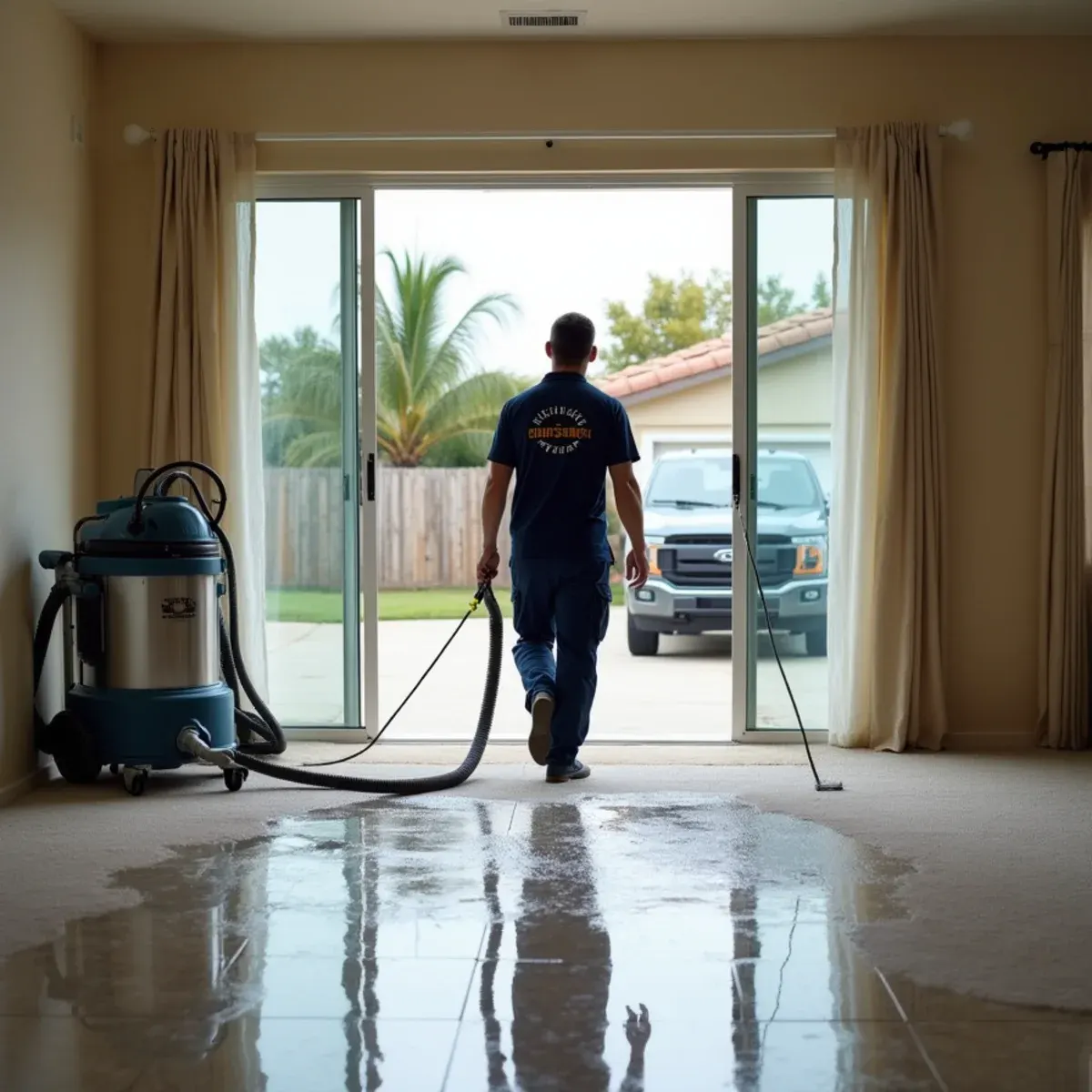
The tract housing that replaced the Valencia groves through the fifties, sixties and seventies is uniform enough that we can often guess the floor plan from the address. That uniformity shows up in how these losses look: under-slab copper on the hot side develops a pinhole, warm water spreads out across the slab under the carpet, and the first sign is a warm patch near the hall or a carpet edge that feels damp by the baseboard. By the time it's obvious, water has usually crossed two rooms.
Extraction on those calls is about direction, not just volume. Water under carpet moves outward in every direction until something stops it, and what stops it is typically the bottom plate of an interior wall. So we work from the wet perimeter inward, weighted-extract the pad in overlapping passes, and check the base of every wall the water reached. In the older pocket around Old Town Placentia the construction is different enough that we recalibrate, and student rentals near Cal State Fullerton bring their own problem: nobody was home when it started.
What Placentia Changes About Water Extraction
1Hot-water slab leaks spread further
A hot-side under-slab leak warms the concrete and the water spreads faster and further than a cold-line failure of the same size. It also drives more vapor into the room. Extraction has to be wider than the visibly wet area, and we map the wet perimeter with a moisture meter before we run a single pass rather than guessing from what looks dark.
2Whole-tract copper reaching the same age
Because these tracts were plumbed within a few years of each other, we see the same failure repeatedly on the same streets. That's useful. If a neighbor two doors down had a slab leak last winter, your supply lines are the same vintage. It doesn't mean yours will fail, but it means a warm spot on the floor deserves a call the same day, not the same month.
3Absent-tenant losses near Cal State Fullerton
Student rentals in the Kraemer and Morse corridors are often empty for days at a stretch. When a supply line lets go on a Friday, the water has the weekend. Those become deep-saturation extraction jobs — pad removal throughout, baseboard removal to release water trapped at wall plates, and cabinet toe-kick extraction rather than a simple carpet pass.
How the Work Runs
The method is the same one we use on every water extraction job, documented to the IICRC S500:2025 standard. Here it is in short — the full water extraction & removal process explains each stage in detail.
- Bulk removal with submersible pumps
- Truck-mounted extraction on carpet and pad
- Hard-surface and specialty extraction
- Cavity and void extraction
- Removing what cannot be saved
- Post-extraction moisture reading
The Placentia Background Worth Knowing
Copper under a slab fails in two directions at once. From the inside, decades of water flow erode thin spots at bends and fittings, especially on the hot side where the metal runs warmer and the water moves faster. From the outside, soil chemistry and stray current attack the pipe wall. Either way the result is a pinhole rather than a burst, which is precisely why these losses are so expensive by the time we see them. A pinhole under concrete can run for months, soaking the sub-base, wicking up into the slab, and surfacing at the edge of the carpet as a stain nobody can explain.
There is more on the housing stock, drainage and plumbing history of this city on our water damage restoration in Placentia page.
Placentia at a glance
- Dominant construction era
- 1955–1980
- Foundation type
- slab on grade
- Supply piping found here
- under-slab copper, galvanized steel
- Drain line materials
- cast iron
- Terrain and water table
- flat, moderate water table
- Most common local failure
- under-slab copper reaching the end of its service life across whole tracts at once
- Highest-value local prevention
- the annual water-meter test, and treating a neighbor's slab leak as information
What It Costs in Placentia
We do not quote a number over the phone before seeing the property — anyone who does is guessing. The variables that actually move the price on a water extraction job are volume and depth of water, flooring type, contamination level, and they are broken down in full on the water extraction & removal page. The assessment and the written estimate are free anywhere in Placentia, day or night, with no obligation.
Water Extraction Questions from Placentia Homeowners
No. A warm patch on a Placentia slab floor is the classic hot-line signature, and waiting only widens the wet area under your carpet. Shut the water at the meter and see whether the leak indicator still turns. If it does, call us and a leak-detection plumber the same day. Extraction done at forty square feet is a very different job from extraction done at four hundred.
For a typical single-room residential loss, extraction runs one to three hours. Multi-room losses or Category 3 water can take most of a day because of containment setup and material removal. We will give you a realistic timeframe after the walkthrough, before we start.
Often we can save the carpet and only replace the pad, which is the cheaper and less disruptive path. The deciding factors are water category, how long it sat, and whether the pad is a moisture barrier type. Clean water caught quickly usually means the carpet stays.
Worried is the wrong word, but you should start paying attention. These tracts were built in tight windows with the same copper at the same depth in the same soil, so failures cluster on a street rather than scattering randomly. Treat a neighbor's slab leak as a service bulletin for your own house. Run the meter test, listen for the water heater cycling at odd hours, and check the hallway and bedroom floors for warm or damp patches every so often.