
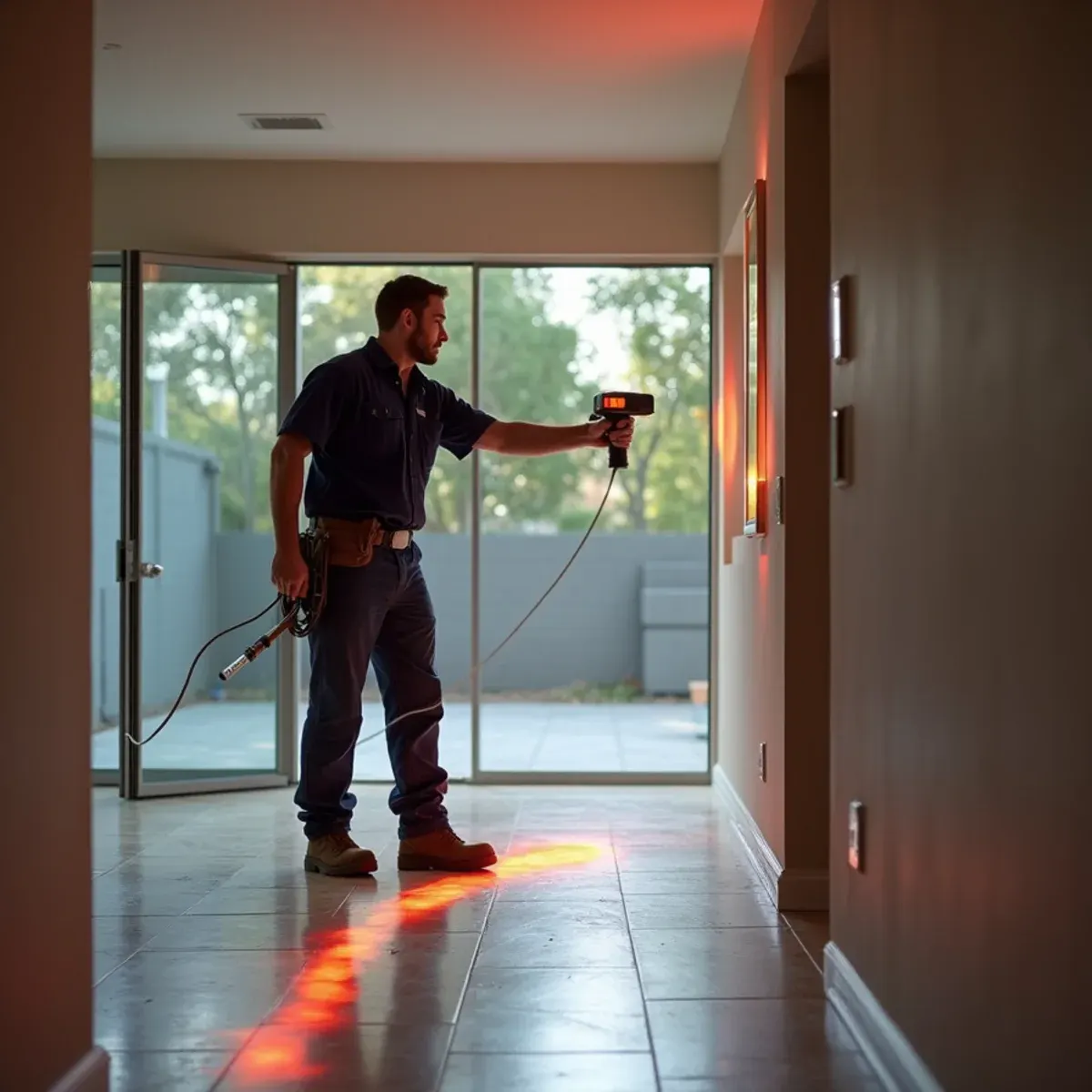
It usually starts the same way here. Somebody notices a warm strip crossing the hallway of a 1960s single-story on the Morse Avenue side of town, or the water heater runs when the house is asleep. Placentia was built out of the Valencia orange groves in a tight window between the mid-1950s and the late 1970s, mostly by a handful of builders using the same under-slab copper detail. When that copper reaches the end of its service life, it doesn't do it one house at a time.
That uniformity is useful. If two houses on your block have already had slab leaks, your own lines were installed the same year, in the same soil, carrying the same water. It doesn't mean you're leaking, but it does mean the annual meter test is worth doing. Around Old Town Placentia the stock is older and less predictable, and the student rentals near Cal State Fullerton bring a different problem — nobody's home during the day to notice, so those leaks run for months before anyone calls.
What Placentia Changes About Slab Leak Damage
1Failures cluster by tract and year
When one house on a Placentia street loses a line, we often see two or three more within a year or two on the same block. Same builder, same copper stock, same soil chemistry, same water. It isn't superstition — it's a shared installation date reaching the same point at the same time. Worth an annual meter test if your neighbors are already calling plumbers.
2Rentals near Cal State Fullerton run longer
Student-occupied houses on the Placentia side of the campus tend to catch leaks late. Nobody's home midday to hear the water heater cycling, the bill goes to a landlord across town, and a warm floor gets treated as a quirk. By the time we're called, the slab has taken on real moisture and the baseboards have wicked. A meter read between tenants costs nothing.
3Old Town Placentia breaks the pattern
The older pocket around Old Town doesn't behave like the tract. Mixed foundations, galvanized left in place, additions poured against original structures, and no two houses plumbed the same way. We don't bring tract assumptions into those blocks — everything gets located from scratch, and we're more likely to recommend an overhead reroute than to chase a single pinhole.
How the Work Runs
The method is the same one we use on every slab leak damage job, documented to the IICRC S500:2025 standard. Here it is in short — the full slab leak water damage repair process explains each stage in detail.
- Confirm it is actually a slab leak
- Electronic leak location
- Choose the repair approach with you
- Dry the slab and the affected assemblies
- Address the flooring and wall base
- Restore the floor and finish
The Placentia Background Worth Knowing
Copper under a slab fails in two directions at once. From the inside, decades of water flow erode thin spots at bends and fittings, especially on the hot side where the metal runs warmer and the water moves faster. From the outside, soil chemistry and stray current attack the pipe wall. Either way the result is a pinhole rather than a burst, which is precisely why these losses are so expensive by the time we see them. A pinhole under concrete can run for months, soaking the sub-base, wicking up into the slab, and surfacing at the edge of the carpet as a stain nobody can explain.
There is more on the housing stock, drainage and plumbing history of this city on our water damage restoration in Placentia page.
Placentia at a glance
- Dominant construction era
- 1955–1980
- Foundation type
- slab on grade
- Supply piping found here
- under-slab copper, galvanized steel
- Drain line materials
- cast iron
- Terrain and water table
- flat, moderate water table
- Most common local failure
- under-slab copper reaching the end of its service life across whole tracts at once
- Highest-value local prevention
- the annual water-meter test, and treating a neighbor's slab leak as information
What It Costs in Placentia
We do not quote a number over the phone before seeing the property — anyone who does is guessing. The variables that actually move the price on a slab leak damage job are how long the leak ran undetected, flooring type over the leak, repair method chosen, and they are broken down in full on the slab leak water damage repair page. The assessment and the written estimate are free anywhere in Placentia, day or night, with no obligation.
Slab Leak Damage Questions from Placentia Homeowners
Not automatically, but it's a fair question in a tract this uniform. Start with a proper meter test, irrigation isolated, house side only. Then look at the copper that came out of your neighbors' floors. Wall thickness on a removed section tells you a great deal. If it's thinned across the board, a reroute before the next failure is usually cheaper than two spot repairs and two floor restorations.
The meter test is the first step: shut off every fixture and watch the low-flow indicator. If it moves and nothing is wet above the floor, suspect the slab. Warm spots on the floor, running-water sounds from below, and flooring that lifts or cups without an obvious cause all point the same direction. We confirm it with thermal imaging and moisture mapping at no charge.
Not always. Depending on where the leak is and the condition of the system, rerouting the line overhead through the attic and walls avoids opening the concrete entirely. When a spot repair is the better option, precise electronic location keeps the opening small — typically a couple of feet, not a trench across the room.
Worried is the wrong word, but you should start paying attention. These tracts were built in tight windows with the same copper at the same depth in the same soil, so failures cluster on a street rather than scattering randomly. Treat a neighbor's slab leak as a service bulletin for your own house. Run the meter test, listen for the water heater cycling at odd hours, and check the hallway and bedroom floors for warm or damp patches every so often.