
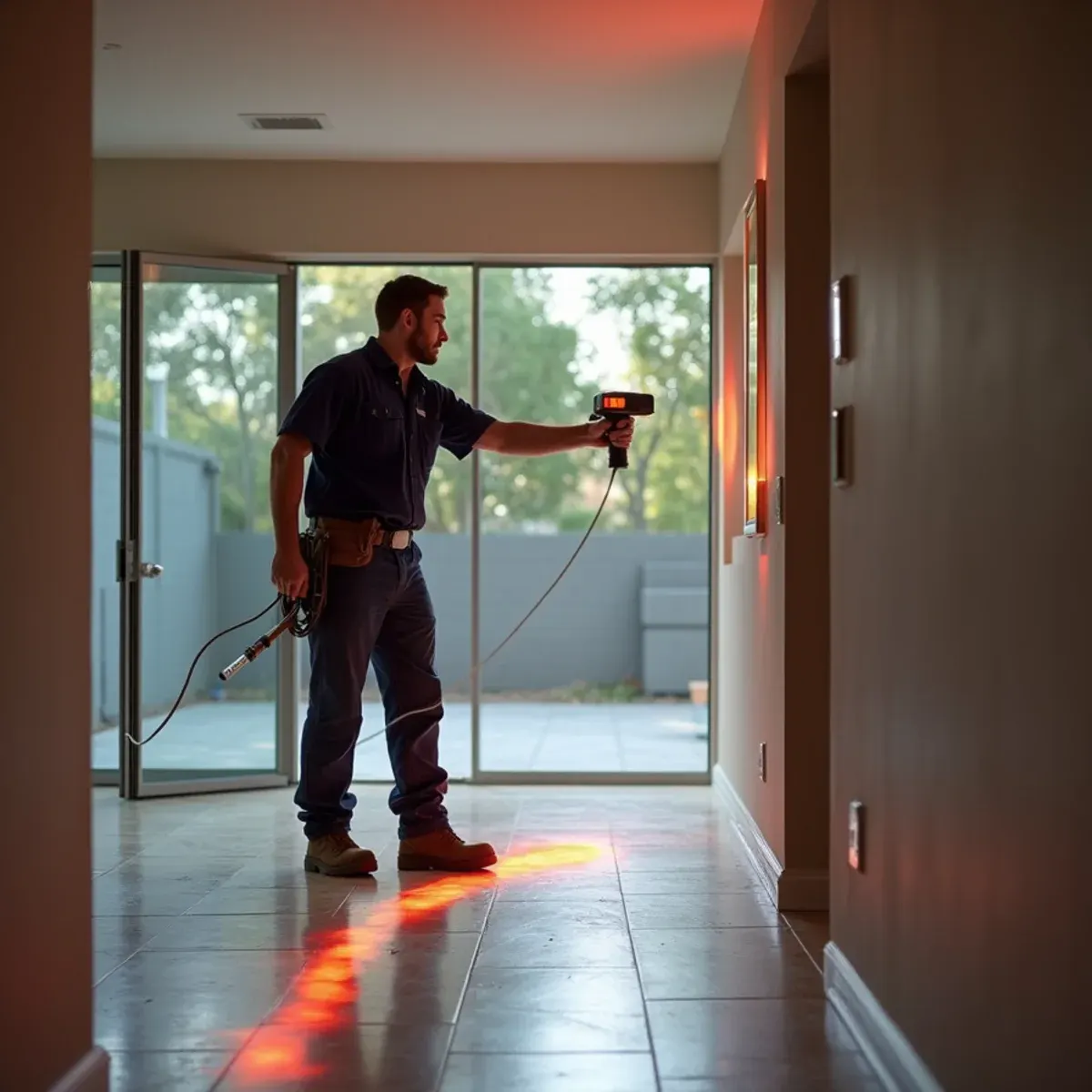
Here's the good news for a lot of Fullerton. The failure that would mean cutting concrete in a slab city is often reachable on your back with a headlamp. Pre-war Craftsman and Spanish Revival homes near downtown and up toward Raymond Hills sit on raised foundations, and a failed supply line under them can be repaired in an afternoon. The bad news is the same fact viewed from the other side. Water drips into crawl-space dirt instead of appearing on a kitchen floor, so these leaks run for weeks before anything upstairs gives them away.
Fullerton isn't all raised, though. The postwar tracts and the hillside construction around Sunny Hills are slab-on-grade, and rolling terrain means water under a slab travels downgrade and surfaces at the low end of the house. Then there's the rental belt around Cal State Fullerton and Fullerton College, where the real problem isn't detection at all. It's that a leak gets mentioned in a group chat for ten days before anybody calls a landlord. Old-growth Douglas fir framing and thick original oak floors are worth drying properly. They aren't worth waiting on.
What Fullerton Changes About Slab Leak Damage
1Crawl-space leaks announce themselves late
Under a raised foundation, water drips into soil instead of spreading across a floor, so nothing upstairs looks wrong for weeks. What shows first is smell, then a slight give underfoot, then fungal growth on the joists. If one room in a pre-war house smells musty and the floors read dry, that's worth a look underneath rather than a dehumidifier in the corner.
2Old-growth fir and oak are worth drying
The Douglas fir framing and thick oak floors in these houses are denser than anything milled today and cannot be matched from a supplier. That changes the calculation. We'll spend longer drying from below and monitoring readings before reaching for a saw. Sometimes the wood still loses. But the default here is save first, and we'll show you the numbers behind the call.
3Student rentals need a posted shutoff
Around Cal State Fullerton and Fullerton College, the gap between a leak starting and someone calling the landlord is the single biggest driver of cost. A card by the door with the main shutoff location and a 24-hour number changes that. So does telling tenants they won't be blamed for reporting it, which is usually the real reason nobody phones.
How the Work Runs
The method is the same one we use on every slab leak damage job, documented to the IICRC S500:2025 standard. Here it is in short — the full slab leak water damage repair process explains each stage in detail.
- Confirm it is actually a slab leak
- Electronic leak location
- Choose the repair approach with you
- Dry the slab and the affected assemblies
- Address the flooring and wall base
- Restore the floor and finish
The Fullerton Background Worth Knowing
The pre-war homes around downtown Fullerton were built with materials that behave completely differently from modern construction. Lath and plaster walls hold several times the water drywall does. Old-growth Douglas fir framing is dense and dries slowly. Original oak and fir flooring is thick, high-quality material that is well worth saving.
There is more on the housing stock, drainage and plumbing history of this city on our water damage restoration in Fullerton page.
Fullerton at a glance
- Dominant construction era
- 1910–1980
- Foundation type
- mixed on grade
- Supply piping found here
- galvanized steel, copper, original pre-war piping
- Drain line materials
- cast iron, clay
- Terrain and water table
- rolling, moderate water table
- Most common local failure
- crawl-space leaks that run undetected for weeks because the water drips away instead of pooling on a floor
- Highest-value local prevention
- posting a shutoff location and emergency contact in every rental, since delayed reporting is the local failure mode
What It Costs in Fullerton
We do not quote a number over the phone before seeing the property — anyone who does is guessing. The variables that actually move the price on a slab leak damage job are how long the leak ran undetected, flooring type over the leak, repair method chosen, and they are broken down in full on the slab leak water damage repair page. The assessment and the written estimate are free anywhere in Fullerton, day or night, with no obligation.
Slab Leak Damage Questions from Fullerton Homeowners
The crawl space, first. On a raised foundation a failed supply line drips into the soil below, and the smell reaches you long before moisture appears at floor level. We go underneath with a meter and a light, check the joists and subfloor for staining and growth, and trace the supply run. Caught at that stage it stays a plumbing repair rather than a floor replacement.
The meter test is the first step: shut off every fixture and watch the low-flow indicator. If it moves and nothing is wet above the floor, suspect the slab. Warm spots on the floor, running-water sounds from below, and flooring that lifts or cups without an obvious cause all point the same direction. We confirm it with thermal imaging and moisture mapping at no charge.
Not always. Depending on where the leak is and the condition of the system, rerouting the line overhead through the attic and walls avoids opening the concrete entirely. When a spot repair is the better option, precise electronic location keeps the opening small — typically a couple of feet, not a trench across the room.
Yes, and they need a different approach. Lath and plaster and old-growth framing hold far more water than modern materials and dry much more slowly, so we plan for seven to fourteen days with higher-capacity equipment. The original material is worth that effort — nothing sold today replaces it.