
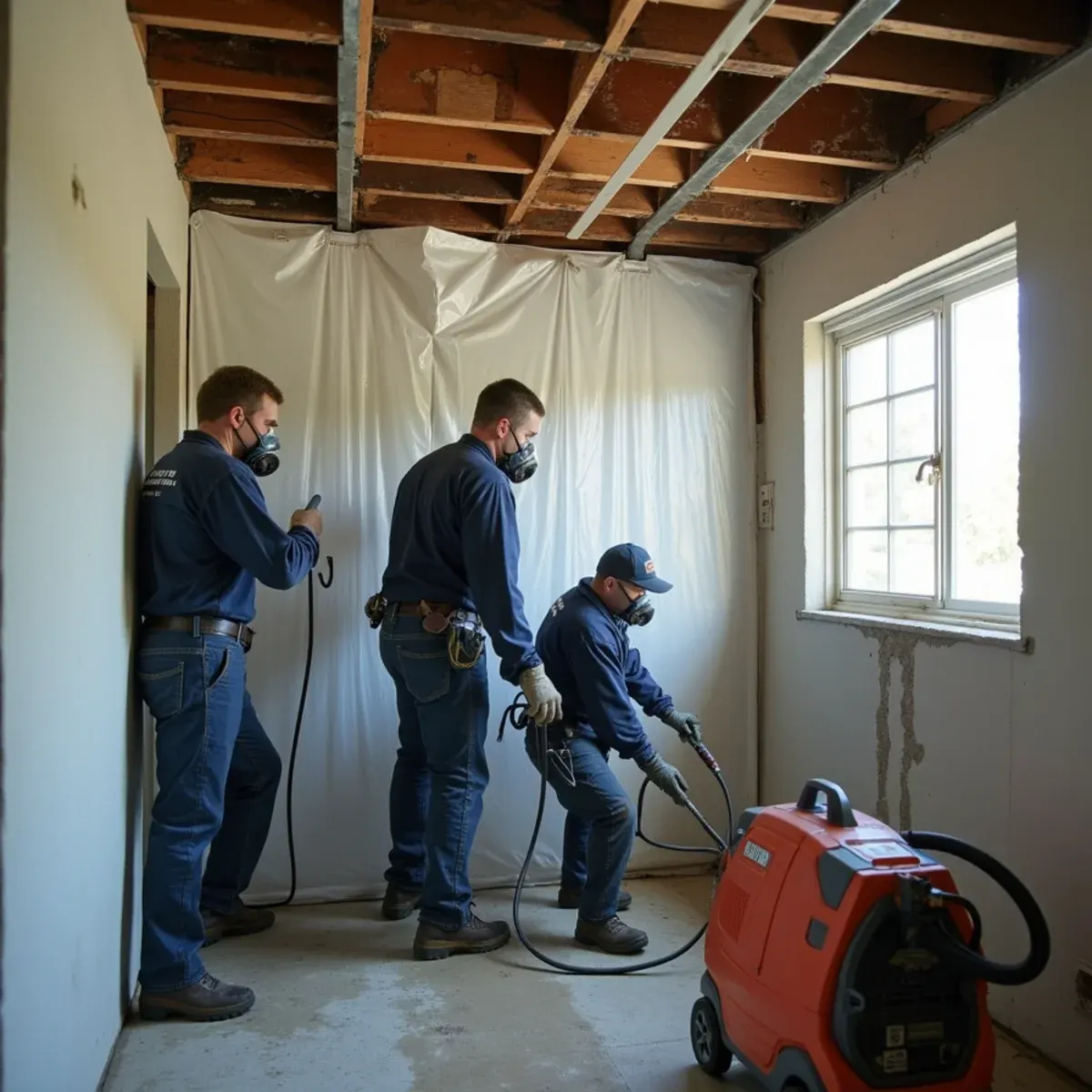
Under a raised-foundation Craftsman, floodwater has somewhere to go, and that is not entirely good news. It runs off the floor and into the crawl space, where it sits on the soil under the vapor barrier with no sun and no airflow. Nothing inside looks wrong. Weeks later a musty smell shows up in a closet, and the joists and subfloor above the standing water have been at elevated moisture the whole time. In the older neighborhoods near downtown and Hillcrest Park, that is the standard Fullerton flood story.
The upside is access. A crawl space can be pumped, cleared and dried from below, and the old-growth Douglas fir framing and thick original fir and oak floors are worth the effort in a way a 1970s subfloor is not. Fullerton also runs uphill and down — Raymond Hills and Sunny Hills push runoff toward properties below, and multi-level homes take it at the lowest floor. In the student rental blocks around Cal State Fullerton and Fullerton College, the problem is almost always that nobody called for four days.
What Fullerton Changes About Flood Cleanup
1Standing water under the floor
Crawl-space flooding does not evaporate on its own. We pump the water, remove and replace contaminated ground cover, treat the exposed soil surface, then dry the joists, rim and subfloor from below with the crawl space contained as its own zone. Readings get taken in the wood, not the air, because a crawl space can read reasonably while the framing above it is still well above safe moisture content.
2Old-growth framing and original floors
Pre-war Fullerton homes were built with dense old-growth fir that tolerates a controlled dry-down far better than modern lumber, and the original flooring is thick enough to survive if we reach it early and dry from both sides. That changes the calculation on removal. We meter, dry, and cut only where contaminated water actually reached, which is exactly why establishing the flood line early matters so much here.
3Student rentals report the loss late
Around both campuses, houses are shared, nobody owns the problem, and a flood on Friday gets reported on Tuesday. By then porous materials are past saving and the scope has doubled. Posting the main shutoff location and a 24-hour contact where tenants can see it is the cheapest thing a Fullerton landlord can do. We note when the loss was first observed versus reported, because carriers ask.
How the Work Runs
The method is the same one we use on every flood cleanup job, documented to the IICRC S500:2025 standard. Here it is in short — the full flood damage cleanup process explains each stage in detail.
- Safety assessment and utility check
- Containment and negative air
- Documentation and contents triage
- Extraction and controlled demolition
- Cleaning and disinfection
- Structural drying and clearance
The Fullerton Background Worth Knowing
The pre-war homes around downtown Fullerton were built with materials that behave completely differently from modern construction. Lath and plaster walls hold several times the water drywall does. Old-growth Douglas fir framing is dense and dries slowly. Original oak and fir flooring is thick, high-quality material that is well worth saving.
There is more on the housing stock, drainage and plumbing history of this city on our water damage restoration in Fullerton page.
Fullerton at a glance
- Dominant construction era
- 1910–1980
- Foundation type
- mixed on grade
- Supply piping found here
- galvanized steel, copper, original pre-war piping
- Drain line materials
- cast iron, clay
- Terrain and water table
- rolling, moderate water table
- Most common local failure
- crawl-space leaks that run undetected for weeks because the water drips away instead of pooling on a floor
- Highest-value local prevention
- posting a shutoff location and emergency contact in every rental, since delayed reporting is the local failure mode
What It Costs in Fullerton
We do not quote a number over the phone before seeing the property — anyone who does is guessing. The variables that actually move the price on a flood cleanup job are how high the water reached, how long it sat before extraction, contents volume in the flooded area, and they are broken down in full on the flood damage cleanup page. The assessment and the written estimate are free anywhere in Fullerton, day or night, with no obligation.
Flood Cleanup Questions from Fullerton Homeowners
It will not, and that is the most common misunderstanding we hear in Fullerton. A crawl space has no sunlight, almost no air exchange, and soil underneath that stays saturated long after the standing water is gone, so the wood above holds elevated moisture for months. That is where fungal growth and the eventual odor come from. Pumping and drying is quick and inexpensive; leaving it is what turns into subfloor and joist repair.
Yes. Water that crossed soil, pavement, or a storm drain is Category 3 by IICRC classification regardless of appearance — it carries bacteria, fuel and oil residue, lawn chemicals, and whatever else was on the ground. Do not walk through it in open shoes, and keep children and pets out of the area entirely.
If the water came from outside across the ground, almost certainly not — that requires separate flood insurance. If it came from a failed water heater, a burst pipe, or a supply line inside the garage, it is usually covered. We document the source carefully because that distinction determines everything.
Yes, and they need a different approach. Lath and plaster and old-growth framing hold far more water than modern materials and dry much more slowly, so we plan for seven to fourteen days with higher-capacity equipment. The original material is worth that effort — nothing sold today replaces it.