
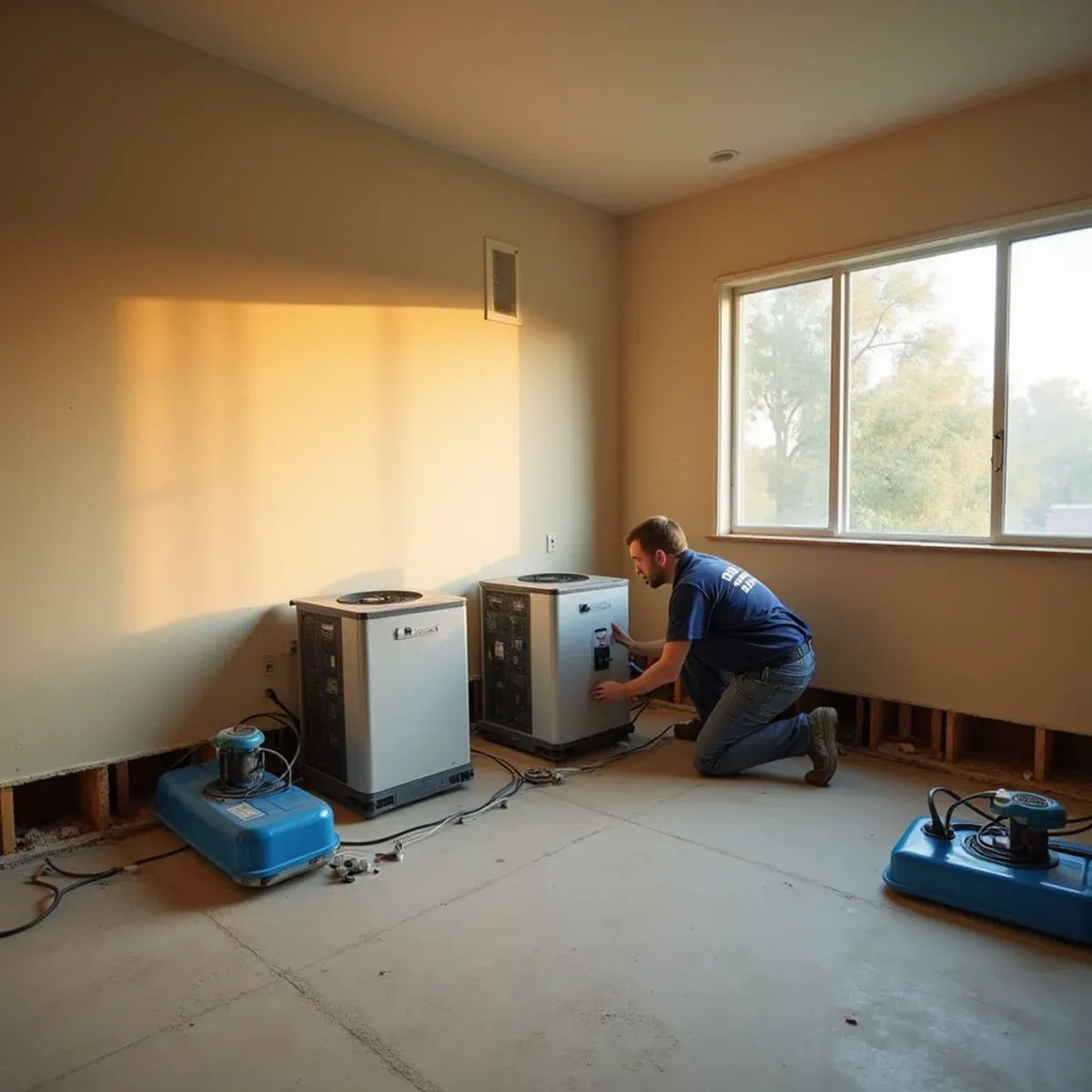
A drip under a Craftsman near downtown Fullerton doesn't pool on the floor. It falls into the crawl space, soaks the soil and the underside of the subfloor, and keeps going for weeks. No ceiling stain, no puddle, just a smell that gets stronger and a room that never warms up. By the time we're called, the joists are wet, the insulation is hanging, and the dry standard has to be set from framing at the far end of the crawl. The good news is real, though: it's all reachable from below without opening a floor.
These pre-war houses around Hillcrest Park have old-growth Douglas fir framing and thick original oak or fir flooring that earns the extra days proper drying takes. We run the crawl as its own sealed chamber, dehumidify it instead of ventilating it with damp outside air, and monitor the subfloor from both faces. Near Cal State Fullerton and Fullerton College the story usually shifts to timing, because student rentals report late, and by our first visit we're often looking at material wet long enough to change the conversation about what stays.
What Fullerton Changes About Structural Drying
1The crawl space becomes the chamber
Rather than drying the house from inside, we seal and dehumidify the crawl itself, treating the joists and subfloor from beneath. Ventilating a crawl with outside air on a humid morning adds moisture instead of removing it. Readings get taken from underneath and from the finished floor above, because a subfloor can read dry on one face while the other still holds water.
2Old-growth flooring earns extra days
The fir and oak in these houses is denser than anything sold today, which is exactly why it's worth saving and why it gives up water slowly. Drying it in place means a controlled rate, mats where the floor is finished, and daily readings through the boards. Rushing a floor like this produces cupping and splits that cost far more than the extra two days would have.
3Delayed reporting in student rentals
Around the two campuses, a leak often gets mentioned a week or two after it starts. That's not a character flaw, it's what happens with shared houses and absent owners, but it changes the job. Material wet that long may have visible growth and may not be salvageable by drying alone. We say so on the first visit rather than running equipment on something that has to come out.
How the Work Runs
The method is the same one we use on every structural drying job, documented to the IICRC S500:2025 standard. Here it is in short — the full structural drying & dehumidification process explains each stage in detail.
- Establish the dry standard
- Calculate the load and build the chamber
- Place air movers for surface evaporation
- Run LGR dehumidification to capture the moisture
- Monitor and adjust daily
- Verify, document, and demobilize
The Fullerton Background Worth Knowing
The pre-war homes around downtown Fullerton were built with materials that behave completely differently from modern construction. Lath and plaster walls hold several times the water drywall does. Old-growth Douglas fir framing is dense and dries slowly. Original oak and fir flooring is thick, high-quality material that is well worth saving.
There is more on the housing stock, drainage and plumbing history of this city on our water damage restoration in Fullerton page.
Fullerton at a glance
- Dominant construction era
- 1910–1980
- Foundation type
- mixed on grade
- Supply piping found here
- galvanized steel, copper, original pre-war piping
- Drain line materials
- cast iron, clay
- Terrain and water table
- rolling, moderate water table
- Most common local failure
- crawl-space leaks that run undetected for weeks because the water drips away instead of pooling on a floor
- Highest-value local prevention
- posting a shutoff location and emergency contact in every rental, since delayed reporting is the local failure mode
What It Costs in Fullerton
We do not quote a number over the phone before seeing the property — anyone who does is guessing. The variables that actually move the price on a structural drying job are size of the drying chamber, class of water intrusion, material types involved, and they are broken down in full on the structural drying & dehumidification page. The assessment and the written estimate are free anywhere in Fullerton, day or night, with no obligation.
Structural Drying Questions from Fullerton Homeowners
In most cases, yes. A raised foundation is a real advantage over a slab here, because everything is reachable from beneath. We seal the crawl into a controlled space, take out saturated insulation and any standing water, then dry the framing from underneath while metering the finished floor from above. The musty smell usually fades as the material dries. Where framing has been wet for weeks and shows growth, cleaning happens alongside the drying, and we'll show you what we found.
Three to five days covers most residential losses. Saturated hardwood, plaster, or a concrete slab can run seven or more. We will give you an estimated window after the first readings and update you daily — and equipment comes out when the numbers say so, not on a fixed schedule.
We would rather you did not. Drying is a continuous process, and every hour off extends the total run — which usually costs more than the sleep is worth. If noise is genuinely unmanageable we can often reconfigure the chamber or reposition units to reduce it. Talk to us instead of unplugging them.
Yes, and they need a different approach. Lath and plaster and old-growth framing hold far more water than modern materials and dry much more slowly, so we plan for seven to fourteen days with higher-capacity equipment. The original material is worth that effort — nothing sold today replaces it.