
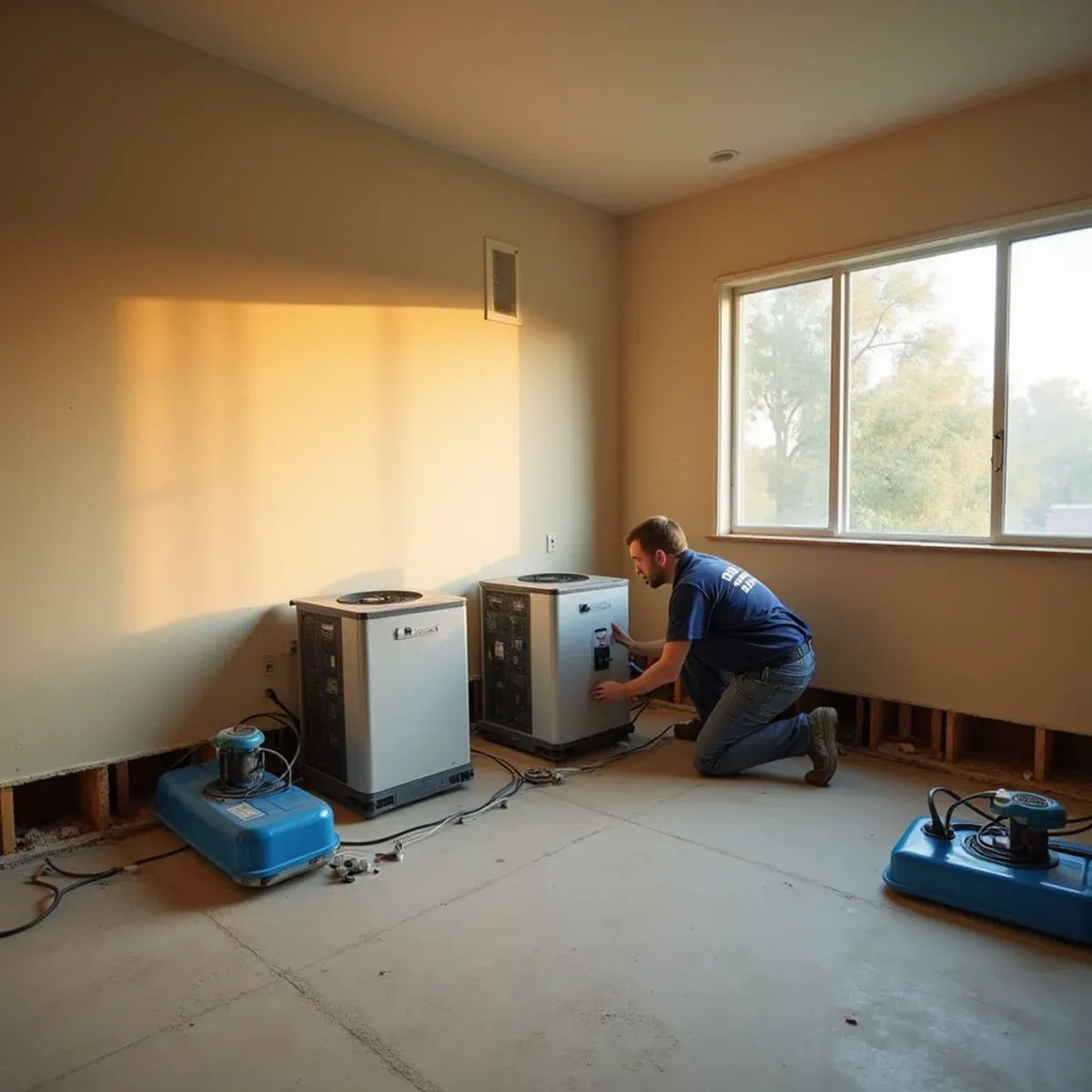
Most cities around here are dead flat. La Mirada isn't. It rolls, which normally works in your favor because storm water moves off a property instead of standing on it. The trouble starts where fifty years of added patios, raised planters, retaining walls and settled hardscape have quietly turned that flow back toward the house. Then water arrives at the slab edge on the uphill side, wicks into the bottom plate and the drywall above it, and shows up inside as a damp band along the baseboard that nobody can trace to a pipe.
That kind of loss cannot be dried until the outside is handled, at least temporarily, or the chamber refills with the next rain. Once it's stopped, the work is perimeter drying: bottom plates, sill, insulation in the affected bays and the slab edge, all measured against unaffected material further into the room. The housing helps. La Mirada was built as a planned community inside a tight twelve-year window, so construction runs consistent from block to block and we generally know the wall assembly before opening it.
What La Mirada Changes About Structural Drying
1Stop the exterior source before drying
Running equipment while water is still entering at the foundation is money spent on nothing. We sandbag, divert or temporarily seal the entry path first, then start the chamber. It also gives the drying log a defensible start point, which matters when a carrier asks why a job restarted after a second storm three days in.
2The uphill wall base takes it first
On rolling ground the wet zone is a band along the base of the wall facing the slope, not a puddle in the middle of a room. We remove base trim, drill behind it to reach the cavity, and dry the bottom plate and insulation in place under negative pressure. Metering higher up the wall tells us how far the wicking actually climbed.
3Late reporting in the Biola rentals
Student housing around the university reports slowly, and a perimeter leak that ran through two storms is a different job than one caught the same night. Longer exposure means saturated insulation, wet framing and sometimes growth on the back of the drywall. We show you what's behind the base trim before deciding what gets dried and what has to come out.
How the Work Runs
The method is the same one we use on every structural drying job, documented to the IICRC S500:2025 standard. Here it is in short — the full structural drying & dehumidification process explains each stage in detail.
- Establish the dry standard
- Calculate the load and build the chamber
- Place air movers for surface evaporation
- Run LGR dehumidification to capture the moisture
- Monitor and adjust daily
- Verify, document, and demobilize
The La Mirada Background Worth Knowing
La Mirada's gentle slopes mean storm water moves across properties instead of sitting on them, which is generally an advantage — except where fifty years of added patios, raised planters, retaining walls, and settled hardscape have redirected it.
There is more on the housing stock, drainage and plumbing history of this city on our water damage restoration in La Mirada page.
La Mirada at a glance
- Dominant construction era
- 1953–1965
- Foundation type
- slab on grade
- Supply piping found here
- under-slab copper, galvanized steel
- Drain line materials
- cast iron
- Terrain and water table
- rolling, moderate water table
- Most common local failure
- exterior water entering where fifty years of added patios, planters and retaining walls redirected the original drainage back toward the house
- Highest-value local prevention
- walking the property during the first real rain and watching where water actually goes
What It Costs in La Mirada
We do not quote a number over the phone before seeing the property — anyone who does is guessing. The variables that actually move the price on a structural drying job are size of the drying chamber, class of water intrusion, material types involved, and they are broken down in full on the structural drying & dehumidification page. The assessment and the written estimate are free anywhere in La Mirada, day or night, with no obligation.
Structural Drying Questions from La Mirada Homeowners
Yes, and it's a common one here, because the rolling terrain sends runoff toward houses where old hardscape has redirected the original drainage. The sequence is what changes. We stop or divert the outside source first, then dry the bottom plate, the insulation in those bays and the slab edge, monitored against dry material deeper in the room. Drying before the exterior is handled just means starting over after the next rain.
Three to five days covers most residential losses. Saturated hardwood, plaster, or a concrete slab can run seven or more. We will give you an estimated window after the first readings and update you daily — and equipment comes out when the numbers say so, not on a fixed schedule.
We would rather you did not. Drying is a continuous process, and every hour off extends the total run — which usually costs more than the sleep is worth. If noise is genuinely unmanageable we can often reconfigure the chamber or reposition units to reduce it. Talk to us instead of unplugging them.
Almost always exterior drainage rather than a plumbing leak — a plugged area drain, a patio that has settled toward the house, or a planter holding moisture against the wall. We identify the actual path rather than just drying the wall, because drying without fixing the cause means doing it again next storm.