
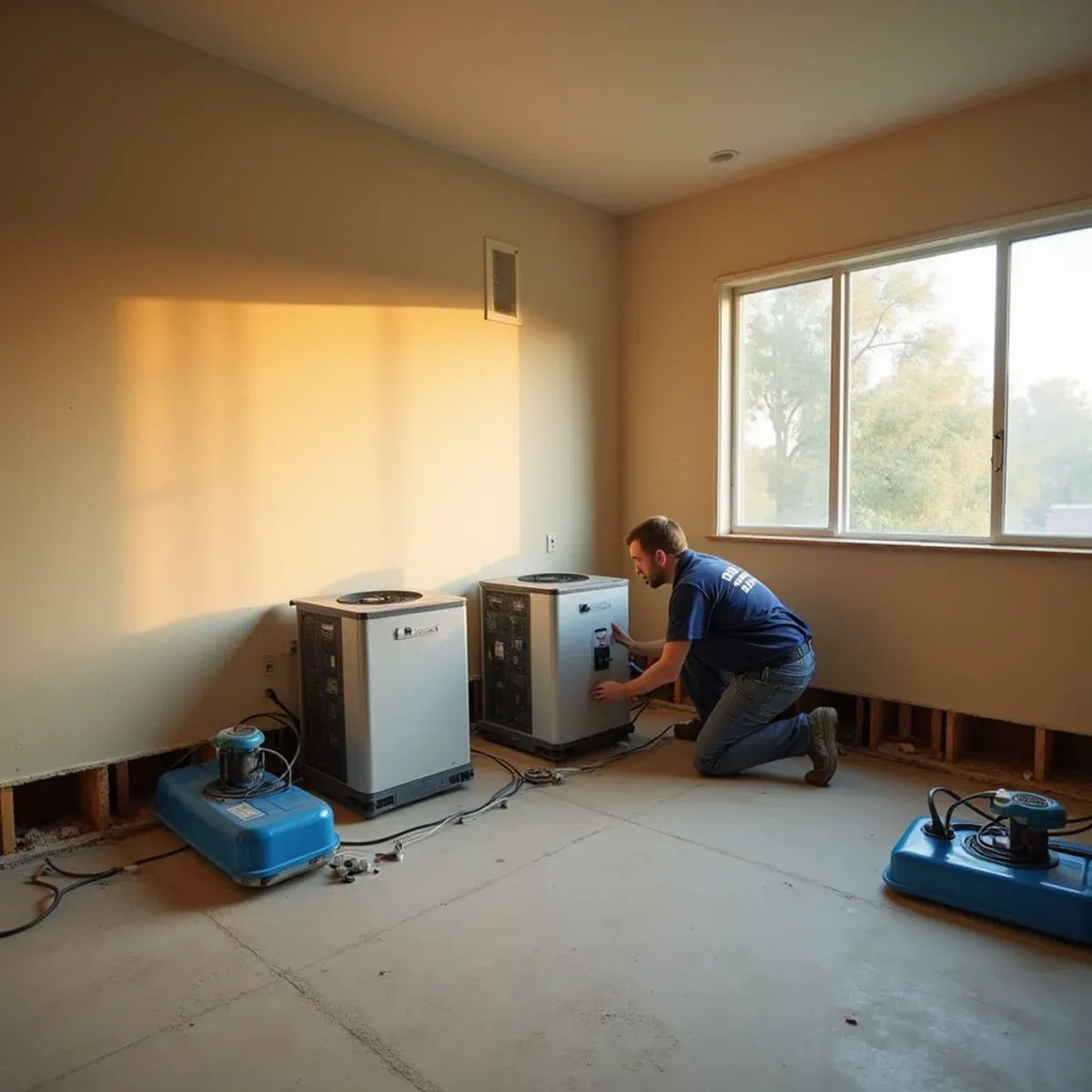
The San Gabriel River channel runs the western edge of Norwalk and carries a very large share of the region's runoff. When it's working hard, the neighborhoods beside it saturate quickly, and the lots here are small enough that there's barely any ground between the sidewalk and the front wall to absorb anything. Water reaches the house sooner than it would in a city with deep setbacks. It also means the yard isn't a staging area. Extraction hose, air movers and dehumidifiers all get laid out inside a compact floor plan without blocking the way through it.
The rest of our work here comes out of the plumbing. Norwalk went from farmland to a full city between roughly 1945 and 1960, built fast and economically, and plenty of homes near Norwalk Park and toward Cerritos College still run original galvanized supply lines. Those fail from the inside out: scale narrows the bore, erosion works at a fitting, and a slow seep runs behind a wall for weeks before anything shows. Slow leaks mean deeply wet material, and deeply wet material means a longer drying schedule than the stain would suggest.
What Norwalk Changes About Structural Drying
1Compact floor plans set the equipment layout
In a small postwar house there's no spare room to park a dehumidifier, so containment and equipment placement have to leave a family a usable path to the kitchen and a bathroom. We calculate the load against the actual room volumes, which are modest, and often get better results from fewer, better-placed air movers than from a room packed full of them.
2Slow galvanized seeps wet material deeply
Seventy-year-old galvanized rarely bursts first. It weeps at a corroded fitting for weeks, and that slow wetting carries moisture deep into framing, wall plates and the concrete underneath, so what you can see badly understates the wet area. It also means a longer schedule and more careful mapping. If a wall is open for the plumbing repair anyway, replacing that run will never be cheaper.
3Saturated ground on the west side
After heavy runoff along the channel, the soil under and around a slab stays loaded for days, and readings at the slab edge reflect that rather than an indoor problem. We pull the baseline from dry concrete elsewhere in the house and follow the trend across the log. Clearing yard and area drains before the season is worth more here than most preventive advice.
How the Work Runs
The method is the same one we use on every structural drying job, documented to the IICRC S500:2025 standard. Here it is in short — the full structural drying & dehumidification process explains each stage in detail.
- Establish the dry standard
- Calculate the load and build the chamber
- Place air movers for surface evaporation
- Run LGR dehumidification to capture the moisture
- Monitor and adjust daily
- Verify, document, and demobilize
The Norwalk Background Worth Knowing
The homes built in Norwalk during the postwar surge were built to be affordable and built fast, which was exactly the right priority at the time. Seventy years later, some of those choices have consequences.
There is more on the housing stock, drainage and plumbing history of this city on our water damage restoration in Norwalk page.
Norwalk at a glance
- Dominant construction era
- 1945–1960
- Foundation type
- slab on grade
- Supply piping found here
- original galvanized steel
- Drain line materials
- cast iron
- Terrain and water table
- flat, moderate water table
- Most common local failure
- original galvanized supply lines failing after decades of internal scaling and erosion at fittings
- Highest-value local prevention
- clearing yard and area drains before the season, since small lots leave little ground between the street and the house
What It Costs in Norwalk
We do not quote a number over the phone before seeing the property — anyone who does is guessing. The variables that actually move the price on a structural drying job are size of the drying chamber, class of water intrusion, material types involved, and they are broken down in full on the structural drying & dehumidification page. The assessment and the written estimate are free anywhere in Norwalk, day or night, with no obligation.
Structural Drying Questions from Norwalk Homeowners
It affects what your readings look like more than it affects the drying itself. After a heavy runoff period the soil around and beneath a slab holds water for days, so slab-edge numbers run high even when the structure above is drying normally. We take a baseline from dry concrete elsewhere in the house and follow the trend across the drying log rather than one measurement, which keeps equipment from staying out longer than the building needs.
Three to five days covers most residential losses. Saturated hardwood, plaster, or a concrete slab can run seven or more. We will give you an estimated window after the first readings and update you daily — and equipment comes out when the numbers say so, not on a fixed schedule.
We would rather you did not. Drying is a continuous process, and every hour off extends the total run — which usually costs more than the sleep is worth. If noise is genuinely unmanageable we can often reconfigure the chamber or reposition units to reduce it. Talk to us instead of unplugging them.
If it is original galvanized from the postwar build-out, it has exceeded any reasonable service life. If you have had one failure, a second is a matter of when. The cheapest moment to repipe is while walls are already open for a repair — the demolition and patching are already in the scope.