
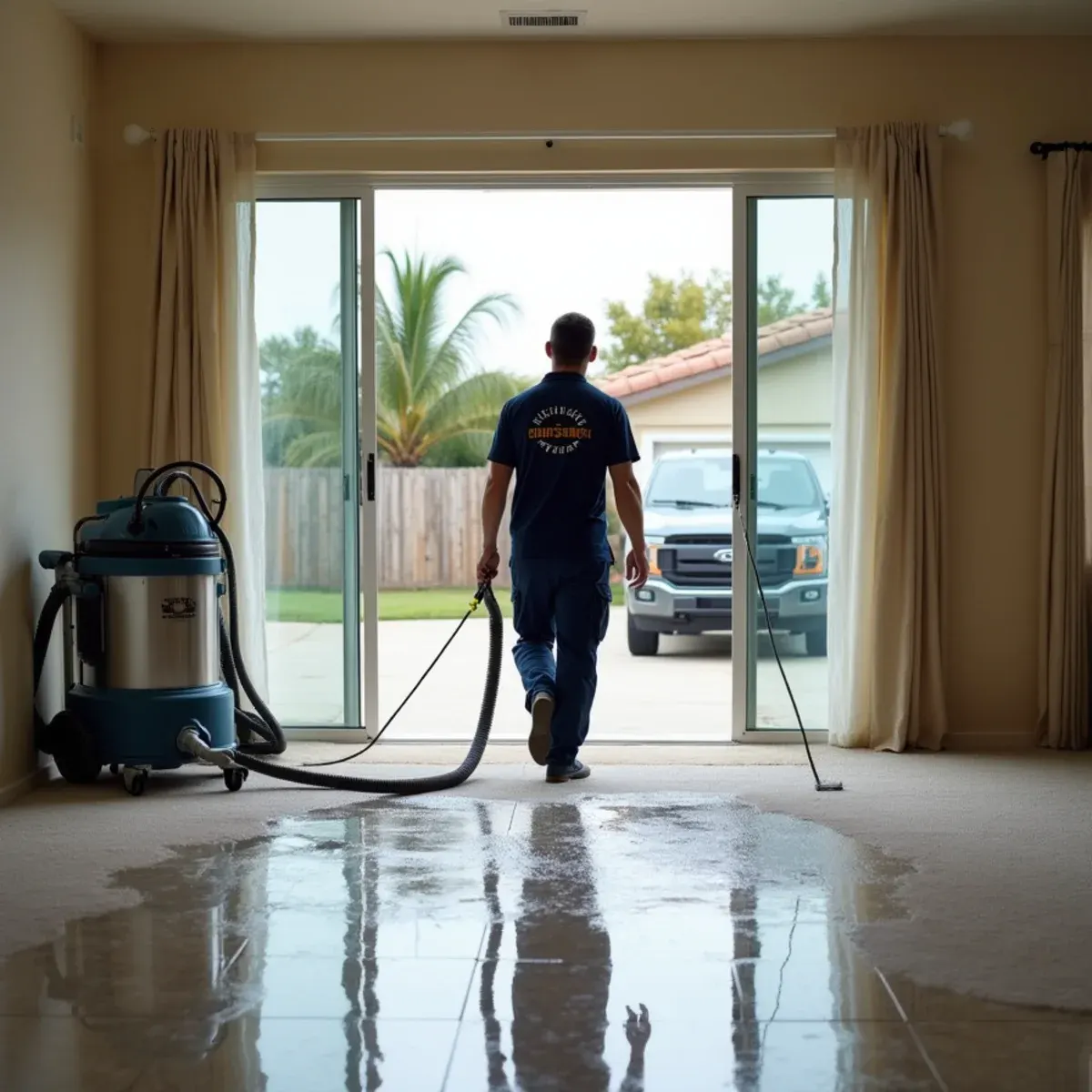
Two things shape extraction in Norwalk. The first is age: the city went from farmland to finished between roughly 1945 and 1960, and a great many of those homes still run on original galvanized supply lines that have been scaling and eroding internally for seventy years. When a fitting finally lets go it does so at pressure, inside a wall, and puts down real water fast. The second is the lots. They're small, built close together, with very little ground between the street and the house to absorb anything at all.
That second point matters more than it sounds. On a small lot there's nowhere for extracted water to go — we can't simply pump it out a side door and let the yard take it, because the yard is ten feet wide and drains toward your neighbor's foundation. Discharge gets planned deliberately. And along the western edge, the San Gabriel River channel carries a very large share of regional runoff; when it's running hard, neighborhoods near Norwalk Park and the west side saturate quickly, and what enters a house is street water with a different scope entirely.
What Norwalk Changes About Water Extraction
1Small lots complicate water discharge
Moving hundreds of gallons out of a house is only half the job — the other half is where it goes. With homes this close together, careless discharge relocates the problem to a neighbor or pushes it back against your own footing. We route to an approved discharge point and keep the run moving away from both structures. On the tightest lots that means longer hose and a slower pump-out, which we plan for rather than improvise.
2Street runoff is Category 3 water
Water that has crossed a street or come out of the channel system is contaminated, regardless of how clear it looks. Under IICRC S500:2025 that's Category 3, and porous materials it touched — carpet pad, base gypsum, insulation — come out rather than get dried. It's a bigger scope than a clean supply break, and we'd rather explain why on the first visit than quietly downgrade it.
3Galvanized failures put down real volume
Seventy-year-old galvanized doesn't fail politely. Internal scale narrows the pipe, velocity rises, and a corroded fitting opens under full pressure inside a wall. In a compact Norwalk floor plan that water reaches two or three rooms before anyone finds the shutoff. Bulk removal comes first — pump, then truck-mounted and weighted extraction — before a single drying fan gets placed.
How the Work Runs
The method is the same one we use on every water extraction job, documented to the IICRC S500:2025 standard. Here it is in short — the full water extraction & removal process explains each stage in detail.
- Bulk removal with submersible pumps
- Truck-mounted extraction on carpet and pad
- Hard-surface and specialty extraction
- Cavity and void extraction
- Removing what cannot be saved
- Post-extraction moisture reading
The Norwalk Background Worth Knowing
The homes built in Norwalk during the postwar surge were built to be affordable and built fast, which was exactly the right priority at the time. Seventy years later, some of those choices have consequences.
There is more on the housing stock, drainage and plumbing history of this city on our water damage restoration in Norwalk page.
Norwalk at a glance
- Dominant construction era
- 1945–1960
- Foundation type
- slab on grade
- Supply piping found here
- original galvanized steel
- Drain line materials
- cast iron
- Terrain and water table
- flat, moderate water table
- Most common local failure
- original galvanized supply lines failing after decades of internal scaling and erosion at fittings
- Highest-value local prevention
- clearing yard and area drains before the season, since small lots leave little ground between the street and the house
What It Costs in Norwalk
We do not quote a number over the phone before seeing the property — anyone who does is guessing. The variables that actually move the price on a water extraction job are volume and depth of water, flooring type, contamination level, and they are broken down in full on the water extraction & removal page. The assessment and the written estimate are free anywhere in Norwalk, day or night, with no obligation.
Water Extraction Questions from Norwalk Homeowners
Yes, substantially. A clean supply leak is Category 1 water and much of the flooring and pad can often be dried and saved. Water that came off the street or out of the channel system is Category 3 — contaminated — so carpet pad, wet base gypsum and insulation come out rather than get dried, and affected surfaces are cleaned before drying begins. Same volume of water, different scope, different cost. We'll tell you which one you have on arrival.
For a typical single-room residential loss, extraction runs one to three hours. Multi-room losses or Category 3 water can take most of a day because of containment setup and material removal. We will give you a realistic timeframe after the walkthrough, before we start.
Often we can save the carpet and only replace the pad, which is the cheaper and less disruptive path. The deciding factors are water category, how long it sat, and whether the pad is a moisture barrier type. Clean water caught quickly usually means the carpet stays.
If it is original galvanized from the postwar build-out, it has exceeded any reasonable service life. If you have had one failure, a second is a matter of when. The cheapest moment to repipe is while walls are already open for a repair — the demolition and patching are already in the scope.