

Norwalk grew fast in the years right after the war, going from farmland to a full city between roughly 1945 and 1960. The housing reflects that: modest single-family homes on small lots, built quickly and economically, with substantial apartment stock added through the following decades.
The plumbing question here is the same one as Lakewood, and for the same reason — everything went in at once, and it is now seventy-plus years old. Original galvanized supply lines that have never been replaced are the single most common thing we find behind a Norwalk wall, and they fail the way galvanized always fails: gradually, internally, and then suddenly.
Norwalk also sits adjacent to the San Gabriel River channel, which matters during a significant storm. The channel handles enormous volume, and the neighborhoods closest to it see the ground saturate faster, with the usual consequence that surface water finds the lowest opening in the house.
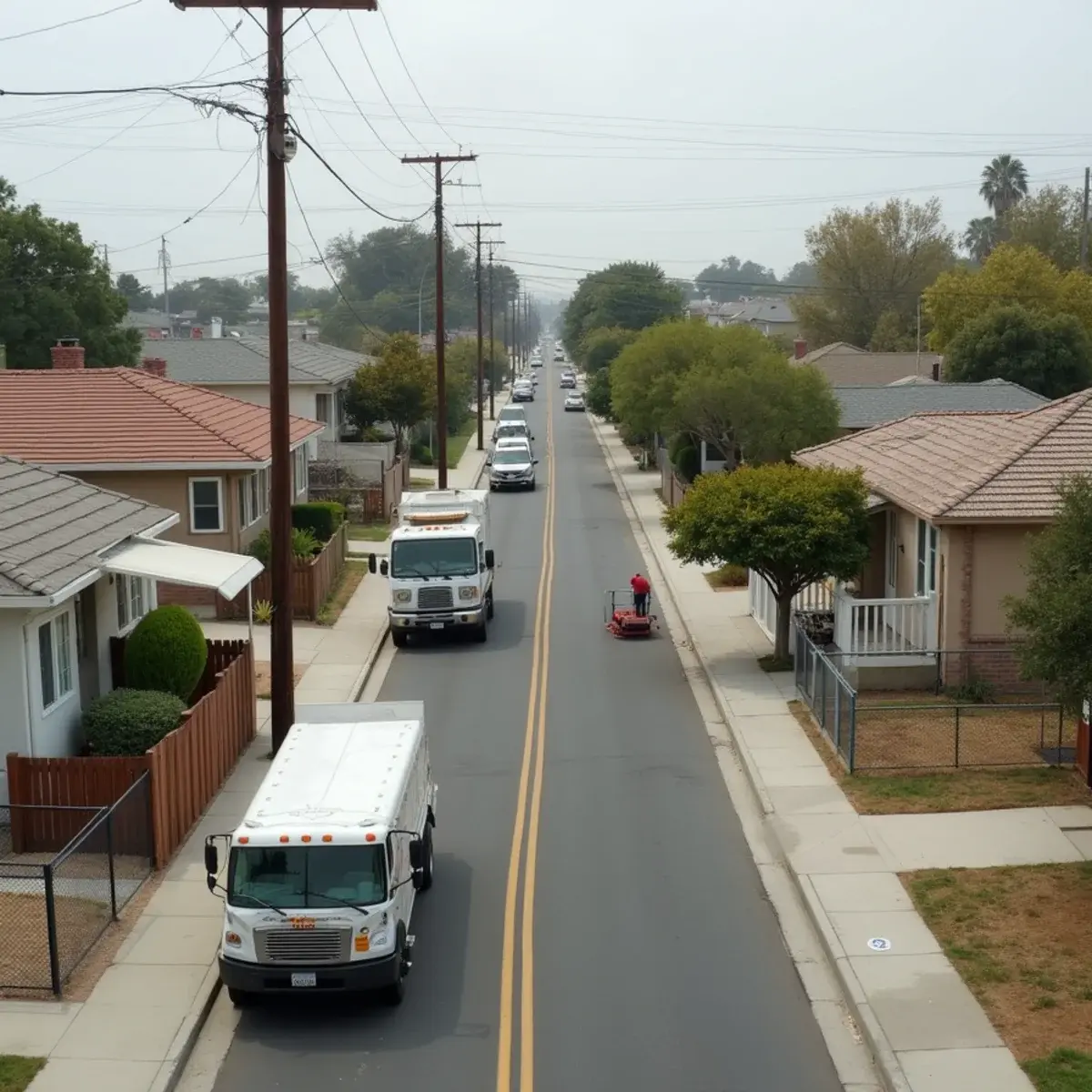
Postwar Construction and What It Means Seventy Years On
The homes built in Norwalk during the postwar surge were built to be affordable and built fast, which was exactly the right priority at the time. Seventy years later, some of those choices have consequences.
Original galvanized supply piping is the main one. It corrodes internally, scales up, narrows, and eventually fails at a thin spot or a fitting. The signs are gradual — declining pressure, rust-colored water from a tap that has not run overnight, hot side noticeably worse than cold — and homeowners often adapt to them rather than acting on them.
Cast-iron drain lines are the second. Seventy years of use channels out the bottom of the pipe, and the mature street trees planted when these neighborhoods were new have root systems that find any opening. Slow drains across multiple fixtures at once, or a toilet gurgling when the washer drains, means the main line is restricted and a backup is coming.
Proximity to the San Gabriel River Channel
The San Gabriel River channel runs along Norwalk's western edge and carries a very large share of the regional runoff during a storm. For most of the year that is invisible. During an atmospheric river it means the neighborhoods nearest the channel have ground that saturates quickly and drainage infrastructure working at capacity.
The practical effect on homes is the same as everywhere in this flat basin: once the soil stops accepting water, it runs across the surface toward the lowest opening. In Norwalk's housing stock, that is usually a garage door or a settled patio slab, and the small lot sizes mean there is less ground between the street and the house to absorb anything.
Prevention here is the standard seasonal list and it genuinely works: clear the yard and area drains before the first storm, since they silt up completely over a dry summer; make sure downspouts discharge well away from the foundation rather than at its base; add a threshold seal at the garage; and re-grade any hardscape that ponds against the wall. On a small lot those four things account for most of the risk.
Neighborhoods and Landmarks We Cover in Norwalk
We work throughout Norwalk — every neighborhood, every street, residential and commercial. If your address is in the city, we cover it.
Neighborhoods & corridors
- Norwalk Boulevard corridor
- Rosecrans Avenue area
- Firestone Boulevard corridor
- Studebaker Road area
- Cerritos College area
Landmarks nearby
- Cerritos College
- Norwalk Park
- Norwalk Town Square
- Hargitt House Museum
- Norwalk Metro Green Line Station
- San Gabriel River
Why Norwalk Residents Call Us First
Any restoration company can put Norwalk on a service-area list. What matters at 2 a.m. is how far the truck has to come and whether the crew has opened a wall in a house like yours before.
About 15 minutes northwest
We dispatch from 6122-6182 Katella Ave in Cypress — not from a regional depot and not from a call centre that sells your job to whoever bids for it. That is the whole reason the 60-minute commitment is one we can put in writing.
Original galvanized from the 1945–60 build-out
Decades of internal scaling erode the fittings until one lets go. The failures cluster by street because the installs did.
Small lots leave nowhere for storm water
There is little permeable ground between the street and the house. Clearing yard and area drains before the season prevents most of it.
- 20+ years restoring Orange County homes
- IICRC Certified Firm
- Licensed, Bonded & Insured
- We bill your insurance company directly
- IICRC S500:2025 compliant on every job
- 100% satisfaction guarantee — in writing, on every job
Norwalk Water Damage Questions
If it is original galvanized from the postwar build-out, it has exceeded any reasonable service life. If you have had one failure, a second is a matter of when. The cheapest moment to repipe is while walls are already open for a repair — the demolition and patching are already in the scope.
The neighborhoods nearest the channel see ground saturate faster during heavy storms, which increases surface flooding risk. Standard homeowners policies exclude ground-source flooding, so it is worth confirming whether you carry separate flood coverage before the season.
Multiple fixtures slowing together means the blockage is in the main line, not in any one fixture. In a seventy-year-old cast-iron lateral that usually means corrosion, root intrusion, or both. Get it camera-inspected before it backs up — a Category 3 remediation costs many times what an inspection does.
Often, yes. Norwalk lots from the 1945–60 build-out are small, with very little permeable ground between the street and the house, so the yard and area drains are doing essentially all of the work. When one is blocked with leaf litter or silt there is nowhere else for the water to go and it backs up against the slab. Clearing them before the season is a twenty-minute job that prevents a large share of what we get called out for here.