
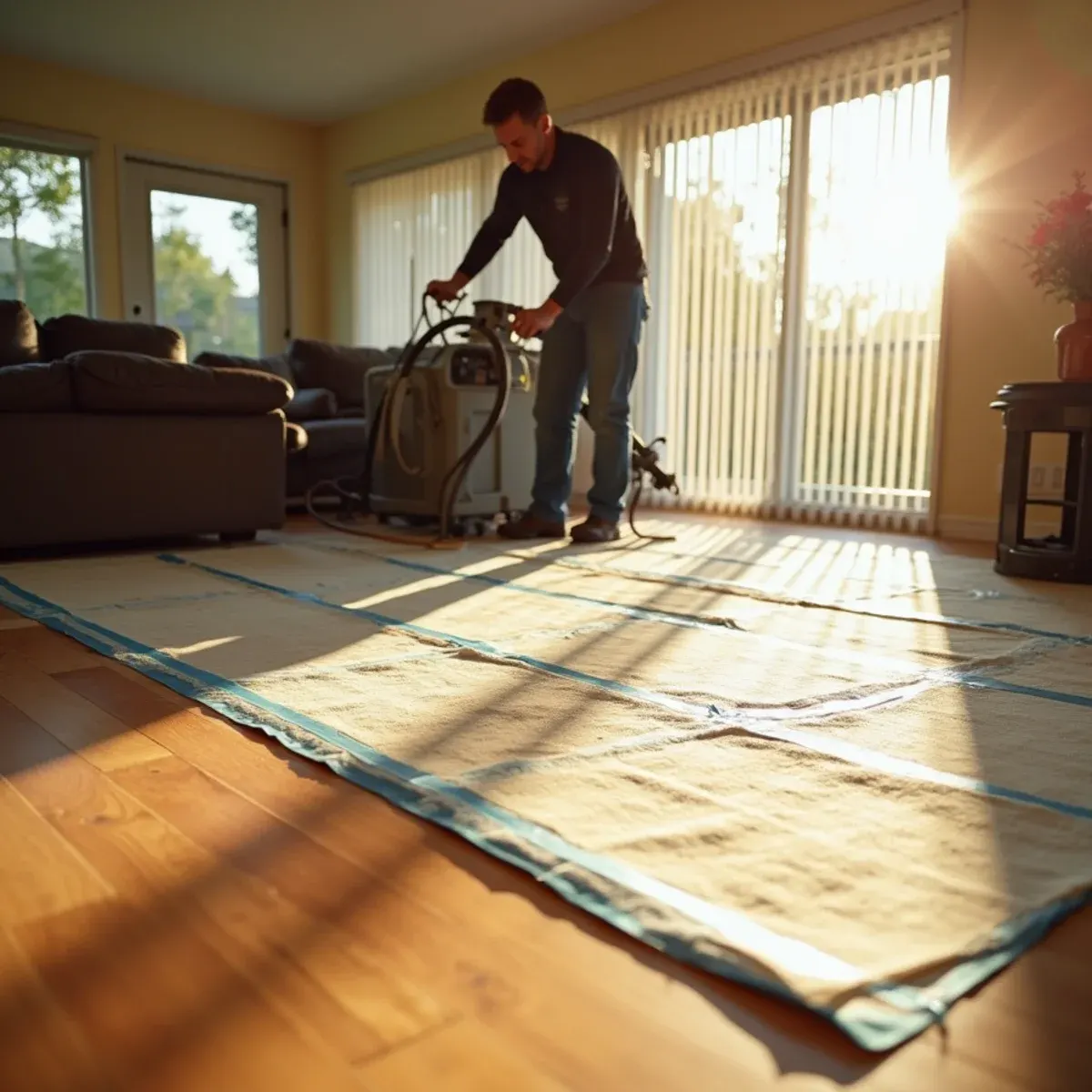
Let us start with the hard part. When water comes off the San Gabriel River channel or backs up out of a street drain and gets into a Norwalk house, that is not clean water, and a wood floor that soaked it up does not get dried. Under IICRC S500:2025 it comes out. We would rather say that on the first visit than take a week of your money proving it. The channel along the western edge carries a very large share of regional runoff, and the neighborhoods beside it saturate quickly when it is running high.
The far more common call is the other kind, and that one we like. Original galvanized supply lines from the postwar build-out are failing all over this city. Scale narrows the pipe, a fitting erodes, and clean water runs out across the floor. Solid wood that takes clean water and gets mats on it within a day usually comes back. These are small lots and modest homes built fast between 1945 and 1960, almost all slab, so there is no crawl space to work from and the mat system carries the entire job.
What Norwalk Changes About Hardwood Floor Drying
1Clean water and channel water differ
A supply-line failure is a drying problem. Water that came off the San Gabriel River channel or backed out of a street drain is Category 3 under IICRC S500:2025, and porous wood that absorbed it gets removed rather than dried. We tell you which one you have on the first visit, because the two lead to completely different weeks and completely different costs.
2Small lots leave nothing to absorb runoff
Postwar Norwalk was built compact: modest homes, small lots, very little ground between the street and the house. There is barely any soil to take up water, so when the yard and area drains silt up, runoff has nowhere to go but against the walls. Clearing those drains before the season is the cheapest floor protection available here.
3Document before anything comes out
Where flooring has to be removed, what happens in the first hour matters more than the removal itself. Moisture readings, photographs, water line marks and material samples all get recorded before demolition starts. We bill insurance directly, and a claim involving the channel gets looked at closely, so that documentation is what carries it through.
How the Work Runs
The method is the same one we use on every hardwood floor drying job, documented to the IICRC S500:2025 standard. Here it is in short — the full hardwood floor water damage drying process explains each stage in detail.
- Measure before deciding anything
- Extract from below the surface
- Control the drying rate deliberately
- Dry the subfloor and any cavity below
- Let it acclimate before judging it
- Sand and refinish only if needed
The Norwalk Background Worth Knowing
The homes built in Norwalk during the postwar surge were built to be affordable and built fast, which was exactly the right priority at the time. Seventy years later, some of those choices have consequences.
There is more on the housing stock, drainage and plumbing history of this city on our water damage restoration in Norwalk page.
Norwalk at a glance
- Dominant construction era
- 1945–1960
- Foundation type
- slab on grade
- Supply piping found here
- original galvanized steel
- Drain line materials
- cast iron
- Terrain and water table
- flat, moderate water table
- Most common local failure
- original galvanized supply lines failing after decades of internal scaling and erosion at fittings
- Highest-value local prevention
- clearing yard and area drains before the season, since small lots leave little ground between the street and the house
What It Costs in Norwalk
We do not quote a number over the phone before seeing the property — anyone who does is guessing. The variables that actually move the price on a hardwood floor drying job are square footage under the mat system, solid versus engineered wood, what is underneath, and they are broken down in full on the hardwood floor water damage drying page. The assessment and the written estimate are free anywhere in Norwalk, day or night, with no obligation.
Hardwood Floor Drying Questions from Norwalk Homeowners
Honestly, usually not the finish flooring itself. Channel and street-drain water is Category 3, and wood that absorbed it comes out under the standard rather than getting dried in place. What can very often be saved is the structure below, the slab, the framing and the wall assemblies, and drying those quickly is what gets you back in sooner. A clean supply leak is a different story entirely.
Frequently, yes. Cupping is caused by uneven moisture between the top and bottom of each board, and when the moisture equalizes during controlled drying, much of the deformation reverses. Full flattening can take two to four weeks of acclimation after the equipment comes out, which is why we do not recommend sanding immediately.
Five to ten days under the mat system is typical, which is longer than drywall because wood gives up moisture slowly and has to be dried at a controlled rate. Rushing it causes splitting and permanent gapping, so the extra days are doing real work.
If it is original galvanized from the postwar build-out, it has exceeded any reasonable service life. If you have had one failure, a second is a matter of when. The cheapest moment to repipe is while walls are already open for a repair — the demolition and patching are already in the scope.