
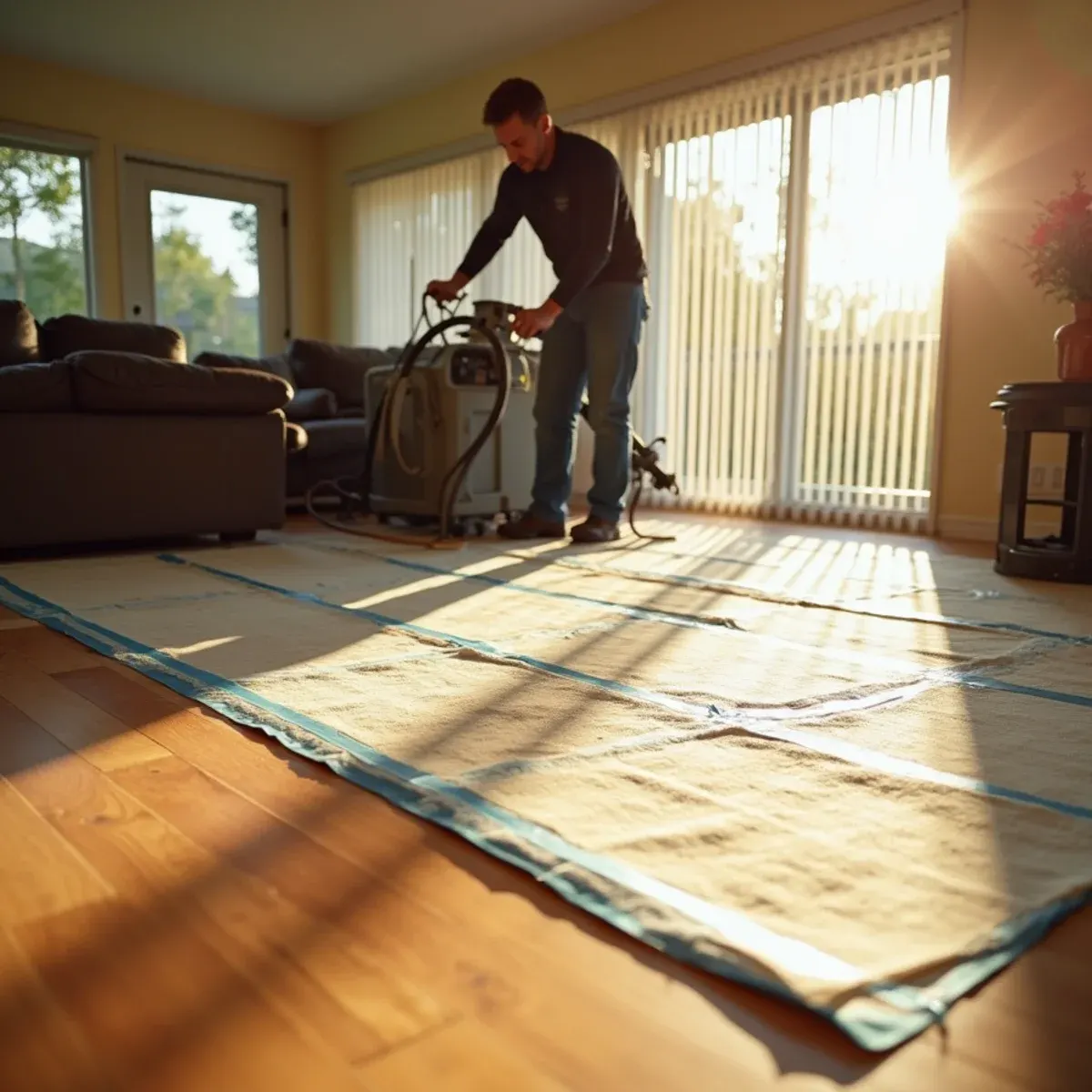
Carson has one of the larger mobile home park populations in the area, and that changes the first question we ask on the phone. In a manufactured home the wood-look flooring sits on particleboard decking with insulation and a belly wrap underneath, and once water gets into that assembly it stays there. The decking swells, loses its bond and turns soft. No mat system fixes that, because the problem isn't the surface layer. If your floor feels spongy underfoot, treat it as wet until a meter proves otherwise.
The conventional tract housing in Scottsdale, Carson Park and Victoria is a different job. Those are 1950s-to-1970s slab homes with galvanized and under-slab copper, and the wood floors in them are retrofits. Shallow groundwater near the harbor flats keeps those slabs damp, so we set drying goals against unaffected sections of the same floor rather than assuming a dry substrate. Where we find solid wood nailed to plywood, the odds are good. Where it's floating plank with a fiberboard core, we say so on the first visit.
What Carson Changes About Hardwood Floor Drying
1Belly wrap traps water underneath
In a manufactured home the underfloor insulation and belly wrap hold water against the particleboard decking, out of sight and out of any airflow. Surface drying does nothing for it. The wrap has to be opened, saturated insulation pulled, and the decking read directly. Anyone who dries only the top of that floor is leaving the actual problem sealed in place beneath you.
2Park spacing limits what we can stage
Space between coaches in Carson's mobile home parks is tight, and available power is limited by the pedestal. We plan equipment over the phone before dispatch — how many units the service will carry, where the dehumidifier sits, whether we need to bring our own power. It saves an hour of standing in a narrow driveway working it out after the truck arrives.
3Damp slabs under retrofit tract floors
The 1950s-to-1970s houses in Scottsdale, Carson Park and Victoria sit over shallow groundwater near the harbor flats, and their slabs stay damp year-round. The wood floors in them are retrofits laid over that slab. We set the drying goal against an unaffected part of the same floor rather than assuming the substrate reaches a textbook number, because here it won't.
How the Work Runs
The method is the same one we use on every hardwood floor drying job, documented to the IICRC S500:2025 standard. Here it is in short — the full hardwood floor water damage drying process explains each stage in detail.
- Measure before deciding anything
- Extract from below the surface
- Control the drying rate deliberately
- Dry the subfloor and any cavity below
- Let it acclimate before judging it
- Sand and refinish only if needed
The Carson Background Worth Knowing
Manufactured homes are built with the floor deck, usually particleboard or OSB, sitting on a steel frame, with batt insulation below it and a vapor barrier belly wrap stapled underneath to hold everything in place. Supply lines run through that cavity. When one leaks, the water does not run out onto the ground where you would see it. The belly wrap catches and holds it, the insulation soaks it up, and you now have a sealed reservoir under your floor with no path to evaporate. It can sit there for months before anything shows upstairs.
There is more on the housing stock, drainage and plumbing history of this city on our water damage restoration in Carson page.
Carson at a glance
- Dominant construction era
- 1950–1975
- Foundation type
- slab on grade
- Supply piping found here
- galvanized steel, under-slab copper, manufactured-home supply lines
- Drain line materials
- cast iron
- Terrain and water table
- flat, shallow water table
- Most common local failure
- manufactured-home underfloor leaks trapped in the belly wrap, alongside conventional 1960s slab failures
- Highest-value local prevention
- treating any soft spot in a manufactured-home floor as moisture until a meter proves otherwise
What It Costs in Carson
We do not quote a number over the phone before seeing the property — anyone who does is guessing. The variables that actually move the price on a hardwood floor drying job are square footage under the mat system, solid versus engineered wood, what is underneath, and they are broken down in full on the hardwood floor water damage drying page. The assessment and the written estimate are free anywhere in Carson, day or night, with no obligation.
Hardwood Floor Drying Questions from Carson Homeowners
Soft usually means the particleboard decking has already lost its bond, and drying doesn't reverse that. We'll open the belly wrap underneath, read the decking directly, and show you what we find. If it's still firm and only the surface layer is wet, we can dry it. If it crumbles at the edge of the meter pin, that section gets cut out and replaced, and we dry the framing and cavity so the new decking goes down dry.
Frequently, yes. Cupping is caused by uneven moisture between the top and bottom of each board, and when the moisture equalizes during controlled drying, much of the deformation reverses. Full flattening can take two to four weeks of acclimation after the equipment comes out, which is why we do not recommend sanding immediately.
Five to ten days under the mat system is typical, which is longer than drywall because wood gives up moisture slowly and has to be dried at a controlled rate. Rushing it causes splitting and permanent gapping, so the extra days are doing real work.
By locating it rather than arguing about it. The dividing line is the connection point where the park's service meets your home. Upstream of that is the park's responsibility, downstream is yours. We open the belly wrap where water is pooling, trace the wet path back to its source, and photograph what we find with the connection in frame. That documentation settles the question. Guessing from where the wet spot showed up inside is unreliable, because water travels along the frame first.