
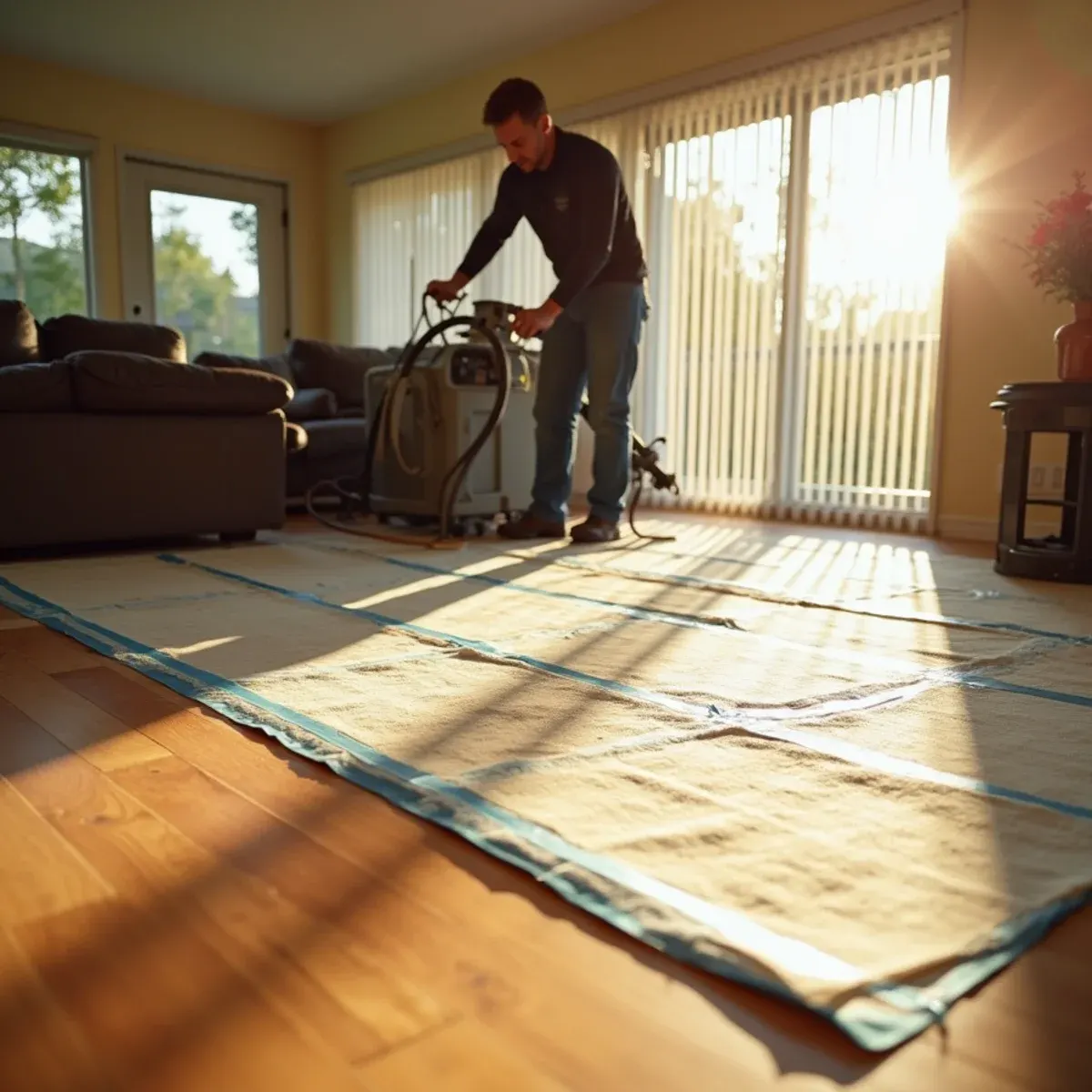
A 365-foot hill completely surrounded by Long Beach behaves nothing like the flat cities around it. Water here doesn't pond and soak in — it moves, and it moves fast. On the steep engineered lots around Panorama and Hilltop, a blocked terrace drain or a plugged retaining-wall weep sends a sheet of water at a garage or a lower-level slider with real velocity, and it's inside and traveling under the flooring before anyone gets to a door with a towel.
The 1990s and 2000s townhomes built on former oil land add a second problem: they stack. Wide-plank engineered flooring on an upper level over wood framing means a supply failure doesn't stay in one unit — it goes through the floor assembly and shows up as a stained ceiling downstairs or next door. We have to dry the floor from above and the cavity from below, coordinate with an HOA, and be blunt early about which planks are coming out. The older 1920s houses on the hill have solid wood, and those we can usually save.
What Signal Hill Changes About Hardwood Floor Drying
1One floor, two ceilings, three parties
In the hillside townhomes and condos built on former oil land, an upper-unit failure is never one household's problem. We dry the floor from above and the ceiling cavity below at the same time, and there's usually an HOA deciding who authorizes what. We keep the readings and the documentation separated by unit so two claims and a shared assembly don't get tangled together.
2Slope water arrives with velocity
On a hill this steep, runoff doesn't pond and seep — it moves. A blocked terrace drain or a plugged retaining-wall weep above a Panorama or Hilltop lot sends a sheet of water at a lower-level slider hard enough to push past a threshold seal. It gets under the flooring at speed and travels considerably farther than the visible wet line suggests.
3Marine air limits ventilation drying
Surrounded by Long Beach and close enough to the water that the marine layer sits on the hill most mornings, this is not a place to open windows and run fans. We close the space and dry mechanically. It adds time compared with a job in Yorba Linda or Placentia, and we'd rather set that expectation on day one than explain it on day four.
How the Work Runs
The method is the same one we use on every hardwood floor drying job, documented to the IICRC S500:2025 standard. Here it is in short — the full hardwood floor water damage drying process explains each stage in detail.
- Measure before deciding anything
- Extract from below the surface
- Control the drying rate deliberately
- Dry the subfloor and any cavity below
- Let it acclimate before judging it
- Sand and refinish only if needed
The Signal Hill Background Worth Knowing
On these lots the drainage is engineered rather than natural. Terrace drains catch water partway down a slope, v-ditches carry it around a pad instead of across it, and retaining walls have weep holes with a gravel drain behind them so pressure never builds in the soil. All of that works until something clogs. Then a retaining wall stops being a wall and starts being a dam, and saturated soil pushes water through the joints and into whatever sits on the other side, which is usually a garage, a storage room, or the back of a lower level.
There is more on the housing stock, drainage and plumbing history of this city on our water damage restoration in Signal Hill page.
Signal Hill at a glance
- Dominant construction era
- 1920–2005
- Foundation type
- mixed on grade
- Supply piping found here
- original 1920s piping, galvanized steel, modern PEX in newer hillside builds
- Drain line materials
- cast iron, ABS
- Terrain and water table
- hillside-mixed, deep water table
- Most common local failure
- slope drainage and retaining-wall failures on steep lots, where water arrives with velocity rather than ponding
- Highest-value local prevention
- keeping terrace drains, v-ditches and retaining-wall weeps clear before the first storm
What It Costs in Signal Hill
We do not quote a number over the phone before seeing the property — anyone who does is guessing. The variables that actually move the price on a hardwood floor drying job are square footage under the mat system, solid versus engineered wood, what is underneath, and they are broken down in full on the hardwood floor water damage drying page. The assessment and the written estimate are free anywhere in Signal Hill, day or night, with no obligation.
Hardwood Floor Drying Questions from Signal Hill Homeowners
First we stop the source and pull standing water, then read your floor and the ceiling cavity between the units, because both are part of the same assembly. Buckled engineered plank that has lifted off the subfloor rarely lies back down, so expect some removal along the worst run. We document your unit separately from the one above, which matters a great deal when two policies and an HOA are all involved.
Frequently, yes. Cupping is caused by uneven moisture between the top and bottom of each board, and when the moisture equalizes during controlled drying, much of the deformation reverses. Full flattening can take two to four weeks of acclimation after the equipment comes out, which is why we do not recommend sanding immediately.
Five to ten days under the mat system is typical, which is longer than drywall because wood gives up moisture slowly and has to be dried at a controlled rate. Rushing it causes splitting and permanent gapping, so the extra days are doing real work.
Start uphill. On this hill the cause is almost never at the place the water got in. Walk the slope above your pad and check the terrace drains, the v-ditch and the retaining wall weep holes. A weep that has been painted or stuccoed over is common and completely disables the drain behind the wall. Then look at where the uphill property discharges. Fixing the entry point without finding the redirect just moves the problem a few feet.