
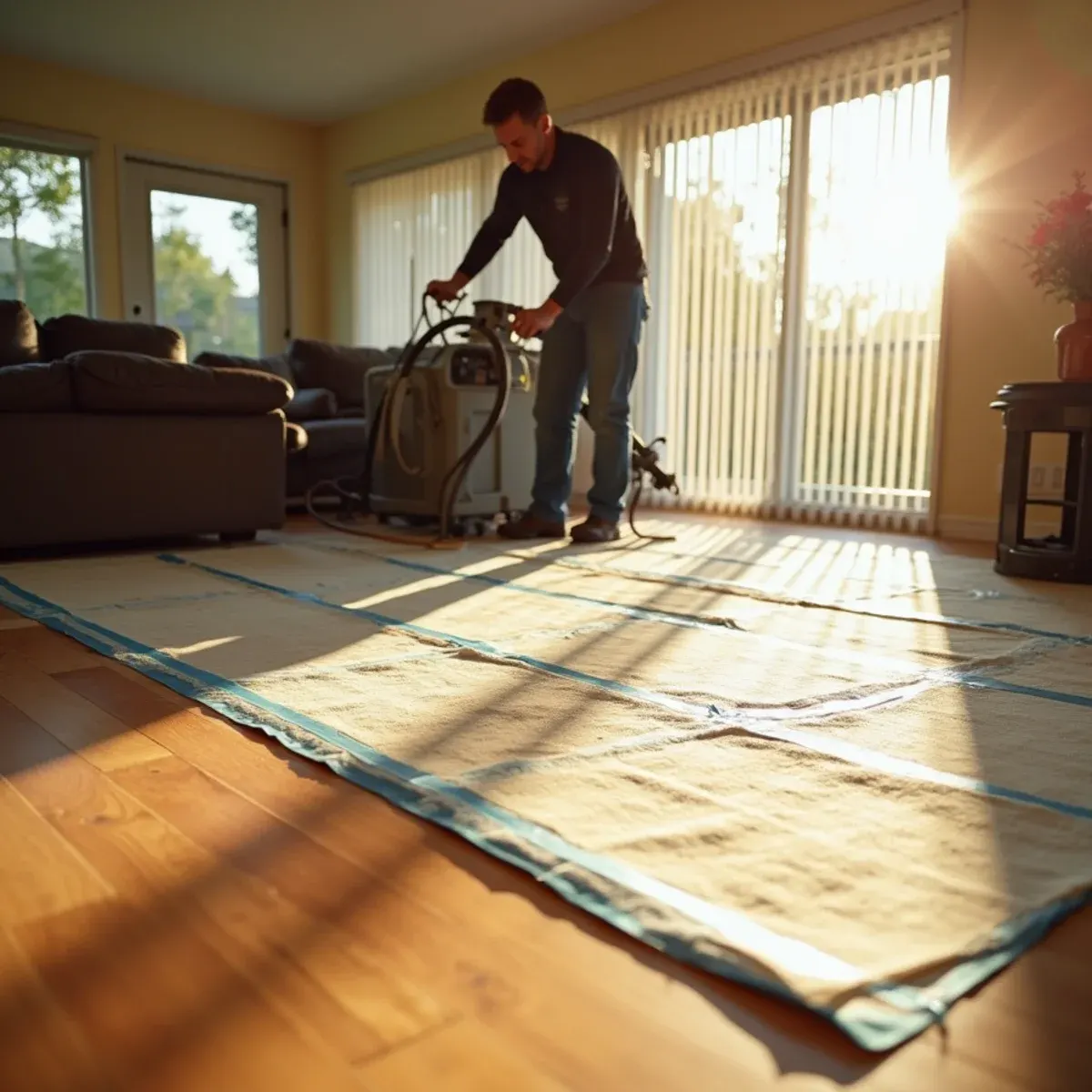
Bellflower filled in fast after the war with small houses on small lots, and a lot of those original galvanized supply lines are still in service at eighty years old. Galvanized rarely bursts. It weeps — a pinhole behind a wall or under a slab, a few ounces an hour, sometimes for weeks. That slow feed is exactly what ruins a wood floor, because the boards have time to take on moisture uniformly from below and cup deeply before there's ever standing water anywhere to explain it.
The other half of our work here is multi-family. When an upstairs unit floods along the Bellflower Boulevard corridor, water travels down through the framing and reaches the wood or laminate floor of the unit below from underneath. That's a harder dry and a more complicated conversation, since two households and usually a property manager are involved. We document moisture readings for each unit separately, so nobody's floor gets written off on the strength of somebody else's numbers.
What Bellflower Changes About Hardwood Floor Drying
1Weeping galvanized cups floors deeply
Eighty-year-old galvanized rarely fails dramatically. It weeps, a few ounces an hour, sometimes for weeks. That slow steady feed soaks the underside of the flooring uniformly and produces heavy cupping with no puddle anywhere to explain it. The upside is that slow, even wetting usually dries back flat, provided nobody sands the floor before the moisture content has fully equalized.
2Upstairs unit, downstairs floor
A lot of the housing along Bellflower Boulevard is multi-family. When a unit floods, water travels through the framing and reaches the floor below from underneath, which is the harder direction to dry. We document readings unit by unit so one tenant's numbers don't decide another tenant's floor, and we coordinate access through the property manager rather than guessing at everyone's schedule.
3Small houses, tight equipment plans
These are compact postwar plans on small lots, and drying equipment takes up real space inside them. We talk through placement before setting anything — where you'll walk, which room stays usable, how power gets divided so we don't trip a 1950s panel. Families usually stay in the house through a floor dry-out here, and it should stay livable while we work.
How the Work Runs
The method is the same one we use on every hardwood floor drying job, documented to the IICRC S500:2025 standard. Here it is in short — the full hardwood floor water damage drying process explains each stage in detail.
- Measure before deciding anything
- Extract from below the surface
- Control the drying rate deliberately
- Dry the subfloor and any cavity below
- Let it acclimate before judging it
- Sand and refinish only if needed
The Bellflower Background Worth Knowing
Galvanized steel was the standard supply pipe when Bellflower was being built, and it fails from the inside out. The zinc lining wears through, the steel underneath corrodes, and scale builds on the interior wall until the pipe is a fraction of its original diameter. Narrower pipe means faster, more turbulent water, which chews at elbows and threaded fittings until one of them lets go. Hot lines corrode faster than cold, which is why hot water pressure is usually the first thing to drop. Eighty years is well past any service life anyone intended when this was installed.
There is more on the housing stock, drainage and plumbing history of this city on our water damage restoration in Bellflower page.
Bellflower at a glance
- Dominant construction era
- 1940–1960
- Foundation type
- slab on grade
- Supply piping found here
- original galvanized steel, early copper
- Drain line materials
- cast iron
- Terrain and water table
- flat, moderate water table
- Most common local failure
- original galvanized supply lines and cast-iron laterals failing together in the same decade
- Highest-value local prevention
- scoping the sewer lateral, which on a house this age has usually never been looked at
What It Costs in Bellflower
We do not quote a number over the phone before seeing the property — anyone who does is guessing. The variables that actually move the price on a hardwood floor drying job are square footage under the mat system, solid versus engineered wood, what is underneath, and they are broken down in full on the hardwood floor water damage drying page. The assessment and the written estimate are free anywhere in Bellflower, day or night, with no obligation.
Hardwood Floor Drying Questions from Bellflower Homeowners
Small and slow is worse for wood than big and fast. A pinhole in galvanized feeds moisture into the underside of the boards for weeks, and the wood absorbs it steadily until the bottom of each board is far wetter than the top. That difference is what cups a floor. A sudden spill sits on the finished surface where you see it and mop it. The good news is this kind of uniform wetting usually reverses well.
Frequently, yes. Cupping is caused by uneven moisture between the top and bottom of each board, and when the moisture equalizes during controlled drying, much of the deformation reverses. Full flattening can take two to four weeks of acclimation after the equipment comes out, which is why we do not recommend sanding immediately.
Five to ten days under the mat system is typical, which is longer than drywall because wood gives up moisture slowly and has to be dried at a controlled rate. Rushing it causes splitting and permanent gapping, so the extra days are doing real work.
It is the most common gap we see here. A cast iron lateral that age has corroded along the bottom, the joints have shifted, and the parkway trees on most Bellflower streets have had seventy years to find them. A camera inspection costs a small fraction of a sewage remediation, and on a line that has never been scoped it usually finds something worth knowing about before it finds you at two in the morning.