
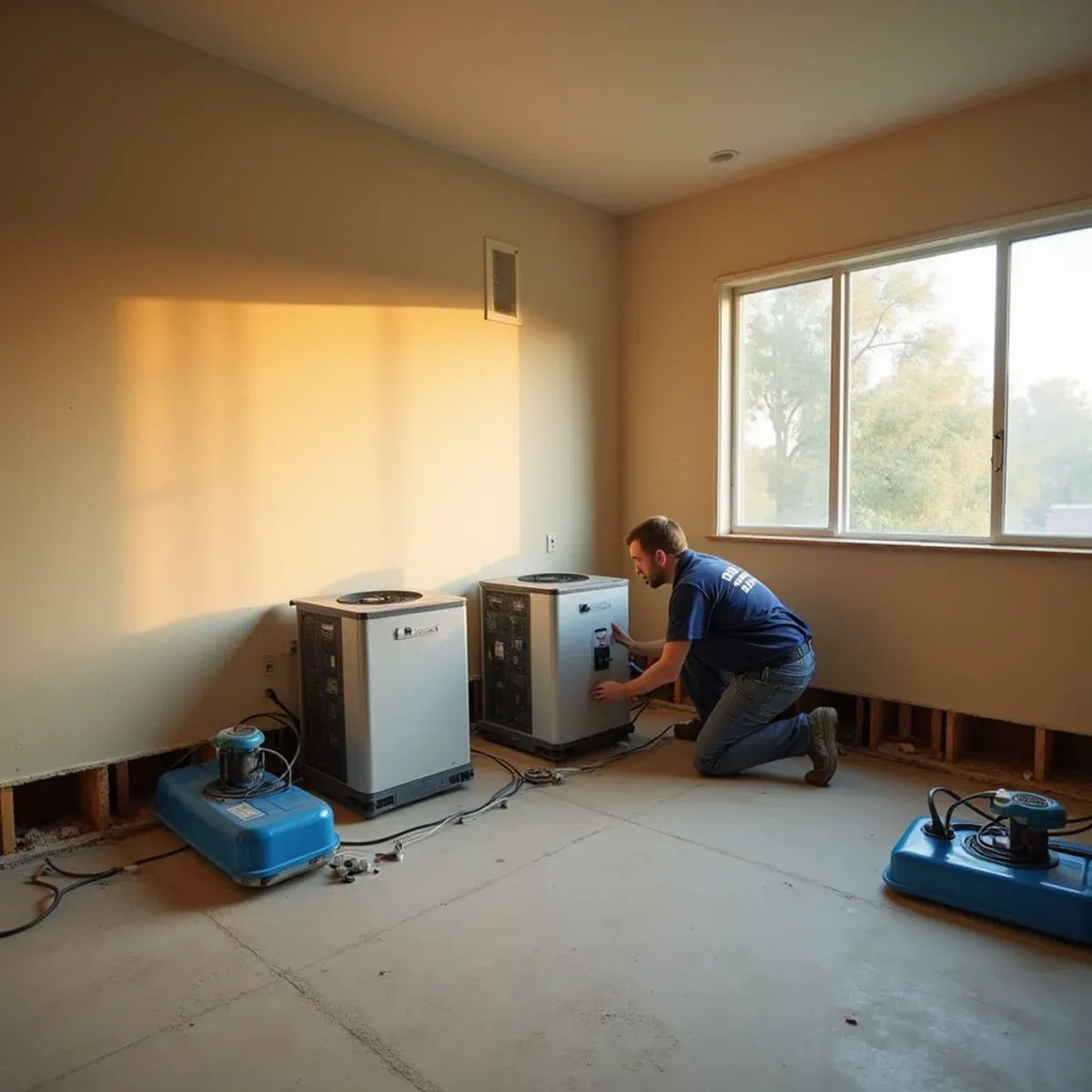
Eighty years is a long time for a water line. Bellflower filled in fast after the war, small houses on small lots where the dairy and orchard land had been, and a lot of those original systems are still in service. Galvanized supply and cast-iron drains tend to reach the end of their lives in the same decade, so we often arrive at a house with a supply pinhole in a wall and a slow drain problem under the slab at the same time. Rooms are compact, ceilings are low, and there's rarely a spare corner to park equipment.
The power situation shapes these jobs more than anything else. A modest service with few circuits feeding the whole house won't run a full complement of air movers and an LGR without tripping, so we count the load, split it across circuits and bring distribution when we have to. On houses this age we also lean hard toward drying in place. Pre-1980 flooring adhesives and ceiling textures are worth leaving undisturbed, and testing before demolition is far cheaper than the alternative.
What Bellflower Changes About Structural Drying
1Small services cap the equipment count
Postwar houses here often run a modest electrical service with few circuits for the whole floor plan. Air movers and an LGR pull real current, and a breaker tripping at two in the morning quietly kills a night of drying. We count the load first, spread it across circuits, and bring our own distribution when the house simply can't carry a full chamber on its own.
2Pre-1980 materials favor drying over demolition
Flooring adhesives, sheet goods and ceiling textures from the 1940s and 1950s are best left undisturbed, and disturbing them turns a drying job into a very different kind of project. That makes drying in place the preferred route on Bellflower houses, with testing before anything gets cut. Where readings say a material can't be saved, we say so and have it handled properly.
3Duplexes and fourplexes dry as one job
There's a lot of multi-family here, much of it on the same eighty-year-old plumbing. A supply failure in one unit is usually moisture in the shared wall of the next, so we meter adjoining units before setting equipment and coordinate access with the owner. Drying one side of a party wall is drying half a wall, and the other half will tell on you eventually.
How the Work Runs
The method is the same one we use on every structural drying job, documented to the IICRC S500:2025 standard. Here it is in short — the full structural drying & dehumidification process explains each stage in detail.
- Establish the dry standard
- Calculate the load and build the chamber
- Place air movers for surface evaporation
- Run LGR dehumidification to capture the moisture
- Monitor and adjust daily
- Verify, document, and demobilize
The Bellflower Background Worth Knowing
Galvanized steel was the standard supply pipe when Bellflower was being built, and it fails from the inside out. The zinc lining wears through, the steel underneath corrodes, and scale builds on the interior wall until the pipe is a fraction of its original diameter. Narrower pipe means faster, more turbulent water, which chews at elbows and threaded fittings until one of them lets go. Hot lines corrode faster than cold, which is why hot water pressure is usually the first thing to drop. Eighty years is well past any service life anyone intended when this was installed.
There is more on the housing stock, drainage and plumbing history of this city on our water damage restoration in Bellflower page.
Bellflower at a glance
- Dominant construction era
- 1940–1960
- Foundation type
- slab on grade
- Supply piping found here
- original galvanized steel, early copper
- Drain line materials
- cast iron
- Terrain and water table
- flat, moderate water table
- Most common local failure
- original galvanized supply lines and cast-iron laterals failing together in the same decade
- Highest-value local prevention
- scoping the sewer lateral, which on a house this age has usually never been looked at
What It Costs in Bellflower
We do not quote a number over the phone before seeing the property — anyone who does is guessing. The variables that actually move the price on a structural drying job are size of the drying chamber, class of water intrusion, material types involved, and they are broken down in full on the structural drying & dehumidification page. The assessment and the written estimate are free anywhere in Bellflower, day or night, with no obligation.
Structural Drying Questions from Bellflower Homeowners
It's a fair question on a house this age. We calculate amp draw before setting anything, split the load across circuits, and bring our own distribution rather than trusting a small panel. The equipment does use power, and yes, you'll see it. We log runtime hours for every machine so that cost goes into the claim file with everything else instead of quietly landing on you at the end of the job.
Three to five days covers most residential losses. Saturated hardwood, plaster, or a concrete slab can run seven or more. We will give you an estimated window after the first readings and update you daily — and equipment comes out when the numbers say so, not on a fixed schedule.
We would rather you did not. Drying is a continuous process, and every hour off extends the total run — which usually costs more than the sleep is worth. If noise is genuinely unmanageable we can often reconfigure the chamber or reposition units to reduce it. Talk to us instead of unplugging them.
It is the most common gap we see here. A cast iron lateral that age has corroded along the bottom, the joints have shifted, and the parkway trees on most Bellflower streets have had seventy years to find them. A camera inspection costs a small fraction of a sewage remediation, and on a line that has never been scoped it usually finds something worth knowing about before it finds you at two in the morning.