
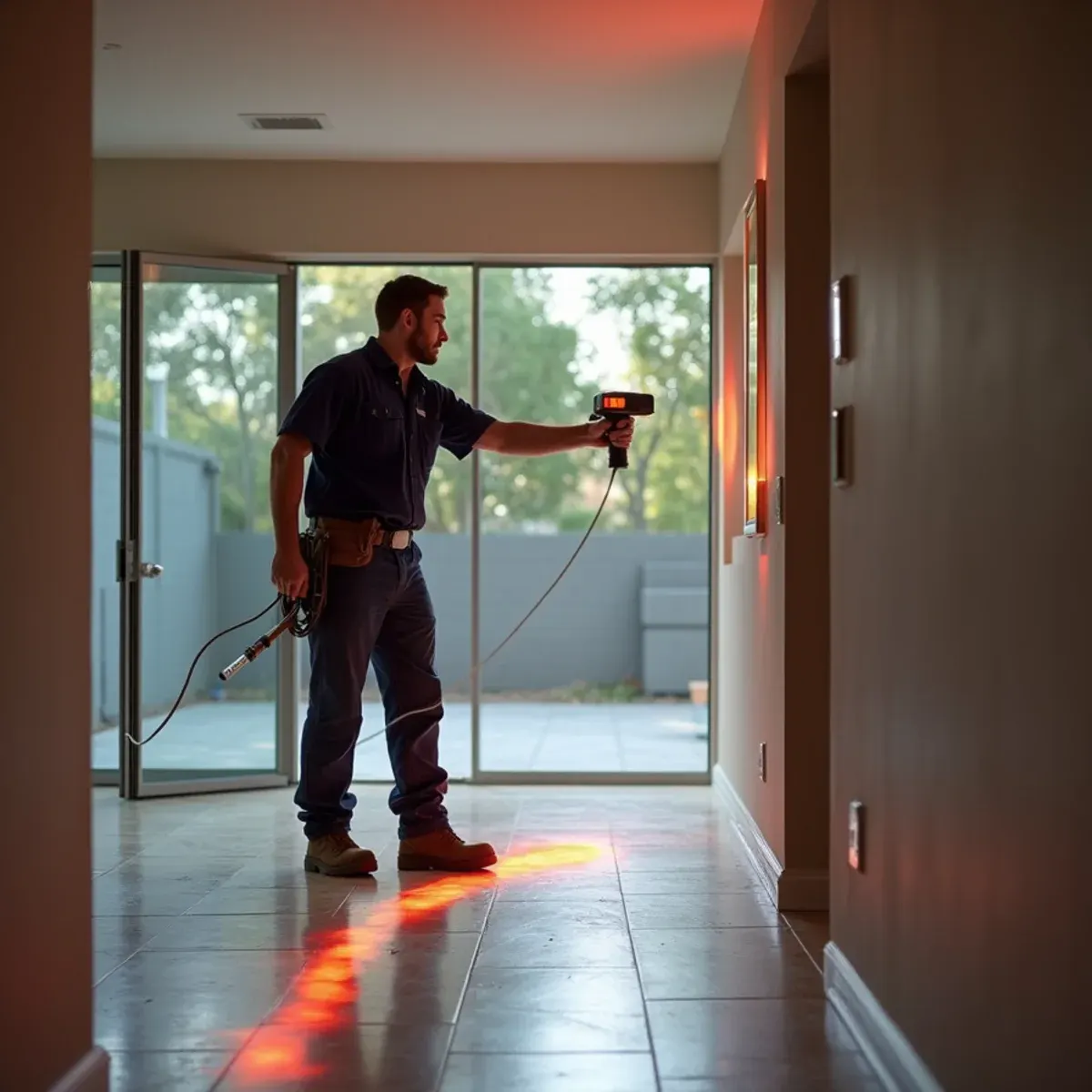
Bellflower's houses are older than most people assume — small postwar places on small lots, filled in fast over dairy and orchard land between about 1940 and 1960. A lot of them still have their original galvanized supply lines. Eighty years is well past what galvanized was ever meant to do. It corrodes from the inside, chokes down, and then goes at a thread or a pinhole, and the ones we find in the slab are usually not the only tired section in the house.
That's why a Bellflower slab leak call so often turns into a longer conversation. We'll do the spot repair if that's what you want, and sometimes it's genuinely the right call. But if we cut a section of pipe out and the wall is down to nothing, we'll tell you that too. The multi-family stock along Bellflower Boulevard and the Rosecrans corridor adds another wrinkle: one slab, several units, and a shutoff that may serve neighbors who had no idea anything was wrong.
What Bellflower Changes About Slab Leak Damage
1Galvanized rarely fails just once
When we cut out a failed section in a 1940s or 1950s Bellflower house and the pipe wall is paper thin, that condition doesn't stop at the cut line. We'll show you the piece we removed and let you decide. Some homeowners want the spot repair and a few more years; others would rather pay once for a reroute. Both are reasonable, and we do both.
2Small lots, tight side yards
Setbacks here run narrow, and equipment access matters more than people expect. Getting a jackhammer, a vacuum and drying gear to the far side of the house sometimes means going through it. We plan the path first and protect the route, because dragging equipment across finished floors causes more damage on some jobs than the leak itself did.
3Duplexes with one slab and one valve
Much of the multi-family along Bellflower Boulevard and the Rosecrans corridor shares a slab and a service. A leak under one unit wets the neighbor's floor, and the shutoff may sit behind a locked gate. We get owners and managers on the phone early, because who pays for what gets decided by documentation we have to collect while the water is still running.
How the Work Runs
The method is the same one we use on every slab leak damage job, documented to the IICRC S500:2025 standard. Here it is in short — the full slab leak water damage repair process explains each stage in detail.
- Confirm it is actually a slab leak
- Electronic leak location
- Choose the repair approach with you
- Dry the slab and the affected assemblies
- Address the flooring and wall base
- Restore the floor and finish
The Bellflower Background Worth Knowing
Galvanized steel was the standard supply pipe when Bellflower was being built, and it fails from the inside out. The zinc lining wears through, the steel underneath corrodes, and scale builds on the interior wall until the pipe is a fraction of its original diameter. Narrower pipe means faster, more turbulent water, which chews at elbows and threaded fittings until one of them lets go. Hot lines corrode faster than cold, which is why hot water pressure is usually the first thing to drop. Eighty years is well past any service life anyone intended when this was installed.
There is more on the housing stock, drainage and plumbing history of this city on our water damage restoration in Bellflower page.
Bellflower at a glance
- Dominant construction era
- 1940–1960
- Foundation type
- slab on grade
- Supply piping found here
- original galvanized steel, early copper
- Drain line materials
- cast iron
- Terrain and water table
- flat, moderate water table
- Most common local failure
- original galvanized supply lines and cast-iron laterals failing together in the same decade
- Highest-value local prevention
- scoping the sewer lateral, which on a house this age has usually never been looked at
What It Costs in Bellflower
We do not quote a number over the phone before seeing the property — anyone who does is guessing. The variables that actually move the price on a slab leak damage job are how long the leak ran undetected, flooring type over the leak, repair method chosen, and they are broken down in full on the slab leak water damage repair page. The assessment and the written estimate are free anywhere in Bellflower, day or night, with no obligation.
Slab Leak Damage Questions from Bellflower Homeowners
Depends on what comes out of the floor. If the removed section still has decent wall thickness and the failure looks like a single defect, a spot repair is honest work. If the galvanized is corroded through its length, you'll be back. On an eighty-year-old Bellflower house we usually see the second case, and we'd rather have that conversation with the pipe in our hand than sell you either answer in advance.
The meter test is the first step: shut off every fixture and watch the low-flow indicator. If it moves and nothing is wet above the floor, suspect the slab. Warm spots on the floor, running-water sounds from below, and flooring that lifts or cups without an obvious cause all point the same direction. We confirm it with thermal imaging and moisture mapping at no charge.
Not always. Depending on where the leak is and the condition of the system, rerouting the line overhead through the attic and walls avoids opening the concrete entirely. When a spot repair is the better option, precise electronic location keeps the opening small — typically a couple of feet, not a trench across the room.
It is the most common gap we see here. A cast iron lateral that age has corroded along the bottom, the joints have shifted, and the parkway trees on most Bellflower streets have had seventy years to find them. A camera inspection costs a small fraction of a sewage remediation, and on a line that has never been scoped it usually finds something worth knowing about before it finds you at two in the morning.