
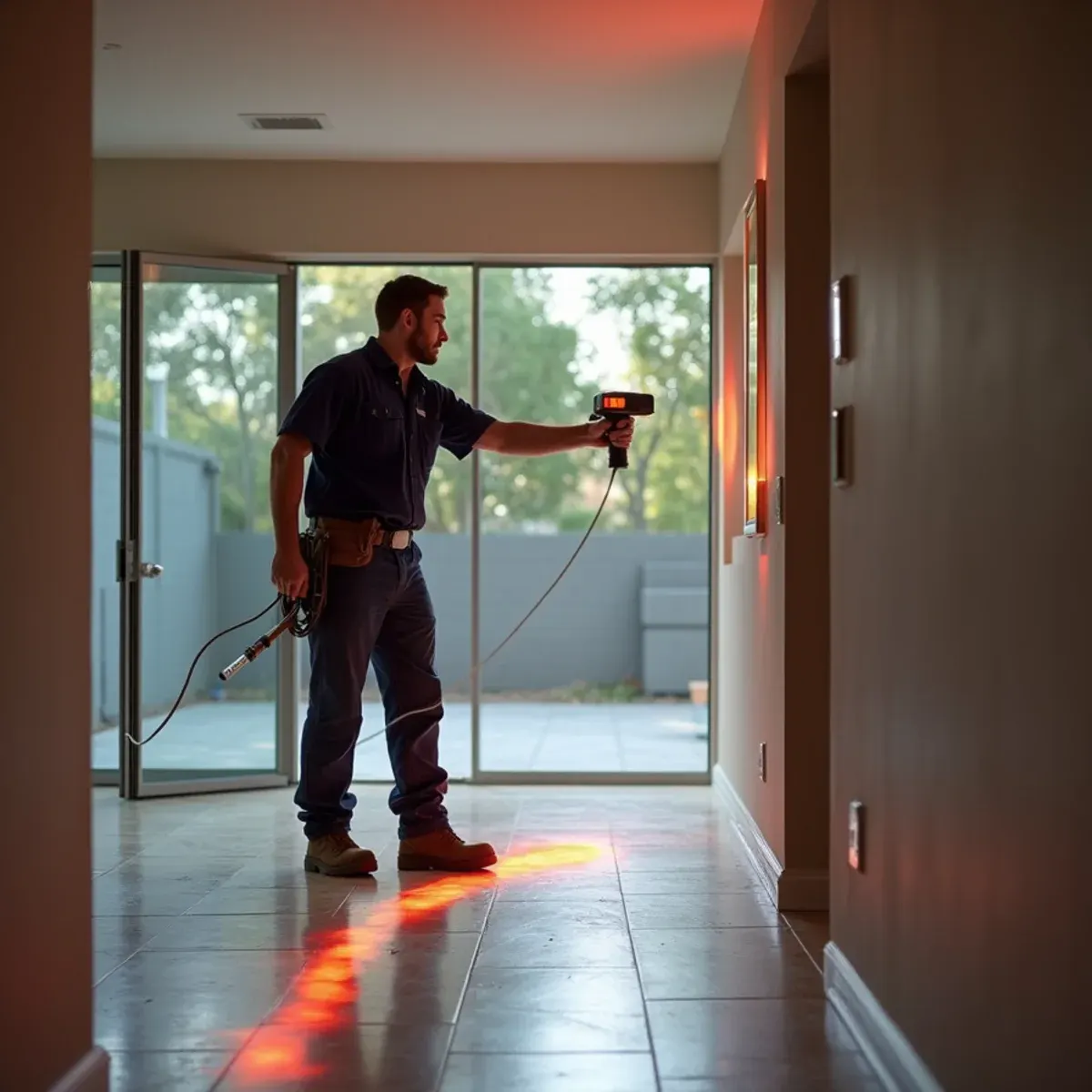
Downey slab leaks come with a preservation problem attached. Jean Vandruff's Cinderella Homes put turrets, arched doorways, scalloped trim and gingerbread detailing on ordinary 1950s tract houses, and none of that woodwork can be bought again. Underneath the detailing it's standard mid-century slab construction — galvanized supply lines, early copper, a slab poured thin over grade. The failures themselves are ordinary. The house around them is not, and a careless access hole costs something real.
So we spend longer on the locate. Meter test, acoustic listening, thermal imaging across the floor, and we mark the smallest opening that will actually get us to the pipe. Where the floor is oak or parquet on sleepers over the slab, water tracks along the sleeper channels and shows up rooms away from the leak, so we map before we cut. Drying in place is the goal whenever readings allow it, and on these houses it's worth the extra equipment days to get there.
What Downey Changes About Slab Leak Damage
1Cinderella trim cannot be replaced
Vandruff's arched doorways, scalloped fascia and gingerbread detailing were milled for these tracts and aren't available now. We plan access cuts to land in closets, under cabinet toe kicks and in low-visibility wall sections, and we protect the millwork before equipment comes in. It costs us time on the locate and saves the homeowner something they cannot buy back.
2Parquet and sleeper floors move water sideways
Plenty of Downey houses have oak or parquet laid over sleepers on the slab. Those channels carry leak water well away from the source, so the buckled section is often two rooms from the pipe. We map the moisture pattern across the whole floor field before deciding where to open it, and we dry the sleeper cavity, not just the surface.
3Galvanized under 1950s slabs
A good share of the mid-century tract here went in with galvanized supply, some of it buried in the pour. Galvanized in concrete corrodes from both sides and gives very little warning before it lets go. When we find it, an overhead reroute usually beats chasing successive pinholes through a floor you care about preserving.
How the Work Runs
The method is the same one we use on every slab leak damage job, documented to the IICRC S500:2025 standard. Here it is in short — the full slab leak water damage repair process explains each stage in detail.
- Confirm it is actually a slab leak
- Electronic leak location
- Choose the repair approach with you
- Dry the slab and the affected assemblies
- Address the flooring and wall base
- Restore the floor and finish
The Downey Background Worth Knowing
The instinct on a wet wall is to open it, and sometimes that is correct. But IICRC S500:2025 is built around restoring rather than replacing wherever the drying goals can genuinely be met, and on a house with original arched casings and applied gingerbread, meeting those goals is worth some patience. We would rather spend three extra days with equipment running than pull a run of trim that would have to be milled from scratch to come back. The standard supports that choice and so does the arithmetic on the estimate, because custom millwork is not cheap and matching a fifties profile is not quick.
There is more on the housing stock, drainage and plumbing history of this city on our water damage restoration in Downey page.
Downey at a glance
- Dominant construction era
- 1950–1965
- Foundation type
- slab on grade
- Supply piping found here
- galvanized steel, under-slab copper
- Drain line materials
- cast iron
- Terrain and water table
- flat, moderate water table
- Most common local failure
- 1950s slab and galvanized failures in houses whose decorative woodwork makes careful, low-demolition drying worth paying for
- Highest-value local prevention
- drying in place wherever readings allow, because the trim and detailing on these houses cannot be bought
What It Costs in Downey
We do not quote a number over the phone before seeing the property — anyone who does is guessing. The variables that actually move the price on a slab leak damage job are how long the leak ran undetected, flooring type over the leak, repair method chosen, and they are broken down in full on the slab leak water damage repair page. The assessment and the written estimate are free anywhere in Downey, day or night, with no obligation.
Slab Leak Damage Questions from Downey Homeowners
That's the goal, and on these houses it drives how we work. We locate with meter isolation, acoustic listening and thermal imaging first, so the opening is as small as the pipe allows. Where the failed run sits under original millwork or continuous parquet, we usually recommend rerouting overhead and abandoning the line in the slab. Drying in place, when readings support it, keeps the original material where it belongs.
The meter test is the first step: shut off every fixture and watch the low-flow indicator. If it moves and nothing is wet above the floor, suspect the slab. Warm spots on the floor, running-water sounds from below, and flooring that lifts or cups without an obvious cause all point the same direction. We confirm it with thermal imaging and moisture mapping at no charge.
Not always. Depending on where the leak is and the condition of the system, rerouting the line overhead through the attic and walls avoids opening the concrete entirely. When a spot repair is the better option, precise electronic location keeps the opening small — typically a couple of feet, not a trench across the room.
Usually, yes. We go into the wall cavity through small ports low on the wall, hidden behind shoe molding or inside a closet, and dry from the inside out rather than taking the finished face off. That takes longer and needs more equipment than gutting the wall would, which is exactly the trade we think is worth making on a house with millwork that cannot be bought. Where it will not work, we tell you early.