
Nobody is manufacturing new Cinderella Homes trim. The turrets, the scalloped bargeboards, the arched doorways and the gingerbread detailing Jean Vandruff put on ordinary 1950s tract housing are the reason people buy these homes, and once they're demolished for drying access they're gone. Underneath the woodwork it's standard mid-century construction — slab on grade, galvanized supply, cast-iron drains — so the failures are ordinary. The response shouldn't be.
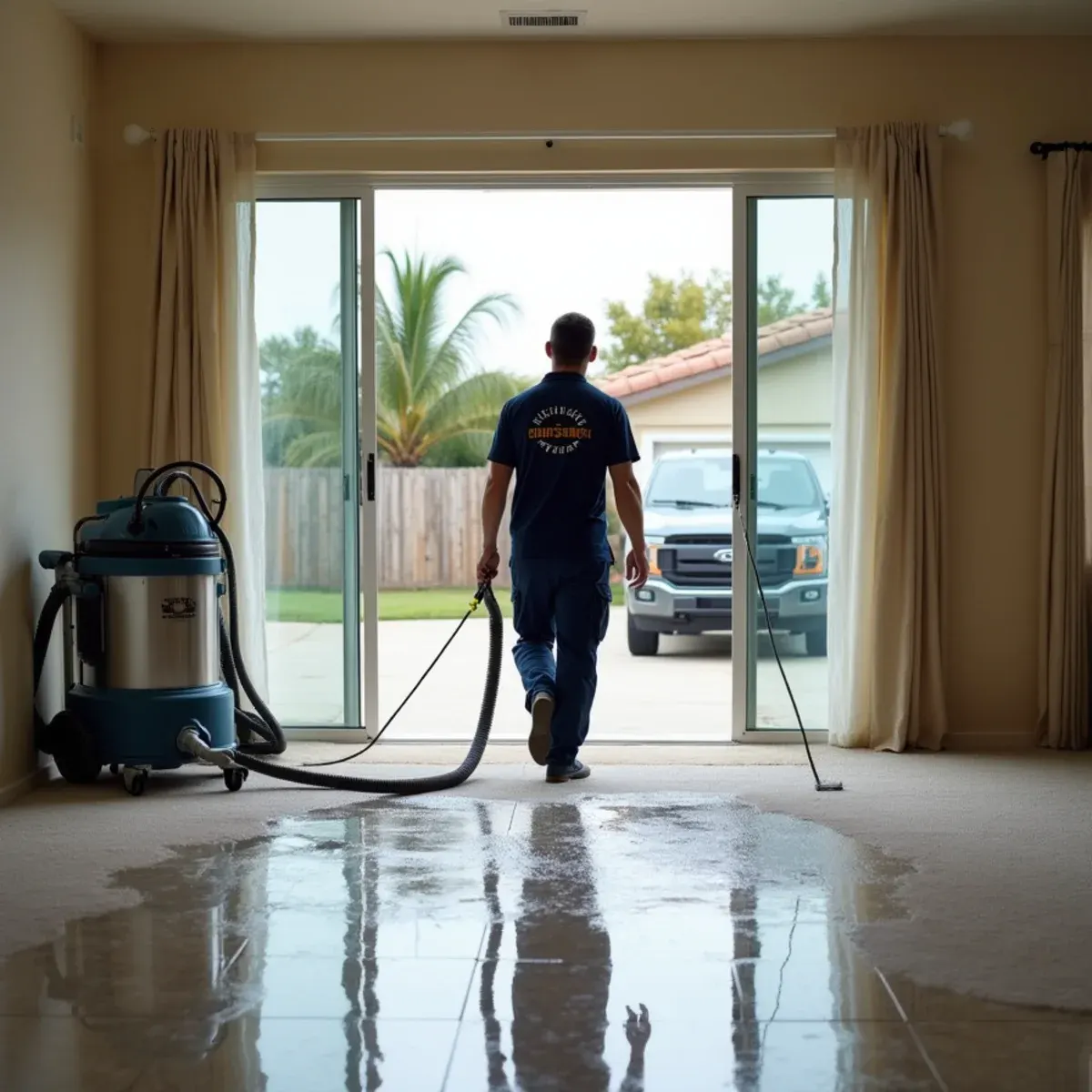
That's why we push extraction so hard on Downey jobs. The more water we physically pull out of carpet, pad, subfloor and wall cavities, the more likely it is we can dry an assembly in place instead of cutting it out. Cavity extraction through small, hidden penetrations behind baseboard, negative-pressure drying inside wall assemblies, and mat systems over hardwood all buy us the option to keep original material. It doesn't always work — saturated pad still comes out, and we'll tell you when a wall has to open. But in the Cinderella tract and the Orange Estates and Rancho Estates streets, we start from the assumption that the finish is worth the extra hours.
What Downey Changes About Water Extraction
1Extraction volume decides demolition scope
Whether a wall can dry in place depends mostly on how much free water is left in it when drying starts. We drill discreet cavity access low on the wall, behind where baseboard will return, and extract from inside the assembly before setting equipment. That single step is often the difference between removing two inches of drywall and removing four feet of it.
2Original oak floors need mat extraction
Many of these houses still have their factory-era hardwood. Weighted carpet tools don't apply, and surface fans alone push water sideways under finish. We use floor mat systems that draw moisture up through the boards under vacuum, monitor with a pinless meter through the drying cycle, and accept that some cupping may relax over weeks rather than pulling boards on day two.
3Galvanized and cast iron of the same vintage
Downey's 1950s stock has supply and waste systems that hit their limits around the same time. We regularly find a supply failure in a house whose cast-iron lateral is also failing quietly. It matters for extraction because it changes water category — a drain-side contribution means the water isn't clean, and porous materials that could otherwise be saved have to come out.
How the Work Runs
The method is the same one we use on every water extraction job, documented to the IICRC S500:2025 standard. Here it is in short — the full water extraction & removal process explains each stage in detail.
- Bulk removal with submersible pumps
- Truck-mounted extraction on carpet and pad
- Hard-surface and specialty extraction
- Cavity and void extraction
- Removing what cannot be saved
- Post-extraction moisture reading
The Downey Background Worth Knowing
The instinct on a wet wall is to open it, and sometimes that is correct. But IICRC S500:2025 is built around restoring rather than replacing wherever the drying goals can genuinely be met, and on a house with original arched casings and applied gingerbread, meeting those goals is worth some patience. We would rather spend three extra days with equipment running than pull a run of trim that would have to be milled from scratch to come back. The standard supports that choice and so does the arithmetic on the estimate, because custom millwork is not cheap and matching a fifties profile is not quick.
There is more on the housing stock, drainage and plumbing history of this city on our water damage restoration in Downey page.
Downey at a glance
- Dominant construction era
- 1950–1965
- Foundation type
- slab on grade
- Supply piping found here
- galvanized steel, under-slab copper
- Drain line materials
- cast iron
- Terrain and water table
- flat, moderate water table
- Most common local failure
- 1950s slab and galvanized failures in houses whose decorative woodwork makes careful, low-demolition drying worth paying for
- Highest-value local prevention
- drying in place wherever readings allow, because the trim and detailing on these houses cannot be bought
What It Costs in Downey
We do not quote a number over the phone before seeing the property — anyone who does is guessing. The variables that actually move the price on a water extraction job are volume and depth of water, flooring type, contamination level, and they are broken down in full on the water extraction & removal page. The assessment and the written estimate are free anywhere in Downey, day or night, with no obligation.
Water Extraction Questions from Downey Homeowners
As little as the readings allow. Baseboard usually comes off, because that's how we get cavity access and it can be reinstalled. Casing, arched openings and decorative bargeboards we leave alone unless a specific piece is saturated and unsalvageable. We photograph and label anything we remove. Where a wall is borderline, we'll extract harder and give it a monitored drying cycle before recommending demolition, and we'll show you the daily readings behind that call.
For a typical single-room residential loss, extraction runs one to three hours. Multi-room losses or Category 3 water can take most of a day because of containment setup and material removal. We will give you a realistic timeframe after the walkthrough, before we start.
Often we can save the carpet and only replace the pad, which is the cheaper and less disruptive path. The deciding factors are water category, how long it sat, and whether the pad is a moisture barrier type. Clean water caught quickly usually means the carpet stays.
Usually, yes. We go into the wall cavity through small ports low on the wall, hidden behind shoe molding or inside a closet, and dry from the inside out rather than taking the finished face off. That takes longer and needs more equipment than gutting the wall would, which is exactly the trade we think is worth making on a house with millwork that cannot be bought. Where it will not work, we tell you early.