
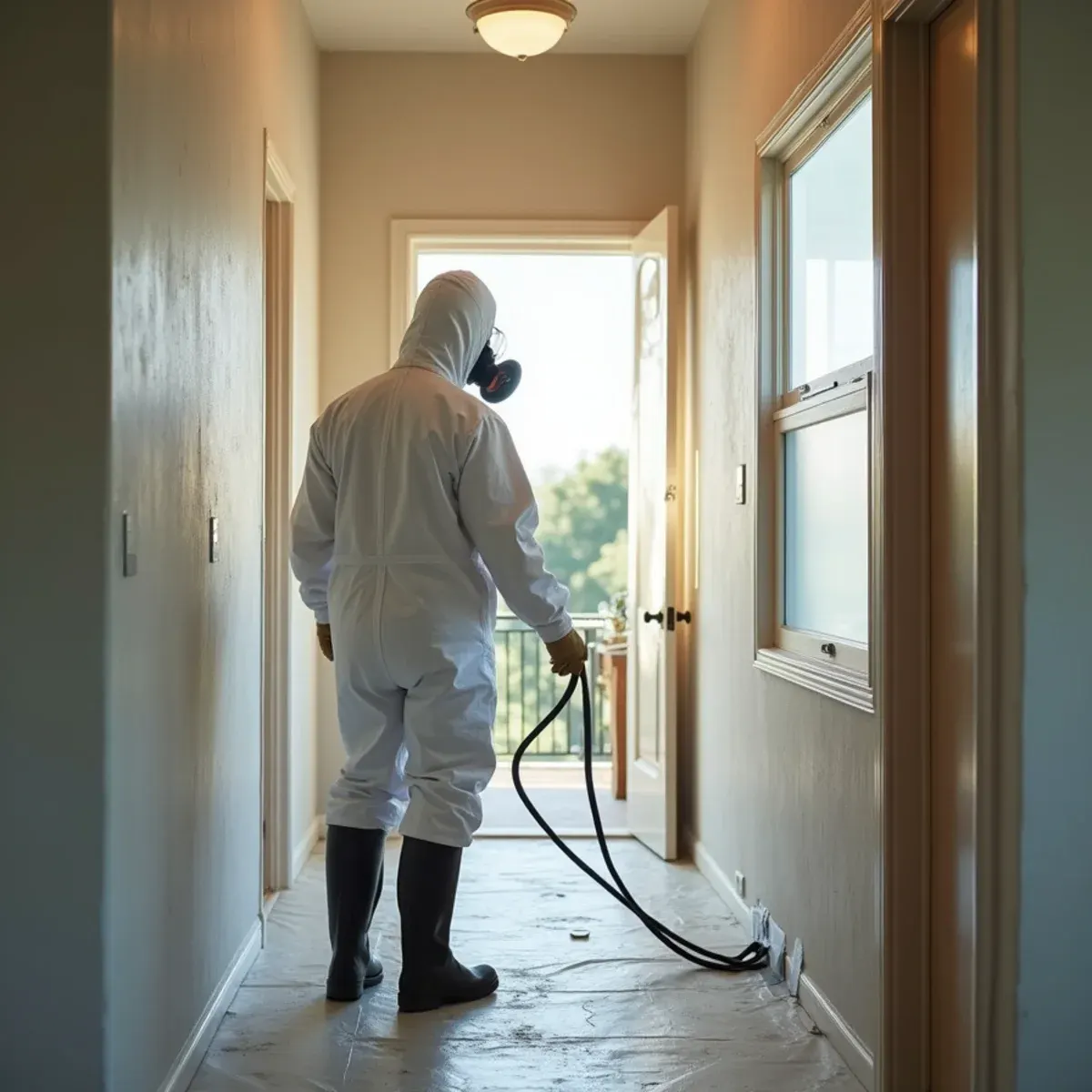
We'll start with the hard part, because Downey homeowners deserve it straight. Sewage is Category 3 water, and porous material that has absorbed it comes out. In most cities that's a straightforward conversation. In Downey it isn't, because a lot of these houses are Jean Vandruff's Cinderella Homes, and the arched doorways, scalloped trim and turned porch detail on them were not ordinary tract millwork even in 1955. You can't reorder it. So the question isn't whether we remove material — it's exactly how much.
Underneath the detailing these are conventional 1950s houses: slab on grade, galvanized supply, cast iron waste lines laid in the same few years across whole tracts. That's what backs up. The city built out fast between 1950 and 1965, so the drain lines under Orange Estates, Northeast Downey and the Cinderella streets are all the same generation and the same age. What varies is what's sitting on top of them — and that's where the careful, slow, low-demolition work earns its cost.
What Downey Changes About Sewage Cleanup
1Cutting to the line, not the stud bay
The easy way to demolish is to the nearest convenient break. On a Cinderella Home that can take out an arch or a run of scalloped casing that had no water on it. We map the contamination with a meter first and cut to that line, even when it means more careful work and more time. Trim that can be saved gets removed intact and labeled.
2What we cannot save, honestly
Particleboard cabinet cores, paper-faced backing, carpet pad and any wood that stayed wet and porous through Category 3 contact are gone. Painted solid-wood casing and dense old-growth base often aren't, and we test rather than assume. We'd rather tell you a piece is finished on day one than let you hope through three days of drying it can't survive.
3Documentation a millworker can use
Anything that has to come out gets photographed in place, measured and, where the profile is unusual, templated before removal. Downey trim gets reproduced by shops that need a section, not a description. Doing that costs us twenty minutes during demolition and saves a rebuild that otherwise ends with someone settling for stock casing from a big-box shelf.
How the Work Runs
The method is the same one we use on every sewage cleanup job, documented to the IICRC S500:2025 standard. Here it is in short — the full sewage backup cleanup process explains each stage in detail.
- Secure the area and set containment
- Full PPE and safe extraction
- Remove contaminated porous materials
- Clean and disinfect all remaining surfaces
- Deodorize at the source
- Dry, verify, and clear
The Downey Background Worth Knowing
The instinct on a wet wall is to open it, and sometimes that is correct. But IICRC S500:2025 is built around restoring rather than replacing wherever the drying goals can genuinely be met, and on a house with original arched casings and applied gingerbread, meeting those goals is worth some patience. We would rather spend three extra days with equipment running than pull a run of trim that would have to be milled from scratch to come back. The standard supports that choice and so does the arithmetic on the estimate, because custom millwork is not cheap and matching a fifties profile is not quick.
There is more on the housing stock, drainage and plumbing history of this city on our water damage restoration in Downey page.
Downey at a glance
- Dominant construction era
- 1950–1965
- Foundation type
- slab on grade
- Supply piping found here
- galvanized steel, under-slab copper
- Drain line materials
- cast iron
- Terrain and water table
- flat, moderate water table
- Most common local failure
- 1950s slab and galvanized failures in houses whose decorative woodwork makes careful, low-demolition drying worth paying for
- Highest-value local prevention
- drying in place wherever readings allow, because the trim and detailing on these houses cannot be bought
What It Costs in Downey
We do not quote a number over the phone before seeing the property — anyone who does is guessing. The variables that actually move the price on a sewage cleanup job are affected square footage, volume of porous material removed, contents in the affected area, and they are broken down in full on the sewage backup cleanup page. The assessment and the written estimate are free anywhere in Downey, day or night, with no obligation.
Sewage Cleanup Questions from Downey Homeowners
Sometimes, and it depends on the piece. Painted solid wood that got surface contact and was cleaned quickly can often be saved after cleaning and verification. Anything with an absorbent core, an open end grain that wicked, or that sat wet overnight generally cannot — IICRC S500:2025 is clear about porous material in Category 3 conditions. We'll test each run rather than condemning the hallway wholesale, and template whatever has to go.
It depends on the source. A toilet that overflows with clean bowl water because of a stuck fill valve is Category 1 or 2 and is far less serious. A toilet that backs up from the main line is carrying waste from the whole system, and that is Category 3 — it needs the full protocol.
No. Standard practice for Category 3 water is removal and disposal of carpet and pad that were contacted. Porous materials cannot be reliably disinfected all the way through, and the health risk of leaving them is not worth the savings.
Usually, yes. We go into the wall cavity through small ports low on the wall, hidden behind shoe molding or inside a closet, and dry from the inside out rather than taking the finished face off. That takes longer and needs more equipment than gutting the wall would, which is exactly the trade we think is worth making on a house with millwork that cannot be bought. Where it will not work, we tell you early.