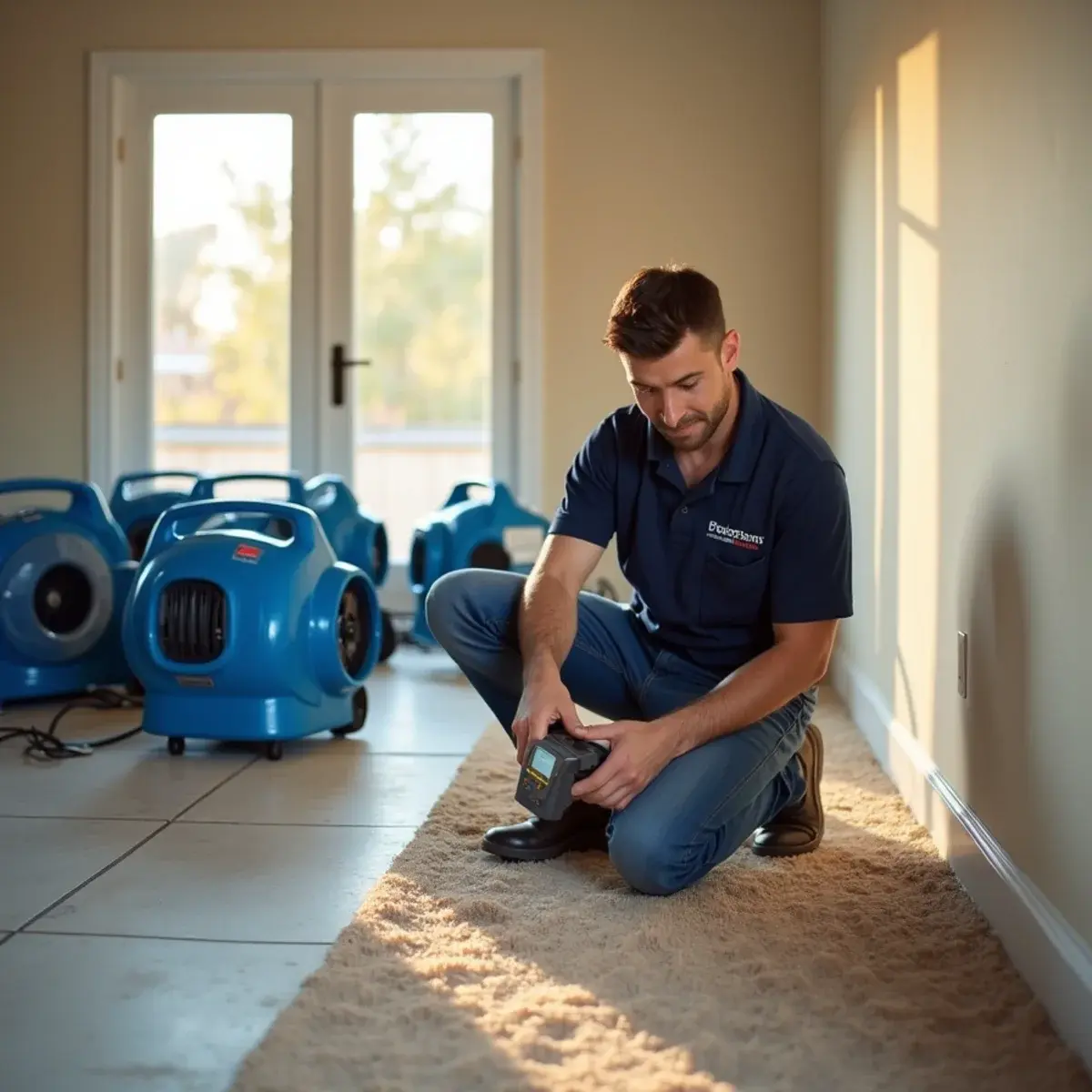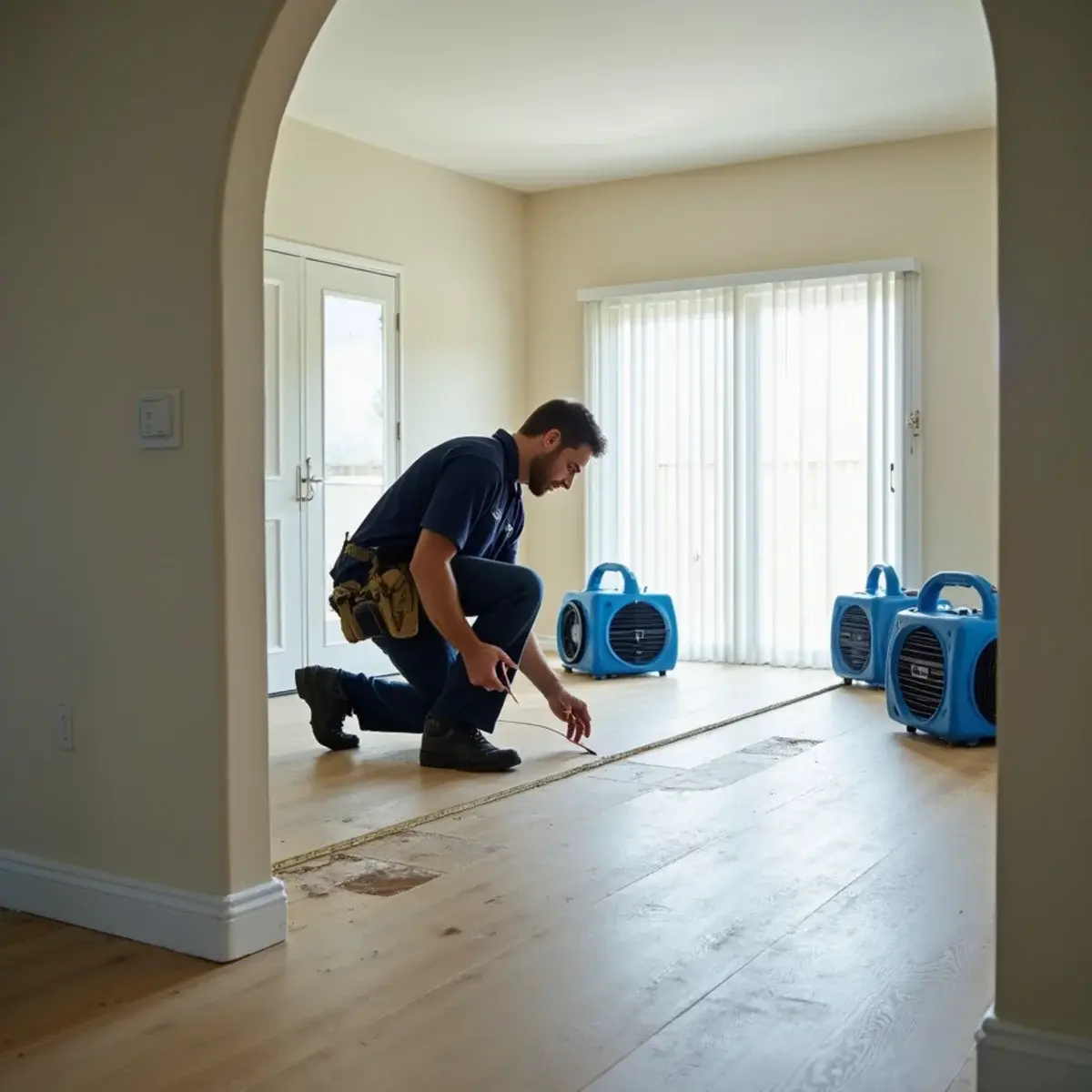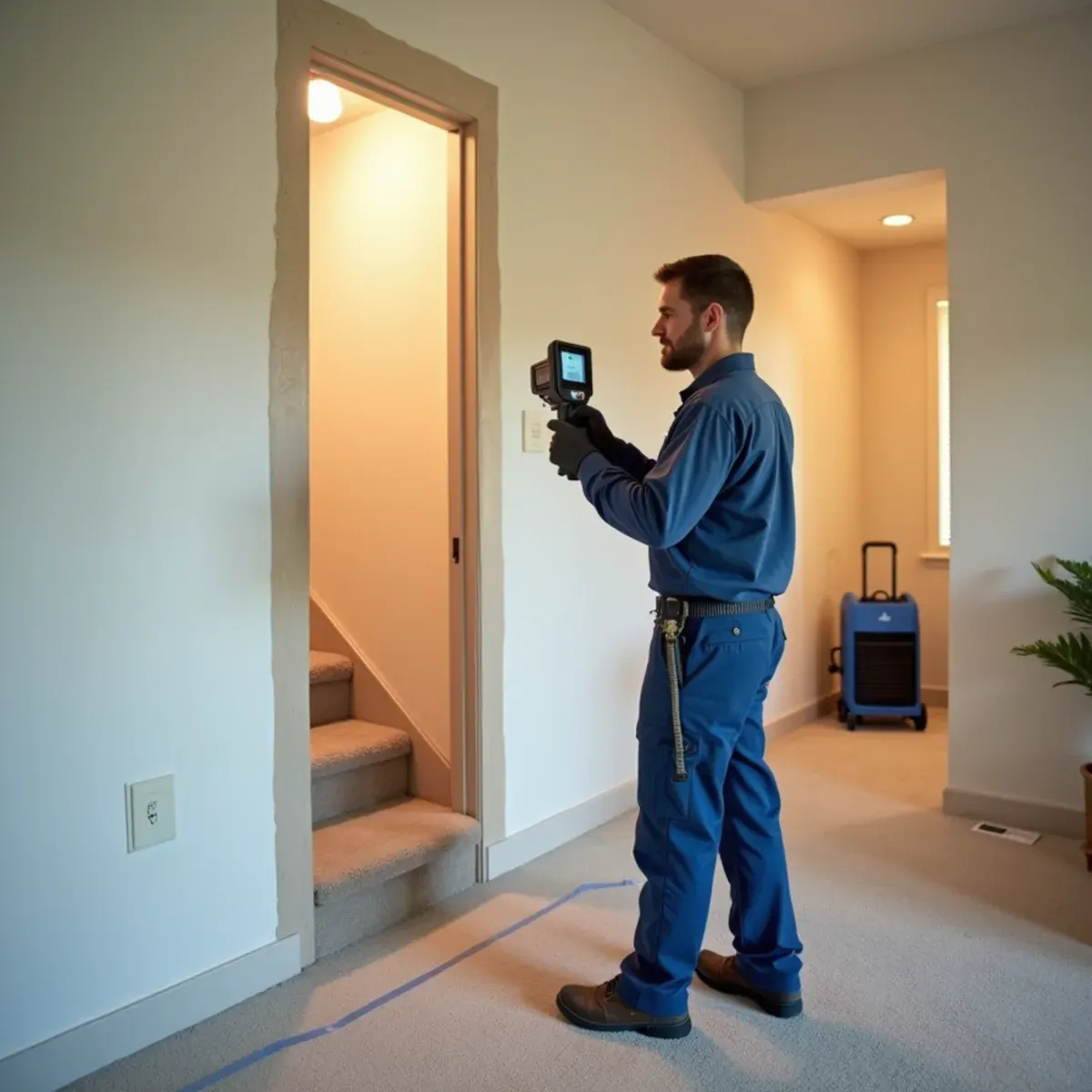
The first thing most homeowners see after a water loss is a line of missing wall. Somebody showed up with a saw, cut two feet up all the way around the room, and left the studs looking at you. Sometimes that was necessary. Often it was not. Drywall is the cheapest material in the assembly and the most visible, which is exactly why it gets removed on reflex — cutting is fast, it looks decisive, and it bills. The honest position is that a lot of wet drywall can be dried in place if someone takes readings first and is willing to be patient with the wall cavity.
Gypsum board is a chalk core sandwiched between two layers of paper, and the two halves behave nothing alike. The core is mineral. It absorbs water, gives it back, and comes out structurally fine as long as it never lost its shape. The paper is organic, and organic means it feeds mold once it stays damp past roughly forty-eight to seventy-two hours at room temperature. So the question is never simply whether the wall got wet. It is how far the water wicked up the paper, whether the core softened or swelled, what kind of water it was, and how long it has been sitting.
When drywall does have to come out, where you cut decides how the repair looks a year later. A cut that stops in the middle of a stud bay leaves nothing to screw the patch to. A cut at a random height leaves a seam floating in the field of the wall, where every raking light in the room will find it. We cut to the center of a stud and to a consistent height across the run — usually two feet or four feet, because that is how board comes — so the new sheet lands on solid framing and the seam falls where it can be hidden.
How Wet Drywall Shows Itself
These usually arrive in this order, and the early ones are easy to talk yourself out of.
A dark tide line above the baseboard
The first honest sign. Water wicks upward through the paper facing by capillary action, and it leaves a straight horizontal edge where it stopped. That line marks the top of the wet zone at its worst moment, not necessarily the current one — the wall behind it may still be soaked.
Paint blistering in a band along the wall
Paint is a vapor barrier of sorts, and moisture pushing out from behind it breaks the bond. You get blistering, bubbling, or a wrinkled band that follows the water line. On a textured wall it can look like the texture is lifting away in sheets.
Baseboard pulling away from the wall
MDF and finger-jointed baseboard swell when they get wet, and swelling pushes the trim off the wall and opens the caulk joint at the top. If the baseboard has moved, water sat at the floor line long enough to get behind it, and the bottom of the drywall is wet whether or not it looks it.
The wall gives under thumb pressure
Press gently at the bottom of the wall. Sound drywall is firm. A wall that dents, feels spongy, or leaves gypsum dust on your thumb has lost core integrity, and that is not recoverable — the crystal structure of the gypsum has broken down and no amount of drying rebuilds it.
Seams and screw heads reading through the paint
As the board takes on and gives up moisture it moves, and movement shows first at the joints. Tape edges telegraph through, screw dimples pop into small round bumps, and a seam that was invisible for twenty years suddenly runs across the wall like a pencil line.
A ceiling that sags or bulges overhead
Ceiling drywall carries water differently than a wall does, because gravity pools it on the back of the paper instead of wicking it upward. A bulge means a pocket of standing water and a sheet that is close to letting go. Clear the room and stay out from under it.
A musty smell strongest near the floor
Odor usually arrives before any visible growth. If the smell is strongest when you crouch at the baseboard, or when the room has been closed up all day, something inside the cavity is damp — commonly the back of the paper facing or the insulation behind it, neither of which you can see.
How We Handle Wet Drywall
The order matters, because every decision after the first one is downstream of what the meter said.
- 1
Meter the wall first
We map the wet area with a non-penetrating meter and confirm it with pin readings through the paper, then take the same readings on an unaffected wall of identical construction. That second number is the dry standard the wall has to come back to. IICRC S500:2025 expects that comparison — a moisture reading means nothing without something to measure it against.
- 2
Decide dry-in-place or remove
Four things drive the call: what category the water was, whether the gypsum core still has integrity, what is in the cavity behind it, and how many hours have passed. Clean water, firm core, fiberglass batts, caught early — that wall usually dries. Category 3 water, a soft core, or cavity insulation that holds moisture against the board, and it comes out.
- 3
Open the cavity, not the wall
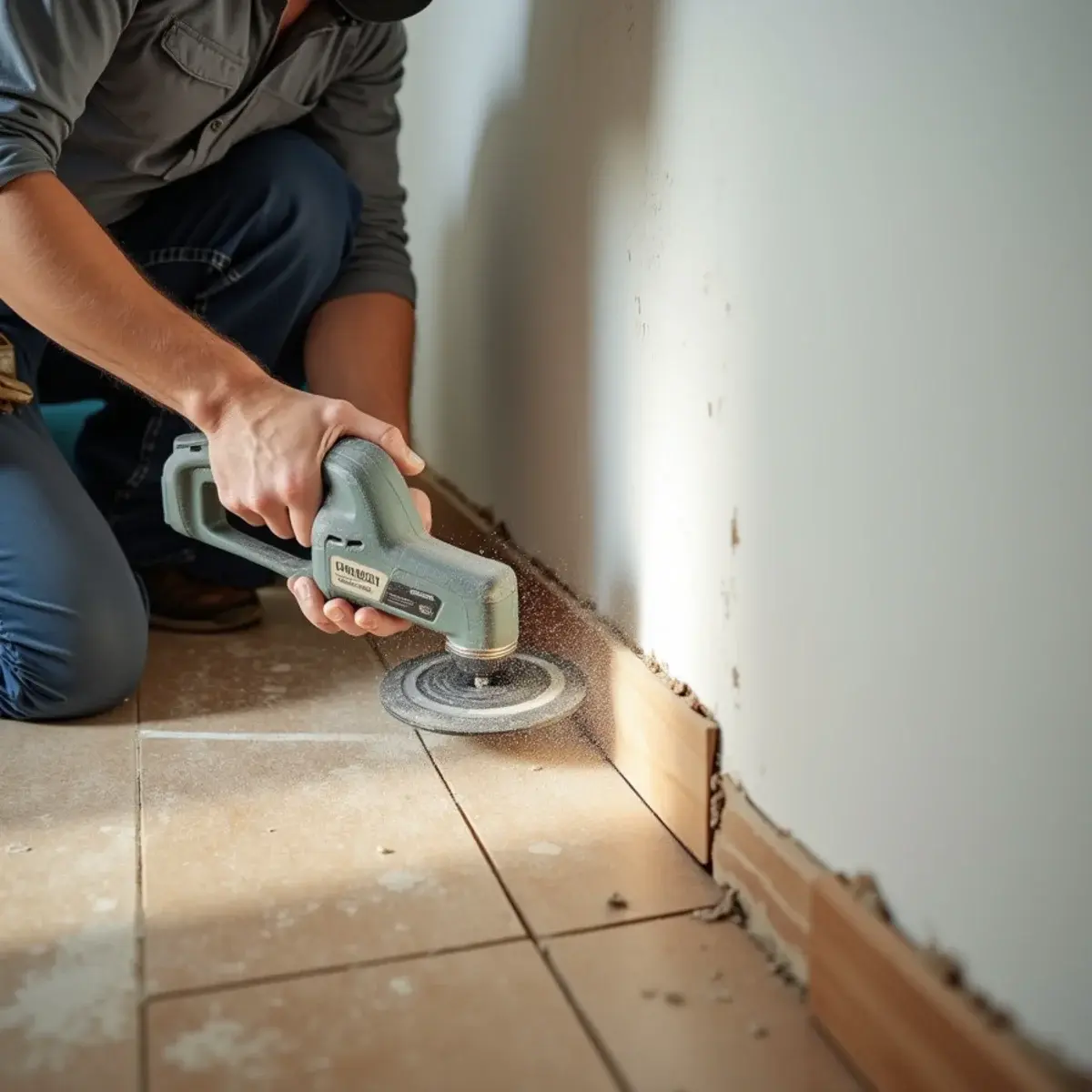
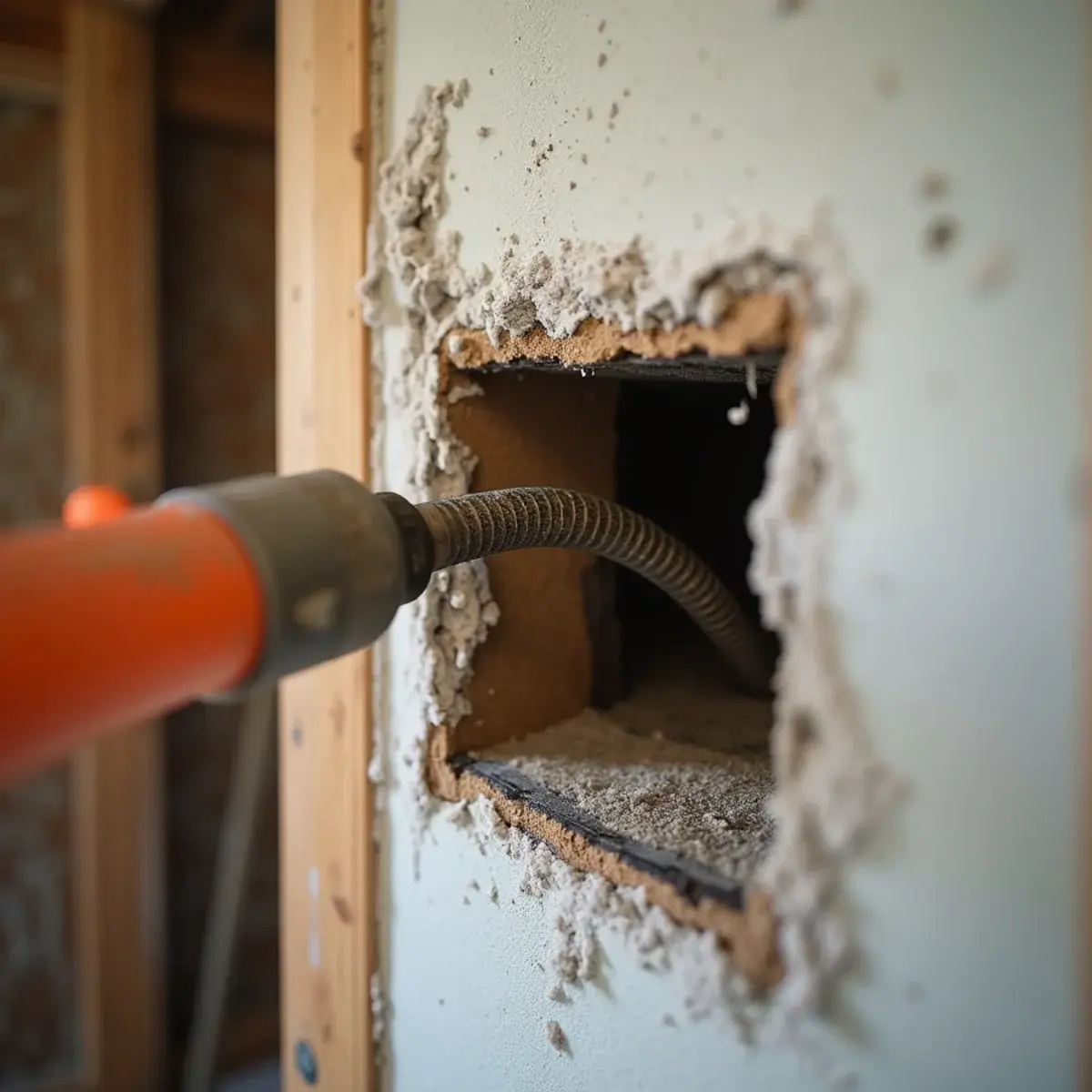
Where the board can be saved, we pull the baseboard and drill a line of small holes into each stud bay behind where the trim will sit, then force conditioned air through the cavity with an injection system. The wall dries from both faces at once, the holes disappear under the baseboard, and the finished surface never gets touched.
- 4
Cut to a stud and a seam line
When the board has to go, we snap a level line at a standard height across the whole run and cut back to the center of a stud on each end, so the patch has framing to land on and the seam sits where board seams belong. We score from the face, check for wiring and supply lines in the bay, and cut shallow rather than fast.
- 5
Clear the cavity and dry the framing
Wet fiberglass loses R-value permanently and wet cellulose holds moisture against the studs, so both come out. Then the framing, the bottom plate, and the back of the opposite wall face get dried and monitored daily until they hit the dry standard. Closing a wall over damp framing is how a repair turns into a mold job six months later.
- 6
Tape, texture, prime, paint
New insulation to the correct R-value, board hung and screwed to pattern, then joints taped and coated — three coats, feathered wide, sanded between. We spray a texture sample first and hold it against the existing wall in the room's own light before touching the repair. Stain-blocking primer over any area that was stained, then finish paint to a natural break.
The Flood Cut Is a Decision, Not a Default
A flood cut is the horizontal cut across a wall at a set height above the floor to remove the wet lower section. It is the right move on a Category 3 loss, on a wall with saturated cellulose or closed-cell insulation, and on any board whose core has gone soft. It is the wrong move on a clean-water loss caught the same day, on a wall with fiberglass batts that can be dried, and on any board that still reads firm and is coming down in moisture content day over day.
The category question does most of the work. Water that came from a supply line is one problem; water that came up through a floor drain or off a slab in a sewage backup is a different one, and S500:2025 treats porous materials contaminated by Category 3 water as remove-and-replace regardless of how good the drying numbers look. Paper-faced gypsum is porous. That is the end of the conversation on those jobs, and we would rather say so plainly than run equipment on a wall that is coming out anyway.
Where we push back is on the middle ground — clean water, a few hours old, and someone reaching for a saw because it is faster than coming back for four days of monitoring. That wall is usually savable, and saving it means you keep your original texture, your original paint line, and a room that does not need to be put back together. It also means less to argue about with your adjuster later, because the mitigation scope and the repair scope both stay small. We will tell you which side of that line your wall is on, and we will show you the readings we used to decide.
- Category 3 water — sewage, a floor drain backup, or ground water — touched the board at any height
- The gypsum core is soft, crumbling, or has swelled and lost its shape
- Visible growth on the paper face or on the back of the baseboard
- The cavity holds cellulose, closed-cell foam, or a vapor barrier that traps moisture against the board
- The board sat wet long enough that the paper facing has delaminated from the core
What the Local Housing Stock Puts Behind Your Drywall
Most of what we open in Cypress, Rossmoor, La Palma, Cerritos, Lakewood and Norwalk is half-inch board on studs sixteen inches on center, sitting on a bottom plate that sits directly on a concrete slab. That detail matters more than it sounds. There is no crawl space under the room to dry from, so water that reaches the plate has one direction to go, which is up into the paper facing of the board and out along the slab under the flooring. It is also why the wet zone in a slab home so often stops at a clean line eight or ten inches up.
The older raised-foundation neighborhoods are a different job entirely. In Old Towne Orange, Uptown Whittier, Old Town Tustin, the Anaheim Colony and Eastside Costa Mesa, a lot of walls are not drywall at all — they are plaster over wood lath, or gypsum lath with a plaster skim. Plaster does not cut, tape or texture like board, and patching it with drywall leaves a thickness difference and a hairline crack that reappears every summer. We handle those as plaster repairs, and we say up front when a wall is going to need a plasterer rather than a taper.
Two more local wrinkles. Closer to the water — Seal Beach, Huntington Beach, Long Beach, Costa Mesa — the marine layer keeps ambient humidity high enough that a wall which would dry in three days inland takes four or five, and dehumidification has to carry more of the load than air movement does. And in the manufactured housing in Stanton, Midway City and Carson, the interior panels are usually vinyl-faced gypsum with battens at the joints rather than taped board. Those panels cannot be textured and painted like drywall, so a repair means matching panel, not blending a seam.
The Repair That Has to Be Done Twice
The most expensive drywall job is the one done twice. It usually goes like this: the wall gets patched a few days after the leak, it looks fine, and four to eight weeks later a stain bleeds through the new paint, the tape edge lifts, or the room starts to smell. Nothing failed in the patch. The cavity behind it was still wet when it was closed, and the new board simply gave the moisture a fresh surface to work on.
There are two separate causes and both are avoidable. The first is closing a wall before the framing and the back of the opposite face have hit the dry standard — a wall can feel dry to the hand while a bottom plate reads high, and only a meter tells you that. The second is painting over a stain with latex. Tannins, minerals and the residue of whatever was in the water migrate straight up through water-based paint and reappear as a ring. A dedicated shellac- or oil-based stain blocker stops it. It costs almost nothing at the time and it is the difference between a repair that ends and one that comes back.
We would rather leave your wall open an extra two days than close it on a guess. That is an uncomfortable conversation when you want your house back, and we have it anyway — with the daily readings in front of you so the decision is yours as much as ours. The same logic applies to the texture. A patch that is taped and textured while the surrounding wall is still giving up moisture will move as the wall stabilizes, and the seam telegraphs through the paint a month later. Finishing work waits for a dry structure. It is the least glamorous part of this trade and it is where most of the callbacks come from.
What Drywall Repair Costs Depends On
No two drywall repairs price the same way, and these are the things that actually move the number:
How much board comes out
Priced by the area removed and replaced, not by the size of the puddle. A wall dried in place costs a fraction of the same wall cut, hauled, rebuilt, textured and painted — which is the strongest financial argument for taking readings before taking out a saw.
Cut height and seam count
A two-foot flood cut removes less board but puts a seam in the middle of the wall that has to be feathered wide to hide. A four-foot cut removes more material and often finishes better and faster, because the seam falls at a natural board line. We will explain the tradeoff rather than defaulting to one.
Texture type and match difficulty
Orange peel blends readily. Heavy knockdown, a hand-troweled finish, or a genuinely smooth Level 5 wall takes considerably more skilled time to make invisible. Acoustic popcorn on a ceiling in a home built before the early 1980s may require asbestos testing before anyone disturbs it, which adds a step and a wait.
What is behind the wall
An open bay with fiberglass batts is simple. A bay with plumbing, a gas line, low-voltage wiring, or a vapor barrier takes longer to open safely and to close correctly. Kitchen and bath walls are the slowest, because cabinets, tile, and backsplash frequently have to come off before the board can be reached at all.
Where the paint has to stop
Paint is rarely a spot repair. Even a perfect color match shows as a sheen difference in raking light, so the finish coat generally runs corner to corner or to the nearest natural break. That means the painted area is often larger than the repaired area, and that difference shows up on the estimate.
Insurance note: Drywall usually splits across two parts of the claim: the cutting, hauling and drying fall under mitigation, and the board, tape, texture and paint fall under the repair estimate. Adjusters routinely approve only the damaged section and leave out the blending. Documenting why a partial patch cannot match — with photos of the texture and the raking light — is what gets the paint and texture scope written correctly the first time.
Why Cypress Homeowners Call Us for Drywall Repair
Plenty of companies list this service. Fewer can tell you what equipment they will bring, what standard the work is measured against, or what happens if they are wrong. Here is what you are actually buying.
Cut lines set by moisture readings
The flood cut goes where the meter says the water stopped, not at a habitual height. That is often the difference between a two-foot repair and a full sheet.
Texture matching is its own skill
Orange peel, knockdown, and hand-troweled finishes each need a different technique. A patch that reads as a patch is a failed repair.
Insulation behind the wall is checked
Wet batt insulation stays wet inside a sealed cavity. Closing a wall over it is the most common cause of a mold call six months later.
- 20+ years restoring Orange County homes
- IICRC Certified Firm
- Licensed, Bonded & Insured
- We bill your insurance company directly
- IICRC S500:2025 compliant on every job
- 100% satisfaction guarantee — in writing, on every job
Frequently Asked Questions
No, and that assumption is why a lot of walls come out that did not need to. Gypsum board that got clean water, still reads firm under thumb pressure, and is coming down in moisture content day over day can usually be dried in place through the cavity. What forces removal is contaminated water, a core that has softened or swelled, visible growth on the paper, or insulation behind it that holds moisture against the board. We take readings before we answer that question.
Usually two feet or four feet above the floor, measured level across the whole run rather than following the stain. Board comes in four-foot widths, so a cut at either height lands the new seam where a factory edge would sit, which is far easier to hide than a seam floating mid-wall. The cut also has to end at the center of a stud on each side, so the patch has something to fasten to. Cutting to the shape of the damage looks thrifty and finishes badly.
In most cases, yes — orange peel and standard knockdown are daily work. We spray a sample board first and hold it against your wall in that room's own light, because texture reads differently under a window than under a can light. Heavy hand-troweled finishes and true smooth walls are harder, and we will tell you before we start if we think a repair will show. Honest answer: a perfect match on a heavy hand finish is not always achievable in a small patch.
For a dry-in-place wall, nothing opens — we drill behind the baseboard and the holes never show. When board does come out, the opening typically stays for three to five days while the framing and cavity come down to the dry standard, longer near the coast where ambient humidity slows everything. We monitor daily and give you the numbers. Closing a wall on a schedule instead of on a reading is the single most common cause of a second repair.
You can, and people do. Two cautions. First, the visible wet area is almost never the whole wet area, so a patch cut to the stain usually closes over damp framing and insulation. Second, there is wiring, and sometimes plumbing or a gas line, in those bays — a saw set too deep finds it. If you want to do the finish work yourself, we are happy to dry it, cut it clean to a stud line, and hand it to you at that point.
Related Reading
- How Long Does Water Damage Restoration Actually Take? — Extraction is measured in hours, drying in days, and reconstruction in weeks. Here is what each phase actually involves and what stretches it.
- What Water Damage Restoration Actually Costs in Orange County — Nobody in this industry likes publishing numbers. Here is how the pricing actually works, what moves it, and how to tell a fair estimate from a bad one.