
In Cerritos the cutting is rarely the hard part. The finishing is. This city was deliberately master-planned, the stock is unusually consistent and well maintained, and it carries a much higher share of two-story homes than its neighbors, which brings the big continuous ceiling planes that come with them: an entry, a stair landing, a great room. A patch in the middle of a plane like that catches side light from a window and announces itself no matter how good the texture match is. So we plan the repaint out to a natural break, a corner or a beam, before the ceiling is ever opened.
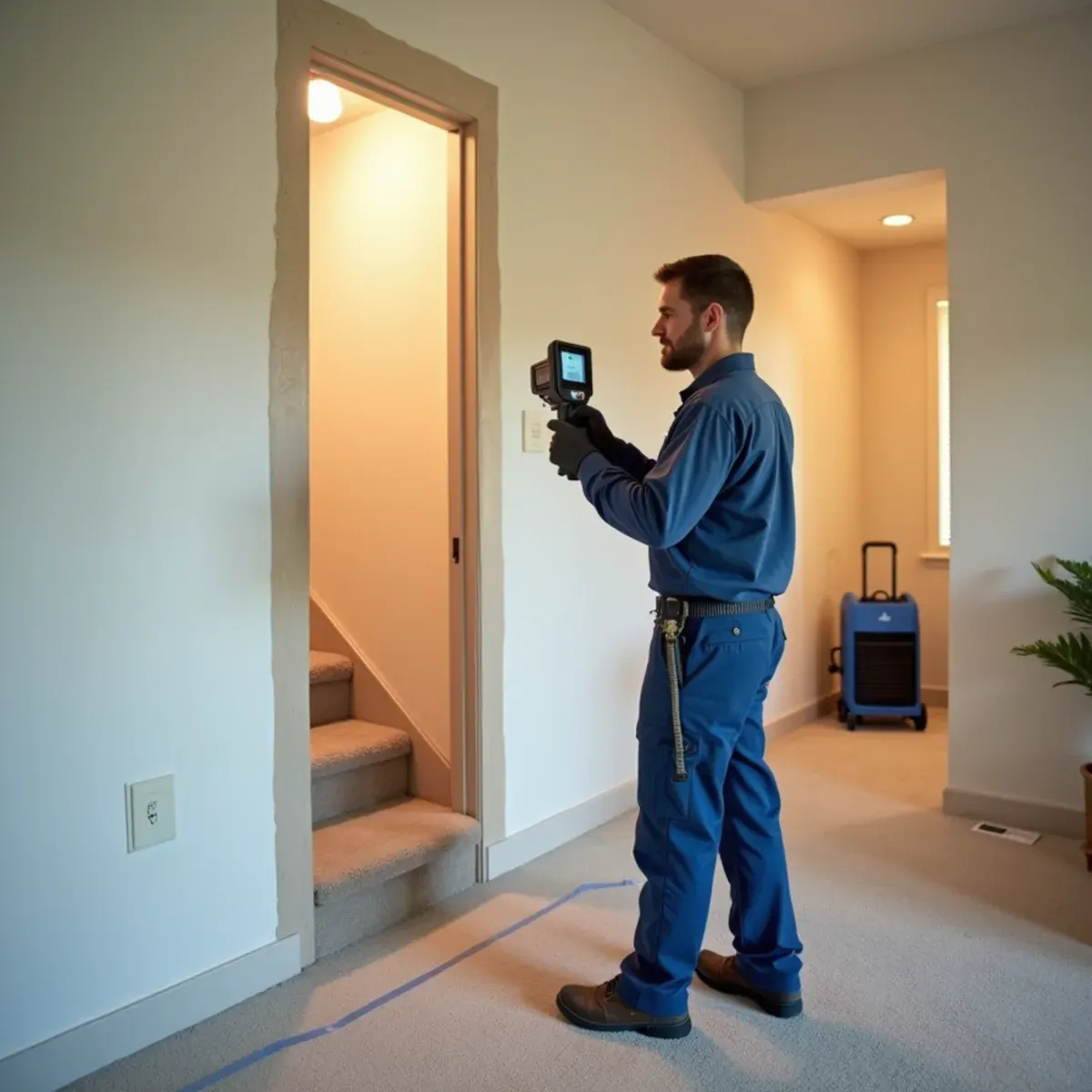
What is bringing us here is timing. The under-slab copper in these 1965 to 1985 homes is only now entering its failure window, and the two-story layouts mean an upstairs failure runs sideways through the enclosed floor assembly and drops through a ceiling well away from the source. We see the same thing in the tracts near Coyote Creek on the Cypress border, in houses that look untouched from the street. The wet area is almost always wider than the stain, so we map it with a meter and a camera before deciding where the cut lands.
What Cerritos Changes About Drywall Repair
1Large ceiling planes show every patch
A two-story entry or great-room ceiling is a single uninterrupted surface with light raking across it from a tall window. Texture can be matched closely and the patch still reads, because the sheen of new paint differs from twenty-year-old paint. We plan the finish out to a break in the plane and price it that way from the start rather than discovering it at the end.
2Water lands far from where it started
In these two-story plans the floor assembly is closed, so an upstairs failure travels along a joist bay and drops wherever it finds an opening, often a room or more from the fixture that failed. Cutting under the stain alone leaves a wet cavity between two finished floors. We open a small access near the source, dry the assembly, and repair both ends of the path.
3Seventies copper reaching its failure window
The under-slab supply lines in Cerritos went in between the mid sixties and mid eighties and are only now reaching the age where pinholes start. Houses here are so well kept that nobody suspects the plumbing, which is exactly why the first sign tends to be a ceiling or a warm spot on a floor. A wall or ceiling repair here is worth pairing with a look at the supply lines.
How the Work Runs
The method is the same one we use on every drywall repair job, documented to the IICRC S500:2025 standard. Here it is in short — the full drywall water damage repair process explains each stage in detail.
- Meter the wall first
- Decide dry-in-place or remove
- Open the cavity, not the wall
- Cut to a stud and a seam line
- Clear the cavity and dry the framing
- Tape, texture, prime, paint
The Cerritos Background Worth Knowing
Cerritos has a considerably higher proportion of two-story homes than the single-story tract cities around it, and that changes the geometry of every water loss. A failure on the second floor does not stay there — it goes through the floor assembly into the ceiling below and spreads laterally across the joists before it drops.
There is more on the housing stock, drainage and plumbing history of this city on our water damage restoration in Cerritos page.
Cerritos at a glance
- Dominant construction era
- 1965–1985
- Foundation type
- slab on grade
- Supply piping found here
- under-slab copper
- Drain line materials
- cast iron, ABS
- Terrain and water table
- flat, moderate water table
- Most common local failure
- upper-floor failures that spread laterally through the enclosed floor assembly before dropping through a ceiling well away from the source
- Highest-value local prevention
- the annual meter test, since 1970s under-slab copper is only now entering its failure window here
What It Costs in Cerritos
We do not quote a number over the phone before seeing the property — anyone who does is guessing. The variables that actually move the price on a drywall repair job are how much board comes out, cut height and seam count, texture type and match difficulty, and they are broken down in full on the drywall water damage repair page. The assessment and the written estimate are free anywhere in Cerritos, day or night, with no obligation.
Drywall Repair Questions from Cerritos Homeowners
We can cut only the wet section, and we will. The question is where the paint stops. On a tall open plane with daylight raking across it, a patch shows through even an excellent texture match because new paint and aged paint reflect differently. We seal the stain properly, texture to match, then repaint out to the nearest natural break such as a corner, a beam or a plane change. That is what makes the repair actually disappear.
No, and that assumption is why a lot of walls come out that did not need to. Gypsum board that got clean water, still reads firm under thumb pressure, and is coming down in moisture content day over day can usually be dried in place through the cavity. What forces removal is contaminated water, a core that has softened or swelled, visible growth on the paper, or insulation behind it that holds moisture against the board. We take readings before we answer that question.
Usually two feet or four feet above the floor, measured level across the whole run rather than following the stain. Board comes in four-foot widths, so a cut at either height lands the new seam where a factory edge would sit, which is far easier to hide than a seam floating mid-wall. The cut also has to end at the center of a stud on each side, so the patch has something to fasten to. Cutting to the shape of the damage looks thrifty and finishes badly.
Usually fifteen to twenty minutes. Cerritos borders Cypress across Coyote Creek, so it is one of our closest service areas and the 60-minute commitment applies fully.