
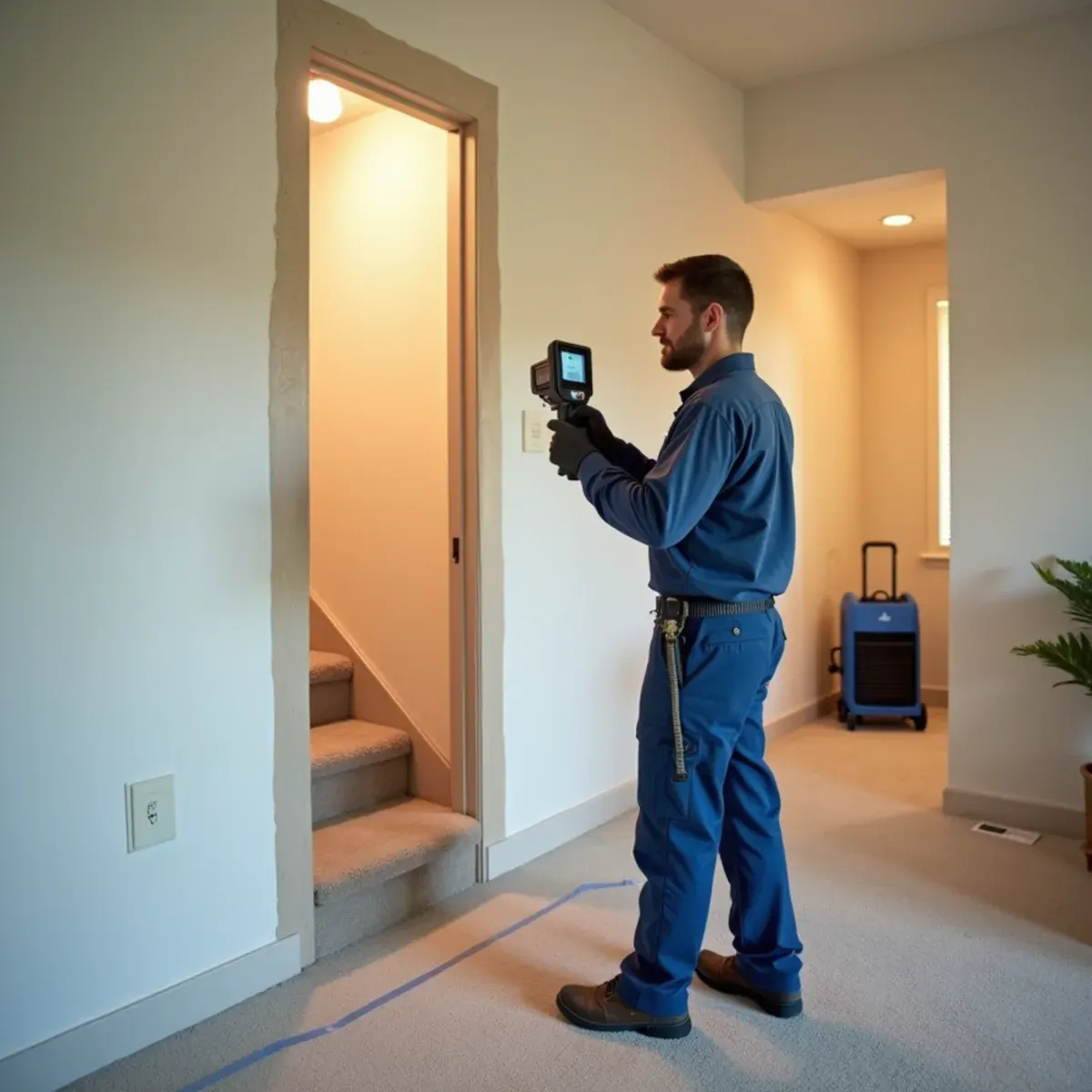
A grease-restricted waste line backs up into a Pioneer Boulevard kitchen at nine at night and the water goes everywhere: under the line, behind the shelving, into the bottom of every wall in the room. That water is Category 3, and there is no drying it in place no matter how fast someone gets a mop out. Contaminated board comes out, the insulation behind it comes out, framing gets cleaned and treated, and the wall goes back new. The only genuine question on those jobs is how quickly we can do it without the restaurant losing another service.
Artesia's commercial density makes this a regular call rather than an occasional one. Little India runs one of the tightest concentrations of independent restaurants and retail anywhere around here, almost all of it in 1950s buildings that were never designed to carry commercial kitchens, on cast iron waste lines that have been collecting grease for decades. Kitchen walls here are usually fiberglass-reinforced panel or stainless over gypsum, which has to come off and go back in a specific order. The residential side of the city, the modest postwar tracts, is ordinary slab-era drywall work.
What Artesia Changes About Drywall Repair
1Category 3 water means removal, not drying
Sewage and grease-loaded backup water is contaminated regardless of how clear it looks on the floor. Paper-faced gypsum absorbs it and cannot be disinfected through the face, so the affected board and the insulation behind it are removed, the cavity is cleaned and treated, and new material goes in. Anyone offering to dry that wall in place is saving you money you will spend twice.
2Kitchen wall layers come off in order
Commercial kitchen walls on Pioneer are built up: gypsum, then fiberglass-reinforced panel or stainless, with shelving and equipment anchored through everything. We label and photograph as we take it apart so the rebuild matches what a health inspection expects, including sealed joints at the panel edges. Getting the order wrong is how a wall passes visually and fails the inspection.
3Work timed around dinner service
These are independent businesses where a lost night matters. We scope during the day, do the demolition and dusty work after close, and get containment down so the kitchen can operate around a sealed section where that is possible. It is a harder way to run a job than shutting the room. It is usually the difference between a repair and a closure.
How the Work Runs
The method is the same one we use on every drywall repair job, documented to the IICRC S500:2025 standard. Here it is in short — the full drywall water damage repair process explains each stage in detail.
- Meter the wall first
- Decide dry-in-place or remove
- Open the cavity, not the wall
- Cut to a stud and a seam line
- Clear the cavity and dry the framing
- Tape, texture, prime, paint
The Artesia Background Worth Knowing
A commercial kitchen is one of the hardest things you can ask a building to accommodate. High water use, continuous drainage, grease loading, floor drains, and equipment connections that get added and modified over the years. When that kitchen is in a building from the 1950s with original cast-iron waste lines, the failure is a matter of time.
There is more on the housing stock, drainage and plumbing history of this city on our water damage restoration in Artesia page.
Artesia at a glance
- Dominant construction era
- 1950–1970
- Foundation type
- slab on grade
- Supply piping found here
- galvanized steel, copper
- Drain line materials
- cast iron
- Terrain and water table
- flat, moderate water table
- Most common local failure
- grease-loaded cast-iron waste lines restricting until a commercial kitchen backs up
- Highest-value local prevention
- hydro-jetting the waste line rather than snaking it, so the pipe wall actually gets cleaned
What It Costs in Artesia
We do not quote a number over the phone before seeing the property — anyone who does is guessing. The variables that actually move the price on a drywall repair job are how much board comes out, cut height and seam count, texture type and match difficulty, and they are broken down in full on the drywall water damage repair page. The assessment and the written estimate are free anywhere in Artesia, day or night, with no obligation.
Drywall Repair Questions from Artesia Homeowners
Sometimes, but the cut is set by contamination rather than by the visible water line. Paper facing wicks upward faster than the water level suggests, and on a grease-loaded backup we are removing anything the contaminated water reached plus a margin above the highest reading, taken to a clean seam height that finishes flat. In many kitchens that lands near two feet. In some it goes higher. We meter it, show you the readings, and cut once.
No, and that assumption is why a lot of walls come out that did not need to. Gypsum board that got clean water, still reads firm under thumb pressure, and is coming down in moisture content day over day can usually be dried in place through the cavity. What forces removal is contaminated water, a core that has softened or swelled, visible growth on the paper, or insulation behind it that holds moisture against the board. We take readings before we answer that question.
Usually two feet or four feet above the floor, measured level across the whole run rather than following the stain. Board comes in four-foot widths, so a cut at either height lands the new seam where a factory edge would sit, which is far easier to hide than a seam floating mid-wall. The cut also has to end at the center of a stud on each side, so the patch has something to fasten to. Cutting to the shape of the damage looks thrifty and finishes badly.
Yes, and on Pioneer Boulevard that is usually how we schedule it. Overnight crews cost somewhat more in labor and almost always cost dramatically less than lost revenue from closing during operating hours.