
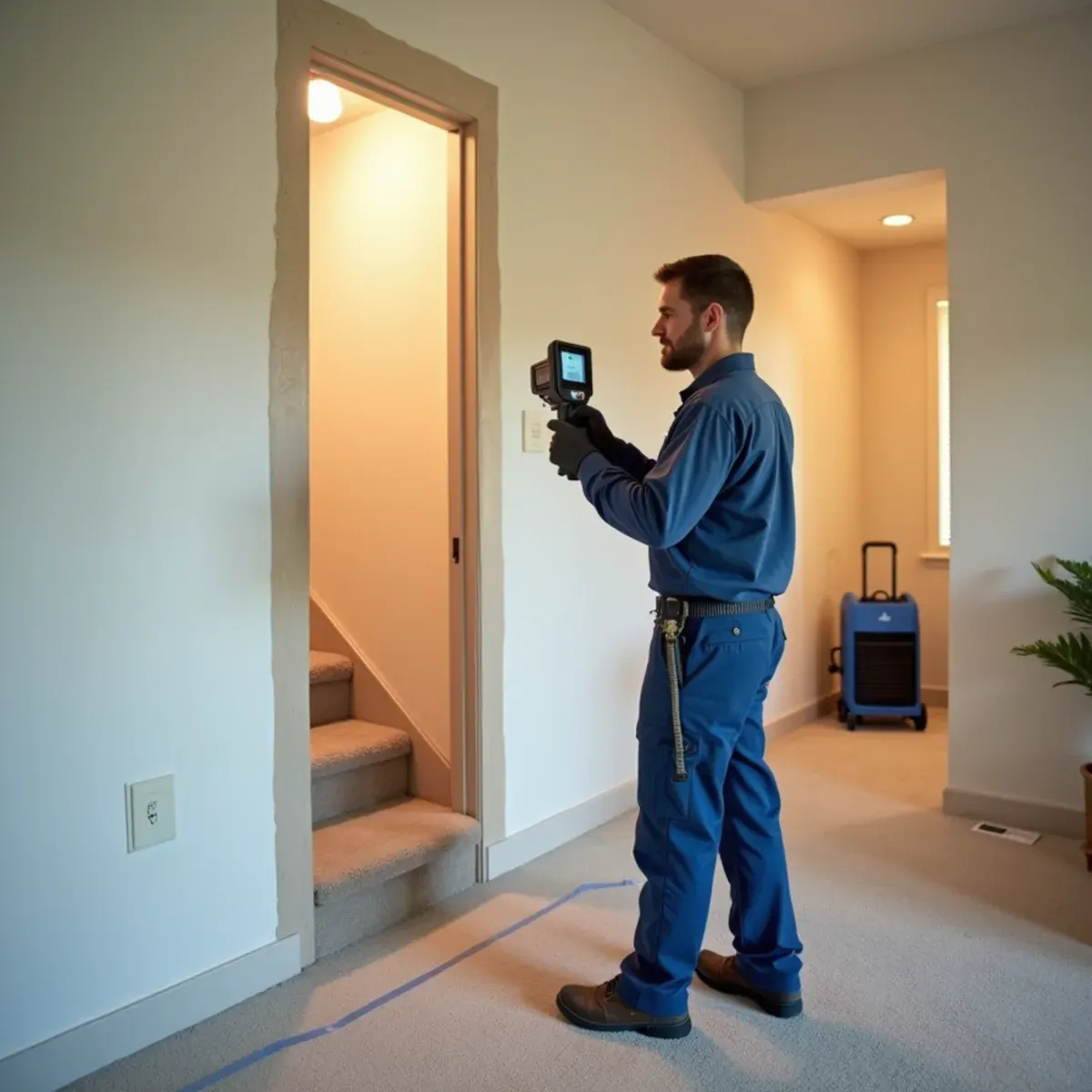
Worth saying up front: a lot of Carson homes don't have drywall in the usual sense. This city has an unusually large mobile home park population, and manufactured homes are finished with vinyl-over-gypsum panels joined by batten strips instead of taped, textured and painted board. You can't feather a joint compound patch into a vinyl-laminated panel and make it disappear. Those repairs are panel replacement and batten work, and when water gets into the belly wrap under the floor, the wet material can sit trapped under the home with nothing showing inside at all.
The conventional side of Carson is postwar tract built roughly 1950 to 1975 on former ranch, oil-field and industrial land, incorporated in 1968, with a shallow water table underneath it. That combination produces the usual slab-leak and storm-water pattern: water at the floor, wicking up the board behind the baseboard, and a cavity slow to give up moisture because the ground below is already wet. Refineries and logistics yards immediately adjacent mean commercial and warehouse office work lands on the same schedule.
What Carson Changes About Drywall Repair
1Manufactured panels: replace, not patch
Vinyl-over-gypsum panels with batten strips can't be feathered with joint compound. There's no paper face to tape into and no texture to hide a transition, so a wet section usually means replacing the panel between battens and matching the printed face as closely as the supply allows. We'll tell you honestly when an exact match isn't available rather than installing it and hoping.
2Belly wrap holds water out of sight
Under a manufactured home, the belly wrap is built to keep things out. When water gets in, it holds that water against the insulation and the underside of the floor with nothing showing in the room above. It has to be opened, drained and dried before anything gets done to the interior walls, or the wall repair fails from underneath a few months later.
3Shallow groundwater slows cavity drying
Carson's water table is shallow and the ground under the postwar tracts holds moisture well after a storm. Cavities take longer to give up water than the same wall would in Placentia or Yorba Linda, and the temptation to close a wall on day three is real. We watch the trend across several readings before board goes back up.
How the Work Runs
The method is the same one we use on every drywall repair job, documented to the IICRC S500:2025 standard. Here it is in short — the full drywall water damage repair process explains each stage in detail.
- Meter the wall first
- Decide dry-in-place or remove
- Open the cavity, not the wall
- Cut to a stud and a seam line
- Clear the cavity and dry the framing
- Tape, texture, prime, paint
The Carson Background Worth Knowing
Manufactured homes are built with the floor deck, usually particleboard or OSB, sitting on a steel frame, with batt insulation below it and a vapor barrier belly wrap stapled underneath to hold everything in place. Supply lines run through that cavity. When one leaks, the water does not run out onto the ground where you would see it. The belly wrap catches and holds it, the insulation soaks it up, and you now have a sealed reservoir under your floor with no path to evaporate. It can sit there for months before anything shows upstairs.
There is more on the housing stock, drainage and plumbing history of this city on our water damage restoration in Carson page.
Carson at a glance
- Dominant construction era
- 1950–1975
- Foundation type
- slab on grade
- Supply piping found here
- galvanized steel, under-slab copper, manufactured-home supply lines
- Drain line materials
- cast iron
- Terrain and water table
- flat, shallow water table
- Most common local failure
- manufactured-home underfloor leaks trapped in the belly wrap, alongside conventional 1960s slab failures
- Highest-value local prevention
- treating any soft spot in a manufactured-home floor as moisture until a meter proves otherwise
What It Costs in Carson
We do not quote a number over the phone before seeing the property — anyone who does is guessing. The variables that actually move the price on a drywall repair job are how much board comes out, cut height and seam count, texture type and match difficulty, and they are broken down in full on the drywall water damage repair page. The assessment and the written estimate are free anywhere in Carson, day or night, with no obligation.
Drywall Repair Questions from Carson Homeowners
Sometimes. If the wet area sits close to a batten, we can replace the panel from batten to batten and the seam disappears into the pattern that's already there. Mid-panel, there's no honest way to hide a patch, because the vinyl face carries a printed texture that can't be feathered or repainted to match. We'll walk you through the options and be straight about color match, since older panel prints aren't always still made.
No, and that assumption is why a lot of walls come out that did not need to. Gypsum board that got clean water, still reads firm under thumb pressure, and is coming down in moisture content day over day can usually be dried in place through the cavity. What forces removal is contaminated water, a core that has softened or swelled, visible growth on the paper, or insulation behind it that holds moisture against the board. We take readings before we answer that question.
Usually two feet or four feet above the floor, measured level across the whole run rather than following the stain. Board comes in four-foot widths, so a cut at either height lands the new seam where a factory edge would sit, which is far easier to hide than a seam floating mid-wall. The cut also has to end at the center of a stud on each side, so the patch has something to fasten to. Cutting to the shape of the damage looks thrifty and finishes badly.
By locating it rather than arguing about it. The dividing line is the connection point where the park's service meets your home. Upstream of that is the park's responsibility, downstream is yours. We open the belly wrap where water is pooling, trace the wet path back to its source, and photograph what we find with the connection in frame. That documentation settles the question. Guessing from where the wet spot showed up inside is unreliable, because water travels along the frame first.