
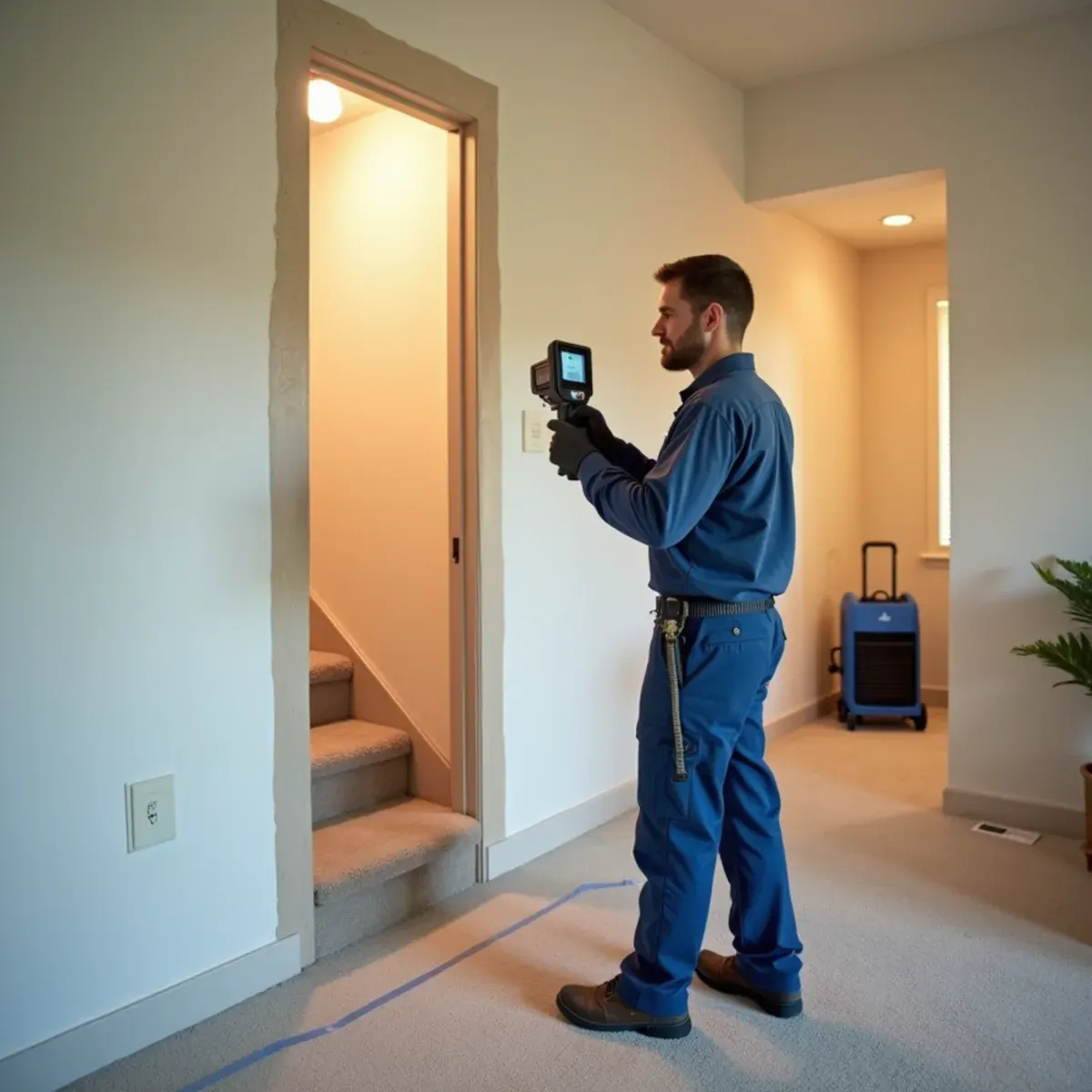
Two Breas show up on our schedule. One is the old oil town near downtown, small 1920s houses with rock lath, early gypsum and plaster skim coats, narrow rooms and original trim worth saving. The other is the hillside tracts climbing toward Carbon Canyon, built in the 1990s and 2000s with five-eighths board on the ceilings, knockdown texture and two-story volumes. A wet wall in one means careful section removal around brittle material. In the other it means a clean cut to the stud, new insulation and a texture we can spray to match.
The canyon side generates most of the storm calls. Carbon Canyon Road funnels runoff, and the hills north of town, shaped by the old Brea Olinda oil field, drop water fast when a storm concentrates. Slope drains built for typical rain get overwhelmed and the water finds the lowest opening — a garage slab edge, a sunken side door, a lower-level wall built against a retaining wall. That last one is the worst version, because the board is furred off concrete and the framing behind it stays wet long after the surface feels dry.
What Brea Changes About Drywall Repair
1Furred walls against concrete stay wet
In the hillside tracts toward Carbon Canyon, lower-level rooms often have drywall furred off a concrete retaining wall. Water behind that assembly has nowhere to go and no airflow to help it. The painted face can read dry while the furring strips and the back of the board are soaked. Those walls get opened rather than monitored, and the concrete face gets dried before anything closes back up.
2Old downtown board is brittle at the cut
The small 1920s houses near downtown were built with rock lath, plaster skim and early gypsum products that don't cut like modern board. They chip, they crumble at the fastener line, and the trim around them is usually original to the house. We score rather than saw where we can and pull casings intact, so the room goes back looking like itself instead of looking repaired.
3Canyon storms arrive concentrated
Runoff off the hills shaped by the Brea Olinda oil field doesn't arrive gently. A concentrated storm sends more water down Carbon Canyon than routine slope drainage was ever built to carry, and it finds the lowest opening — a garage slab edge, a sunken doorway, a window well. The damage is fast, dirty and low on the wall, which puts it in flood-cut territory almost every time.
How the Work Runs
The method is the same one we use on every drywall repair job, documented to the IICRC S500:2025 standard. Here it is in short — the full drywall water damage repair process explains each stage in detail.
- Meter the wall first
- Decide dry-in-place or remove
- Open the cavity, not the wall
- Cut to a stud and a seam line
- Clear the cavity and dry the framing
- Tape, texture, prime, paint
The Brea Background Worth Knowing
Brea's hillside tracts were designed to handle rain. Terrace drains catch runoff partway up a slope, v-ditches carry it around the toe, area drains take the flat yard, and everything ties into a system that moves water past the house rather than through it. The design works. What fails is maintenance. Over a dry summer those inlets fill with eucalyptus leaf litter, decomposed granite, and whatever the wind brought down the canyon, and nobody looks at them because they sit on a slope behind a fence. The first hard storm of the season finds every one that is blocked.
There is more on the housing stock, drainage and plumbing history of this city on our water damage restoration in Brea page.
Brea at a glance
- Dominant construction era
- 1920–2005
- Foundation type
- mixed on grade
- Supply piping found here
- galvanized steel, under-slab copper, PEX in newer hillside tracts
- Drain line materials
- cast iron, clay, ABS
- Terrain and water table
- hillside-mixed, deep water table
- Most common local failure
- canyon and hillside runoff overwhelming slope drainage during concentrated storms
- Highest-value local prevention
- keeping Carbon Canyon-side slope drains, v-ditches and downspout extensions genuinely clear
What It Costs in Brea
We do not quote a number over the phone before seeing the property — anyone who does is guessing. The variables that actually move the price on a drywall repair job are how much board comes out, cut height and seam count, texture type and match difficulty, and they are broken down in full on the drywall water damage repair page. The assessment and the written estimate are free anywhere in Brea, day or night, with no obligation.
Drywall Repair Questions from Brea Homeowners
Garage slabs in the hillside tracts toward Carbon Canyon usually sit lower than the house slab, and the door threshold is the lowest opening on that side of the building. Concentrated canyon runoff finds it first. Water crosses the garage floor, reaches the bottom plate of the shared wall and wicks up the drywall, often on both faces. That's why the repair frequently includes the room on the other side even though the house never saw standing water.
No, and that assumption is why a lot of walls come out that did not need to. Gypsum board that got clean water, still reads firm under thumb pressure, and is coming down in moisture content day over day can usually be dried in place through the cavity. What forces removal is contaminated water, a core that has softened or swelled, visible growth on the paper, or insulation behind it that holds moisture against the board. We take readings before we answer that question.
Usually two feet or four feet above the floor, measured level across the whole run rather than following the stain. Board comes in four-foot widths, so a cut at either height lands the new seam where a factory edge would sit, which is far easier to hide than a seam floating mid-wall. The cut also has to end at the center of a stud on each side, so the patch has something to fasten to. Cutting to the shape of the damage looks thrifty and finishes badly.
Usually not under a standard homeowners policy. Water that runs across the ground and enters a building is surface water, and that is an excluded cause on nearly every form, whether it came off a Carbon Canyon slope or out of the street. Separate flood coverage handles it. Damage from a covered failure is a different story, so let us document the entry point and cause before anything gets cleaned up.