
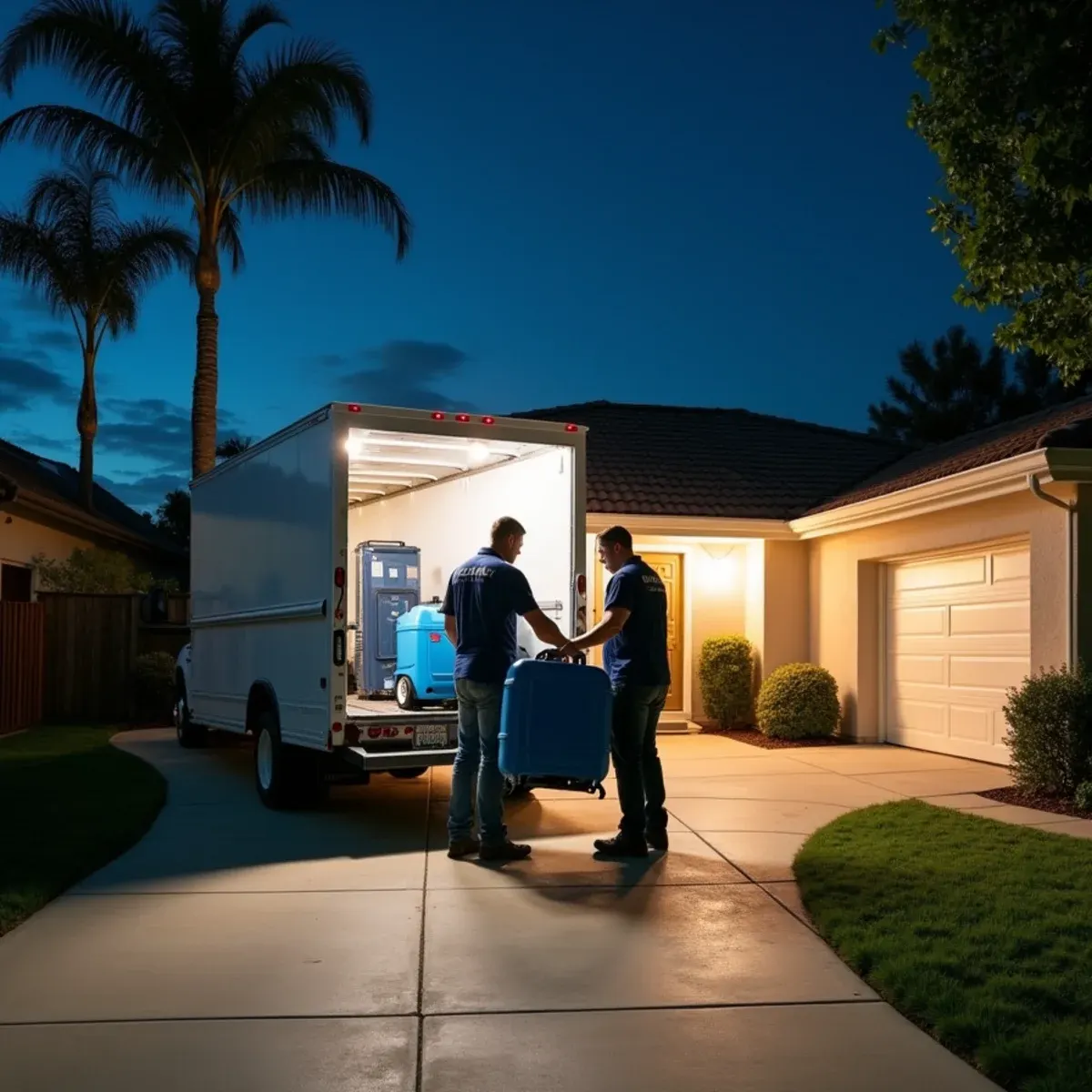
Brea is an oil town that turned into a hillside suburb, and the two halves have almost nothing in common once you are inside the walls. Near downtown you find small early-century houses on mixed foundations with galvanized supply lines and clay laterals, some of them original. Ten minutes north, in Olinda Ranch, Blackstone and the tracts running toward Carbon Canyon, you find 1990s and 2000s construction with PEX, ABS drains, engineered slopes and retaining walls. The Brea Olinda field shaped the northern hills, and the grading up there still reflects it.
The failure modes split the same way. Downtown, a supply line rusts through inside a wall and quietly wets a floor plate. Up canyon, a storm concentrates runoff faster than the slope drainage can move it, and the water arrives at the house with momentum. We ask which Brea you are in before we load the truck, because one call needs cavity drying and pipe tracing and the other needs the flow stopped outside first. Brea Mall and the downtown retail corridor add commercial calls with their own after-hours access problems. We are about eighteen minutes south.
What Brea Changes About Emergency Restoration
1Carbon Canyon storms arrive in bursts
Rain in the canyon does not fall evenly across Brea. A cell can drop a lot of water on the north hills in an hour while downtown stays merely wet, and the slope drainage on those tracts is sized for steady rain, not a burst. That is why hillside calls here cluster tightly in a single night. Clearing v-ditches, terrace drains and downspout extensions before the season buys you a genuine margin.
2Galvanized downtown behaves badly when it goes
Original galvanized in the older housing near downtown corrodes from the inside, so the failure often follows years of restricted flow and rusty water. When it lets go inside a wall, the water is discolored and the surrounding cavity has usually been damp for a while. Under IICRC S500:2025 that history matters for how we classify the water and how aggressively we handle affected porous materials rather than just drying them.
3Retail tenants need the water off fast
Around Brea Mall and Downtown Brea we work in leased restaurant and retail spaces where the shutoff is not where the tenant thinks it is and the landlord's contact is a voicemail box at nine at night. Knowing your own shutoff location, your riser room access and who holds the after-hours key is worth more than any equipment we own during the first fifteen minutes of a real failure.
How the Work Runs
The method is the same one we use on every emergency restoration job, documented to the IICRC S500:2025 standard. Here it is in short — the full emergency water damage restoration process explains each stage in detail.
- Call answered and crew dispatched
- Arrival, safety check, and moisture mapping
- Documentation before anything is touched
- Extraction
- Controlled structural drying
- Cleaning, sanitizing, and final verification
The Brea Background Worth Knowing
Brea's hillside tracts were designed to handle rain. Terrace drains catch runoff partway up a slope, v-ditches carry it around the toe, area drains take the flat yard, and everything ties into a system that moves water past the house rather than through it. The design works. What fails is maintenance. Over a dry summer those inlets fill with eucalyptus leaf litter, decomposed granite, and whatever the wind brought down the canyon, and nobody looks at them because they sit on a slope behind a fence. The first hard storm of the season finds every one that is blocked.
There is more on the housing stock, drainage and plumbing history of this city on our water damage restoration in Brea page.
Brea at a glance
- Dominant construction era
- 1920–2005
- Foundation type
- mixed on grade
- Supply piping found here
- galvanized steel, under-slab copper, PEX in newer hillside tracts
- Drain line materials
- cast iron, clay, ABS
- Terrain and water table
- hillside-mixed, deep water table
- Most common local failure
- canyon and hillside runoff overwhelming slope drainage during concentrated storms
- Highest-value local prevention
- keeping Carbon Canyon-side slope drains, v-ditches and downspout extensions genuinely clear
What It Costs in Brea
We do not quote a number over the phone before seeing the property — anyone who does is guessing. The variables that actually move the price on a emergency restoration job are water category, affected square footage and number of rooms, how many days of equipment, and they are broken down in full on the emergency water damage restoration page. The assessment and the written estimate are free anywhere in Brea, day or night, with no obligation.
Emergency Restoration Questions from Brea Homeowners
Almost always, yes. A plumber's job ends when the pipe holds pressure. By then the water has moved along the floor plate, into insulation and behind baseboard, and in an older downtown house that cavity may have been damp for weeks before the failure. Surfaces feel dry long before framing and sheathing do. We meter the assembly, and if the readings are already at the dry standard we will tell you so and go home.
We commit to being on-site within 60 minutes of a confirmed emergency call anywhere in Cypress, and we credit $100 off your invoice if we miss it. Most of the time we are there in 30 to 45 minutes because our trucks stage on Katella Avenue, right here in the city.
No. The emergency assessment and written estimate are free, 24 hours a day. You are not obligated to hire us after we walk the property, and we will tell you plainly if we think the damage is small enough to handle yourself.
Usually not under a standard homeowners policy. Water that runs across the ground and enters a building is surface water, and that is an excluded cause on nearly every form, whether it came off a Carbon Canyon slope or out of the street. Separate flood coverage handles it. Damage from a covered failure is a different story, so let us document the entry point and cause before anything gets cleaned up.