
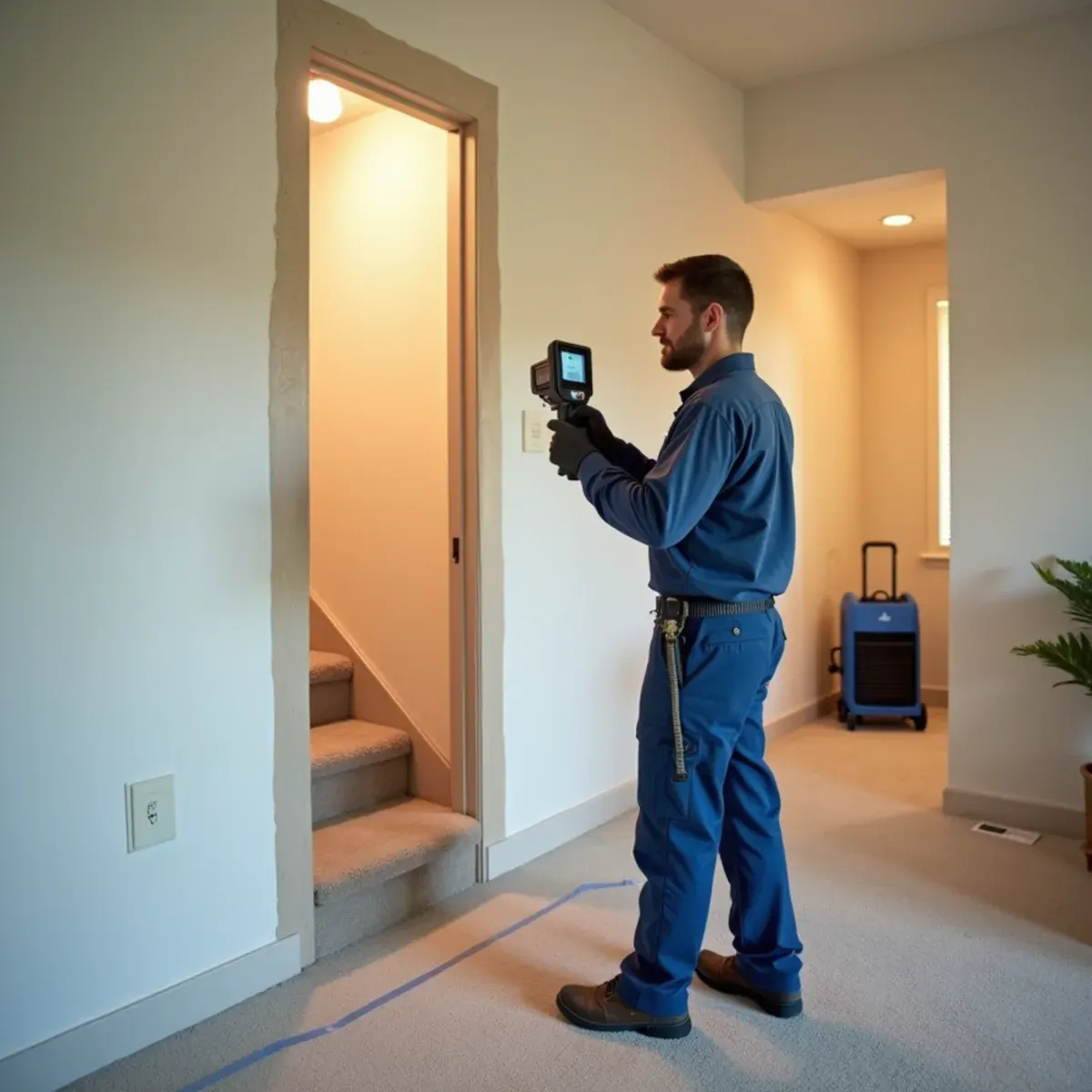
The pre-war houses in Fullerton sit on raised foundations, and that changes how a leak announces itself. Water under a slab has to push up and show itself. Water under a raised floor drips into the crawl space and vanishes, so nothing pools, nothing stains, and the first sign is a soft baseboard or a musty smell weeks later. By then the bottom plate and the lowest foot of wall board have wicked moisture up from underneath. On these houses the cut usually starts at the floor and works up, which is the opposite of what people expect.
Two more Fullerton particulars. The Craftsman and Spanish Revival stock in Raymond Hills and around Sunny Hills is framed in old-growth Douglas fir that is genuinely full dimension and was not always set at sixteen inches on center, so we find the stud rather than measure to it. And the dense student rentals around Cal State Fullerton and Fullerton College come with chronic delayed reporting. A leak known about for a month gets reported in a week. Late reporting means less drying in place and more removal, and that is arithmetic rather than pessimism.
What Fullerton Changes About Drywall Repair
1Crawl-space leaks wet walls from below
On a raised foundation the water leaves rather than pools, so the loss runs quietly for weeks. What it leaves behind is a damp bottom plate and board that has wicked upward from the floor edge. We meter from the baseboard up, open the crawl space to dry the underside, and set the cut above the highest reading rather than at a habitual two feet.
2Old fir framing, unpredictable stud lines
Pre-war Fullerton framing is old-growth Douglas fir, closer to full dimension than anything milled today, and the spacing is not reliably sixteen on center. If you cut to a tape measure you land in a bay and have nothing to fasten to. We locate the actual studs first, then place the cut on them, which keeps the opening tight and the finished seam flat.
3Delayed reporting near the campuses
Student rentals around Cal State Fullerton and Fullerton College generate a particular kind of call: the leak has been known about for weeks and reported yesterday. Paper-faced gypsum that has been damp that long has usually grown something on the cavity side, and the honest scope is removal rather than drying. We show the back of the board so the decision is visible rather than asserted.
How the Work Runs
The method is the same one we use on every drywall repair job, documented to the IICRC S500:2025 standard. Here it is in short — the full drywall water damage repair process explains each stage in detail.
- Meter the wall first
- Decide dry-in-place or remove
- Open the cavity, not the wall
- Cut to a stud and a seam line
- Clear the cavity and dry the framing
- Tape, texture, prime, paint
The Fullerton Background Worth Knowing
The pre-war homes around downtown Fullerton were built with materials that behave completely differently from modern construction. Lath and plaster walls hold several times the water drywall does. Old-growth Douglas fir framing is dense and dries slowly. Original oak and fir flooring is thick, high-quality material that is well worth saving.
There is more on the housing stock, drainage and plumbing history of this city on our water damage restoration in Fullerton page.
Fullerton at a glance
- Dominant construction era
- 1910–1980
- Foundation type
- mixed on grade
- Supply piping found here
- galvanized steel, copper, original pre-war piping
- Drain line materials
- cast iron, clay
- Terrain and water table
- rolling, moderate water table
- Most common local failure
- crawl-space leaks that run undetected for weeks because the water drips away instead of pooling on a floor
- Highest-value local prevention
- posting a shutoff location and emergency contact in every rental, since delayed reporting is the local failure mode
What It Costs in Fullerton
We do not quote a number over the phone before seeing the property — anyone who does is guessing. The variables that actually move the price on a drywall repair job are how much board comes out, cut height and seam count, texture type and match difficulty, and they are broken down in full on the drywall water damage repair page. The assessment and the written estimate are free anywhere in Fullerton, day or night, with no obligation.
Drywall Repair Questions from Fullerton Homeowners
It has to, or the wall repair does not hold. On a raised foundation the water that damaged your wall is usually still under the house, in the soil, in the insulation between the joists and in the subfloor. If we hang new board over a bottom plate that is drawing moisture from a wet crawl space, the new paper facing goes damp within weeks. We dry and treat the crawl space, confirm the plate has come down to a normal reading, then rebuild the wall.
No, and that assumption is why a lot of walls come out that did not need to. Gypsum board that got clean water, still reads firm under thumb pressure, and is coming down in moisture content day over day can usually be dried in place through the cavity. What forces removal is contaminated water, a core that has softened or swelled, visible growth on the paper, or insulation behind it that holds moisture against the board. We take readings before we answer that question.
Usually two feet or four feet above the floor, measured level across the whole run rather than following the stain. Board comes in four-foot widths, so a cut at either height lands the new seam where a factory edge would sit, which is far easier to hide than a seam floating mid-wall. The cut also has to end at the center of a stud on each side, so the patch has something to fasten to. Cutting to the shape of the damage looks thrifty and finishes badly.
Yes, and they need a different approach. Lath and plaster and old-growth framing hold far more water than modern materials and dry much more slowly, so we plan for seven to fourteen days with higher-capacity equipment. The original material is worth that effort — nothing sold today replaces it.