
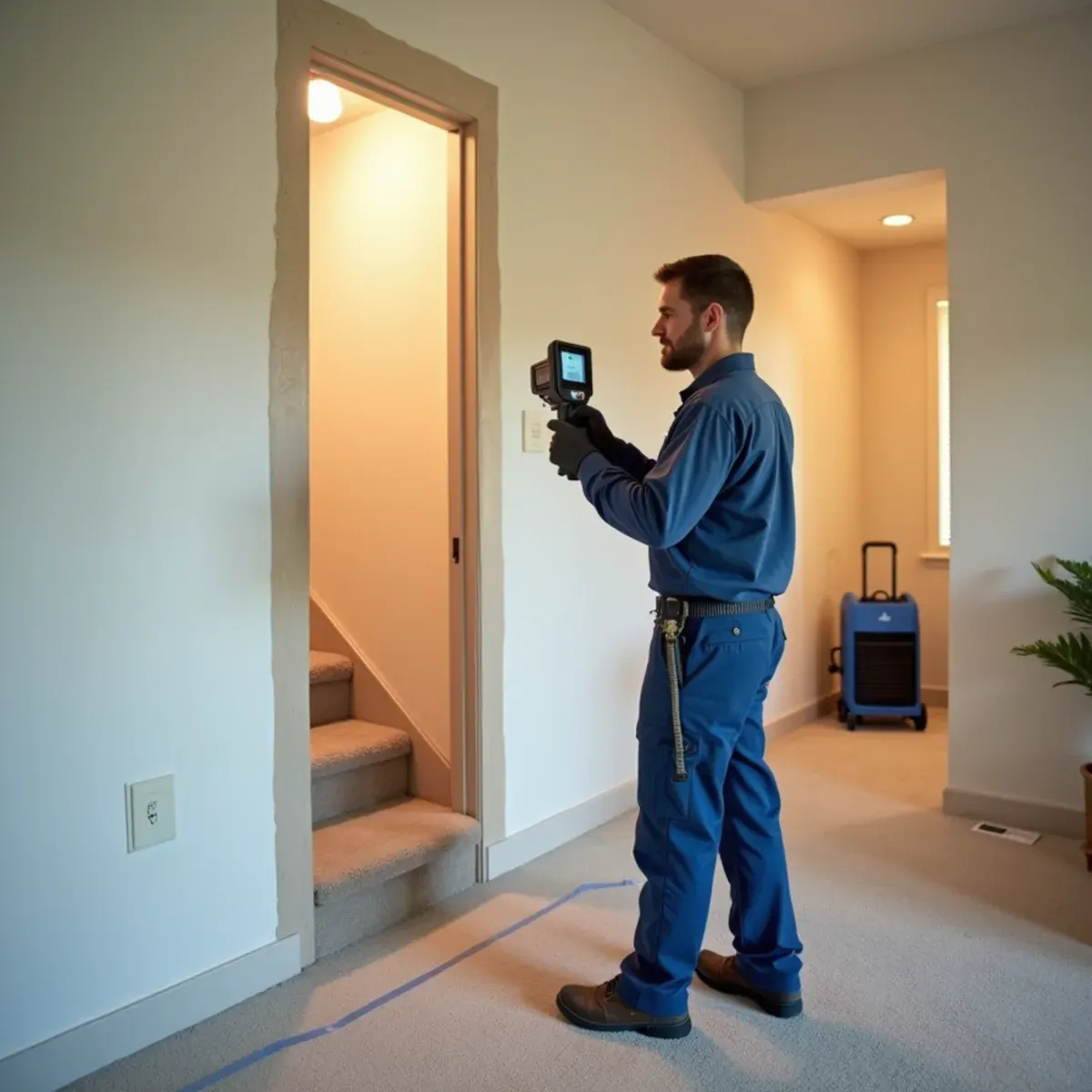
Paramount packs housing tight between commercial corridors, and that shows up in a single week's work. A 1950s house off Rosecrans with wood studs, half-inch board and a slab leak. Then a tenant suite two hundred feet away with metal studs, a demising wall that has to stay rated, and a suspended ceiling grid over the wet area. Same block, same storm or same broken line, two completely different rebuilds. The house needs texture matching and a livable room tonight. The suite needs the rated detail put back correctly and the doors open tomorrow.
The city was built out of the old Hynes and Clearwater dairy communities between 1945 and 1965, and there is very little permeable ground left in it. With the Los Angeles River channel along the western edge and pavement almost everywhere else, storm water runs to the lowest opening instead of soaking in. That means exterior water entering at the slab edge, wetting the bottom of drywall from behind, and sometimes traveling under a shared wall into the neighboring space before anyone on either side notices a stain.
What Paramount Changes About Drywall Repair
1Metal studs survive, the board doesn't
In the commercial suites along Paramount's corridors, partitions are metal stud and track. The framing doesn't swell or rot, so it stays. But the bottom of the board wicks fast and the track holds standing water against it. Cuts run low, the track gets opened and dried, and rated walls get rebuilt with the same board and the same fastening pattern that was there.
2One block, two kinds of building
Housing here is packed tightly between commercial corridors, so one storm produces a 1950s slab house needing texture matching and a tenant suite needing a rated wall and a ceiling grid put back. We staff and sequence those differently. The homeowner wants the room usable tonight. The business wants to reopen, with dust off the inventory and the floor still working.
3Paved ground sends water to the slab
Between the Los Angeles River channel on the west and near-continuous pavement everywhere else, there's very little permeable ground in Paramount. Storm water doesn't soak in. It runs to the lowest opening and gets in at the slab edge, wetting the back of the drywall before anything shows on the painted face. Low cuts and bottom-plate checks are routine here.
How the Work Runs
The method is the same one we use on every drywall repair job, documented to the IICRC S500:2025 standard. Here it is in short — the full drywall water damage repair process explains each stage in detail.
- Meter the wall first
- Decide dry-in-place or remove
- Open the cavity, not the wall
- Cut to a stud and a seam line
- Clear the cavity and dry the framing
- Tape, texture, prime, paint
The Paramount Background Worth Knowing
On a typical Paramount lot, the house, the driveway, the walkways and the rear slab cover most of the parcel. What is left is a narrow side yard, and everything that lands on the roof and the paving is supposed to leave through a couple of small area drains. That system has no margin. When a grate silts up, when a downspout dumps straight onto paving, or when the outlet at the curb has been crushed by a parked truck, the water has no soil to soak into and nowhere else to be. It ponds against the slab edge and comes in at the lowest threshold, which is usually a garage or a side door.
There is more on the housing stock, drainage and plumbing history of this city on our water damage restoration in Paramount page.
Paramount at a glance
- Dominant construction era
- 1945–1965
- Foundation type
- slab on grade
- Supply piping found here
- original galvanized steel, copper
- Drain line materials
- cast iron
- Terrain and water table
- flat, moderate water table
- Most common local failure
- residential and commercial losses on the same block, needing very different handling
- Highest-value local prevention
- clearing area drains before the season on lots with very little permeable ground
What It Costs in Paramount
We do not quote a number over the phone before seeing the property — anyone who does is guessing. The variables that actually move the price on a drywall repair job are how much board comes out, cut height and seam count, texture type and match difficulty, and they are broken down in full on the drywall water damage repair page. The assessment and the written estimate are free anywhere in Paramount, day or night, with no obligation.
Drywall Repair Questions from Paramount Homeowners
Yes. We run around the clock and phase commercial work so the storefront keeps operating. What we can't compress is drying and cure time. Board can go up overnight, but joint compound has to dry between coats, texture has to set and paint needs its own window. We'll contain the area, keep dust off your inventory and give you a realistic sequence rather than promising a finished wall by morning.
No, and that assumption is why a lot of walls come out that did not need to. Gypsum board that got clean water, still reads firm under thumb pressure, and is coming down in moisture content day over day can usually be dried in place through the cavity. What forces removal is contaminated water, a core that has softened or swelled, visible growth on the paper, or insulation behind it that holds moisture against the board. We take readings before we answer that question.
Usually two feet or four feet above the floor, measured level across the whole run rather than following the stain. Board comes in four-foot widths, so a cut at either height lands the new seam where a factory edge would sit, which is far easier to hide than a seam floating mid-wall. The cut also has to end at the center of a stud on each side, so the patch has something to fasten to. Cutting to the shape of the damage looks thrifty and finishes badly.
Almost certainly your area drains. Paramount lots have very little permeable ground, so everything that falls on the roof and the paving has to leave through a couple of small drains. If a grate silts up or the outlet is crushed, the water ponds against the slab and enters at the lowest threshold, which is usually the garage. Rodding the drains and checking the outlet before the season costs far less than drying the garage wall afterward.